

Pinecone
Pinecone is a managed vector database for indexes, inference, and an assistant, not an unpriced ML toolkit. Nexus is marked generally available on that page.
Compare Qdrant if you wanted open-source plus Cloud, Milvus if you wanted another OSS vector engine, and Supabase if you wanted Postgres with vectors as one feature.
Key Features
- Public plan matrix: Starter is for trying small apps (community Discord support). Builder is the new $20 flat row for solo/small teams. Standard is pay-as-you-go after a $50 minimum. Enterprise adds 99.95% SLA, BYOC, private endpoints, CMEK, audit logs.
- Usage beyond the seat: Standard/Enterprise meter Database On-Demand, Inference, and Assistant. The compare table lists storage from $0.33/GB/mo and write/read units that vary by cloud. Confirm the calculator.
- Not a 2024 algorithm zoo: Live products are dense/sparse/full-text indexes, inference, and assistant.
- BYOC is a sales row: Bring-your-own-cloud is contact pricing, outbound-only operations.
Use Cases
- People who will stay on Starter Free long enough to see the 2 GB / 2M write / 1M read caps.
- People who will pay Builder $20 for extra limits and multi-project.
- Teams that will accept a $50 or $500 monthly minimum.
Limitation: Starter example workloads on the page are illustrative, not quotes. We did not re-audit every region rate.
Pricing
pinecone.io/pricing on 2026-08-17.
| Plan | Price | Notes from that page |
|---|---|---|
| Starter | Free | Small apps. Included usage caps. Community Discord. |
| Builder | $20 / month flat | Higher limits. Cloud/region choice. Multiple projects. |
| Standard | $50 / month min | Usage after the minimum. $300 trial credits. SSO/HIPAA add-on. |
| Enterprise | $500 / month min | 99.95% SLA. BYOC, private endpoints, CMEK, Pro support. |
If a leftover blog still says Pinecone has no public dollar table, treat this matrix as the source.
Getting Started
- Open pinecone.io/pricing and start on Starter only long enough to see the caps.
- Confirm Builder $20 before you jump to Standard's $50 minimum.
- Confirm Qdrant if you wanted OSS plus a free Cloud node.
- Do not paste the Starter example recs/day as a contract.
Frequently Asked Questions
Is there a free plan?
Yes. Starter is free with included usage caps.
Is Builder still unlisted?
No. The live page has a $20 flat Builder row.
Same as Qdrant?
No. Qdrant has an Apache-2.0 engine and a usage-based Cloud. Pinecone's public rows start at Free / $20 / $50 min / $500 min.
Alternatives
- Qdrant: OSS engine plus Cloud Free / usage-based Standard.
- Milvus: Open vector database.
- Supabase: Postgres BaaS, not a dedicated vector service.
Tips
- Quote Free / $20 / $50 min / $500 min from the live page.
- Confirm write/read unit rates before you treat $0.33/GB as the whole bill.
- Do not call Starter example workloads a quote.
Conclusion
Pinecone is a priced managed vector DB with Free, $20 Builder, $50 Standard minimum, and $500 Enterprise minimum, not an unpriced ML toolkit. Start at pinecone.io/pricing, then decide whether Qdrant already covers the engine you need.
Comments
No comments yet. Be the first to comment!
Related Tools


Related Insights

Claude Code account precautions: before you spend $200, do these six things
Gmail plus Apple private sign-in, Cliproxy residential routing for CC and emulators, IP/DNS checks, gradual upgrades, and history-preserving sign-out. Includes a profile and script.

Create a US Apple Account: switch the App Store, keep iCloud signed in
Register with your own email and phone, complete store setup, and redeem a US gift card purchased with Alipay. Diagrams explain iCloud, purchase accounts and private Apple sign-in.
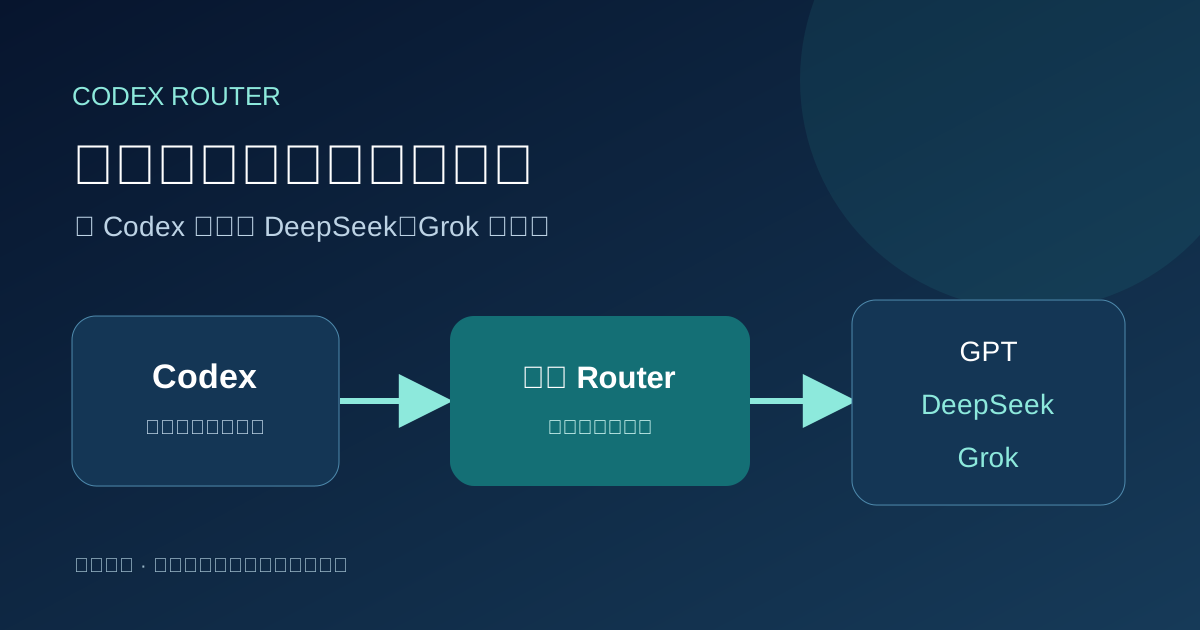
Running low on ChatGPT Codex quota? Switch to DeepSeek or Grok inside Codex
Codex Router lets you keep your Codex workspace while using DeepSeek, Grok, and other external models. A plain-English guide to routing, quotas, and network access.