

Qdrant
Qdrant is an open-source vector search engine plus a managed Cloud, not an unpriced modeling tool. github.com/qdrant/qdrant had 34,018 stars, license Apache-2.0, homepage qdrant.tech.
Compare Pinecone if you wanted a fully managed vector service with public $20/$50/$500 rows, Milvus if you wanted another OSS engine, and Supabase if you wanted Postgres instead.
Key Features
- OSS plus Cloud: Self-host the Apache-2.0 engine, or run Free / Standard / Premium on Qdrant Cloud. Hybrid Cloud and Private Cloud stay on your infrastructure.
- Free Cloud is a small node: FAQ says Free includes 1 GB RAM and 4 GB disk (page also lists 0.5 vCPU / 1 GB RAM / 4 GB disk). Exceed that and upgrade to Standard.
- Standard is usage-based: Dedicated resources, HA, backups, 99.5% SLA. Premium needs a minimum spend and adds SSO, private VPC links, 99.9% SLA.
- Serverless is coming soon: The nav still says Qdrant Serverless (Coming soon). Do not sell it as shipped.
Use Cases
- People who will stay on OSS or Cloud Free for prototypes.
- People who will pay Standard for a dedicated cluster.
- Enterprises that will talk to sales for Premium / Hybrid / Private.
Use the live pricing calculator.
Pricing
qdrant.tech/pricing on 2026-08-17.
| Plan | Price | Notes from that page |
|---|---|---|
| OSS | $0 | Apache-2.0. 34,018 stars. Self-host. |
| Cloud Free | Free forever | 0.5 vCPU / 1 GB RAM / 4 GB disk. Testing and prototypes. |
| Cloud Standard | Usage-based | Dedicated resources, HA, 99.5% SLA. Marketplace deploy. |
| Cloud Premium | Minimum spend | SSO, private VPC links, 99.9% SLA. Talk to engineers. |
| Hybrid / Private Cloud | Contact | Run on your infra or isolated/air-gapped setups. |
If a leftover blog still points at qdrant.io with no Cloud tiers, treat this table as the source.
Getting Started
- Open qdrant.tech/pricing and start on Free or OSS.
- Confirm the calculator before you assume Standard is a $20 seat.
- Confirm Pinecone if you wanted a public $20 Builder row.
- Do not sell Serverless as GA.
Frequently Asked Questions
Is the engine free?
Yes. OSS is Apache-2.0. Cloud also has a free forever node.
What is the official site?
qdrant.tech. GitHub homepage matches that.
Same as Pinecone?
No. Pinecone's public rows are Free / $20 / $50 min / $500 min. Qdrant Standard is usage-based.
Alternatives
- Pinecone: Managed vector DB with a $20 Builder row.
- Milvus: Another open vector database.
- Supabase: Postgres BaaS, not a dedicated vector engine.
Tips
- Quote OSS $0 / Cloud Free / Standard usage-based / Premium min spend.
- Point website at qdrant.tech.
- Confirm the calculator before you invent a Standard dollar.
Conclusion
Qdrant is an Apache-2.0 vector engine with a priced Cloud (Free, usage-based Standard, Premium min spend), not an unpriced modeling tool. Start at qdrant.tech/pricing, then decide whether Pinecone already covers the managed seat you need.
Comments
No comments yet. Be the first to comment!
Related Tools


Related Insights

Claude Code account precautions: before you spend $200, do these six things
Gmail plus Apple private sign-in, Cliproxy residential routing for CC and emulators, IP/DNS checks, gradual upgrades, and history-preserving sign-out. Includes a profile and script.

Create a US Apple Account: switch the App Store, keep iCloud signed in
Register with your own email and phone, complete store setup, and redeem a US gift card purchased with Alipay. Diagrams explain iCloud, purchase accounts and private Apple sign-in.
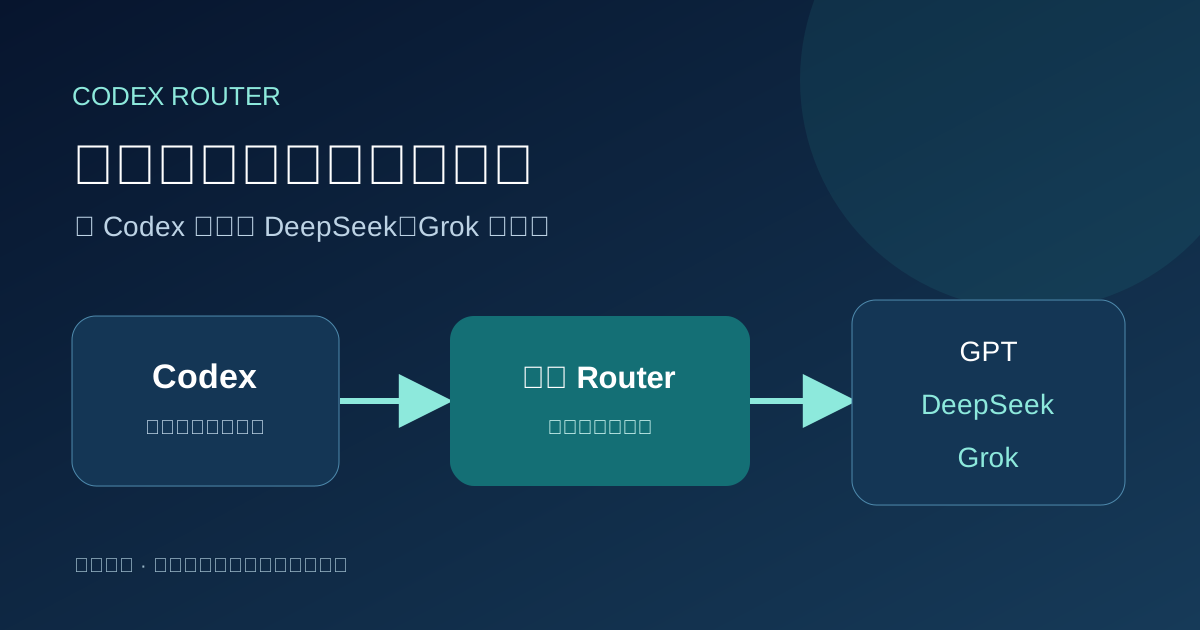
Running low on ChatGPT Codex quota? Switch to DeepSeek or Grok inside Codex
Codex Router lets you keep your Codex workspace while using DeepSeek, Grok, and other external models. A plain-English guide to routing, quotas, and network access.