
Skills + Hooks + Plugins: How Anthropic Redefined AI Coding Tool Extensibility
Have you ever experienced this:
Using GitHub Copilot to write code, wanting it to follow your team's PR standards, but having to repeatedly paste that long prompt at the beginning of every conversation.
Developing projects with Cursor, wanting to automatically run lint before committing code, but having to manually configure complex .cursorrules files, uncertain if they'll even work.
Or wanting your AI assistant to connect to your company's internal databases, APIs, and knowledge bases, only to discover there's no unified integration standard, forcing you to write tons of glue code yourself.
What's the essence of these pain points?
AI coding tool extensibility is still stuck in the "configuration file era."
And Anthropic, with Claude Code's Skills + Hooks + Plugins trinity architecture, has provided an eye-opening answer.
Why Is Extensibility So Important?
Before diving into technical details, let's discuss why extensibility is so critical for AI coding tools.
Generic AI assistants can only do generic things: complete code, explain errors, generate tests. But real development scenarios vary widely:
- Your team might have unique code standards (Google Style Guide, Airbnb Style)
- Your project might depend on specific frameworks and toolchains (Next.js, Django, Kubernetes)
- Your enterprise might have internal systems to integrate (JIRA, GitLab, internal APIs)
- Your workflow might need special automation (pre-commit checks, deployment processes, security scanning)
If an AI assistant can't adapt to these differences, it will forever remain a "toy" rather than a true productivity tool.
This is why Claude Code's extensibility design is so important—it's not about "showing off," but about making AI truly integrate into your workflow.
Skills + Hooks + Plugins: The Trinity Design Philosophy
Claude Code's extensibility is built on three core concepts that each serve distinct purposes while working together seamlessly:
Skills: Knowledge Transfer
What are Skills?
Skills are like "training manuals" you give to your AI assistant. They tell Claude:
- How our team's PRs should be written
- What our database schema looks like
- How this project's architecture is designed
- How to handle certain types of problems
Core Features of Skills:
- Auto-activation: Claude automatically determines whether to load a Skill based on conversation content, no manual invocation needed
- Lightweight: Each Skill only occupies 30-50 tokens when inactive
- Composable: You can write different Skills for different scenarios, and they can work together
A Real Example:
---
name: pr-review-standards
description: Our team's PR review standards
when: When user requests to review or create a PR
---

# PR Review Standards

## Must Check Items:
1. Code style: Follow Airbnb JavaScript Style Guide
2. Test coverage: New code must have unit tests with minimum 80% coverage
3. Documentation: Public APIs must have JSDoc comments
4. Performance: Avoid unnecessary re-renders (React.memo, useMemo)
5. Security: No hardcoded keys or sensitive information

## PR Description Format:
- **Summary**: 3-5 sentences summarizing changes
- **Test Plan**: How to test these changes
- **Screenshots**: If UI changes, include screenshots
With this Skill, Claude will automatically check according to your team's standards when reviewing PRs, rather than using its "generic knowledge."
Hooks: Rule Enforcement
What are Hooks?
If Skills are "suggestions," then Hooks are "enforcement."
Hooks are scripts that automatically run when specific events occur. They can:
- Intercept AI behavior and perform checks
- Inject additional context information
- Validate output compliance with standards
- Execute custom logic before and after tool calls
Hook Events Supported by Claude Code:
| Hook Type | Trigger Timing | Typical Use |
|---|---|---|
UserPromptSubmit | When user submits prompt | Context injection, logging, security checks |
PreToolUse | Before tool call | Permission validation, parameter verification |
PostToolUse | After tool call | Result validation, logging |
Stop | When Claude prepares to exit | Quality checks, automated tasks (lint, test) |
SubagentStop | When subagent completes | Review subagent output |
A Powerful Example: Stop Hook for Automatic Quality Gates
#!/bin/bash
# hooks/stop-hook.sh

echo "🔍 Running quality checks before session ends..."

# 1. Run linter
if ! npm run lint; then
  echo "❌ Lint failed. Please fix the issues."
  exit 2  # Return 2 prevents Claude from exiting, forcing it to fix issues
fi

# 2. Run tests
if ! npm test; then
  echo "❌ Tests failed. Please fix the issues."
  exit 2
fi

# 3. Check for uncommitted changes
if [[ -n $(git status --porcelain) ]]; then
  echo "⚠️ You have uncommitted changes. Consider creating a commit."
fi

echo "✅ All quality checks passed!"
exit 0
This Hook ensures that every time Claude finishes work, the code has passed lint and tests. If checks fail, Claude automatically fixes the issues rather than leaving you with a mess.
This is the essence of "Skills suggest, Hooks enforce."
Plugins: Ecosystem Aggregation
What are Plugins?
Plugins are the packaging and distribution mechanism for Skills + Hooks + MCP servers + custom commands.
They solve a core problem: How to share your customized workflow with your team or community?
A Typical Plugin Structure:
my-plugin/
├── .claude-plugin/
│   └── plugin.json         # Plugin metadata
├── skills/                 # Skills definitions
│   ├── code-review.md
│   └── commit-message.md
├── hooks/                  # Hook scripts
│   ├── stop-hook.sh
│   └── user-prompt-submit.sh
├── commands/               # Custom commands
│   └── deploy.sh
└── .mcp.json              # MCP server configuration
Installation with Just One Command:
/plugin install my-plugin@my-org
Everyone on the team can immediately gain unified workflows and standards.
Real-World Cases: See How Others Use It
Case One: Sionic AI - Running 1000+ Machine Learning Experiments Daily
Sionic AI is a company focused on large model training. They use Claude Code Skills to manage complex ML training processes.
Their Challenges:
- Running numerous experiments daily across different GPU clusters
- Coordinating multiple frameworks: ms-swift, vLLM, DeepSpeed
- Failed experiment paths needed to be documented to avoid repeating mistakes
Their Solution:
Created a series of Skills to encapsulate training knowledge:
---
name: grpo-training
description: GRPO training process using vLLM server and A100 GPUs
---

## Hardware Configuration
- GPU: NVIDIA A100-SXM4-80GB x 8
- Framework: ms-swift + vLLM + DeepSpeed ZeRO2

## Training Steps
1. Start vLLM inference server
2. Configure GRPO training parameters
3. Monitor GPU memory usage
4. Handle OOM errors (known failure paths)

## Common Issues
[Documented 20+ failure cases and solutions]
Results:
Team members simply tell Claude "run GRPO training," and Claude can automatically:
- Select correct hardware configuration
- Set correct framework parameters
- Avoid known failure paths
- Handle common errors
This multiplied their experimental efficiency.
Case Two: Explosive Growth of Community Plugin Ecosystem
As of early 2026, Claude Code's plugin ecosystem includes:
- 500+ official and community plugins
- 270+ built-in Agent Skills
- 140+ specialized toolsets (DevOps, testing, documentation, deployment)
Some interesting community contributions:
- Accessibility Development Plugin: Optimized interface and prompts for neurodiverse users
- Enterprise Compliance Plugin: Automatically checks code compliance with GDPR, SOC2, etc.
- Multi-language Documentation Generator: One-click generation of API docs supporting 10+ languages
- CI/CD Integration Package: All-in-one integration with GitHub Actions, GitLab CI, Jenkins
Comparison with Competitors: Why Is Claude Code's Design More Advanced?
Let's compare the extensibility of three major AI coding tools:
GitHub Copilot: Closed Ecosystem + GitHub-Centric
Extension Methods:
- Copilot Extensions (require GitHub review and hosting)
- Skillsets (lightweight task configuration)
- Agents (complex integration)
Advantages:
- Deep integration with GitHub ecosystem
- Enterprise-grade security and permission management
- Officially maintained SDK and tools
Limitations:
- Must work within GitHub ecosystem
- Plugins require review
- Unfriendly to non-GitHub users
- Extension distribution depends on GitHub Marketplace
Use Case: If your workflow is entirely on GitHub, Copilot is a good choice.
Cursor: Embedded Rules + VS Code Compatible
Extension Methods:
.cursorrulesfiles (project-level rules)- User Rules (global preferences)
- MCP server support
Advantages:
- Rules written in code repository, easy version control
- Low learning curve, just write Markdown
- Based on VS Code, can use existing plugins
Limitations:
- Rules are just "suggestions," can't enforce
- No event-driven Hook mechanism
- Difficult to implement complex automation
- Rule activation depends on LLM understanding, unreliable
Use Case: If you want simple rule customization without complex automation, Cursor suffices.
Claude Code: Open Standards + Trinity Architecture
Extension Methods:
- Skills (knowledge transfer)
- Hooks (rule enforcement)
- Plugins (ecosystem aggregation)
- MCP (open tool protocol)
Advantages:
- True open standards: MCP protocol can be adopted by any tool
- Enforcement capability: Hooks can block non-compliant behavior
- Complete lifecycle coverage: Every stage from prompt submission to session end is controllable
- High programmability: Hooks are real executable scripts, don't depend on LLM understanding
- Community-driven: Anyone can publish plugins without review
Limitations:
- Slightly steeper learning curve (need to understand Skills, Hooks, Plugins differences)
- Ecosystem still rapidly evolving, standards may change
- Requires some scripting ability
Use Case: If you need deep customization, team collaboration, or complex automated workflows, Claude Code is the best choice.
Design Philosophy Differences: Why Is Anthropic's Architecture More Advanced?
Let's analyze these three designs from first principles.
The Essence of the Problem: AI Assistant "Memory" and "Constraints"
AI assistants face two core challenges:
- Memory problem: Each conversation is stateless, AI doesn't remember standards you mentioned last time
- Constraint problem: AI might "forget" or "misunderstand" your requirements, doing things that don't comply with standards
Three Tools' Solutions:
| Tool | Memory Solution | Constraint Solution | Essence |
|---|---|---|---|
| Cursor | Write rules in files, inject context each time | Depend on LLM understanding | "Prompt Engineering" |
| Copilot | Inject context via Skillsets | Depend on GitHub platform | "Platform Lock-in" |
| Claude Code | Skills dynamic activation | Hooks enforcement | "Layered Architecture" |
Cursor's Problem: Rules are just "suggestions," LLM might misunderstand or ignore them, especially in long conversations.
Copilot's Problem: Depends on GitHub ecosystem, won't work outside GitHub.
Claude Code's Advantage:
- Skills handle "knowledge" layer (What & How)
- Hooks handle "execution" layer (Must & Must Not)
- MCP handles "tool" layer (Can Connect)
- Plugins handle "distribution" layer (How to Share)
This is a clear layered architecture where each layer serves its purpose.
Open vs Closed: Strategic Significance of MCP Protocol
Another key advantage of Claude Code is MCP (Model Context Protocol).
MCP is an open standard released by Anthropic that defines how AI models connect to external tools and data sources.
Why Is This Important?
- Breaking ecosystem barriers: MCP servers can be used by any MCP-supporting tool (Claude.ai, Claude Code, even future competitors)
- Avoiding reinventing the wheel: Community has already built hundreds of MCP servers (GitHub, Linear, Notion, PostgreSQL...)
- Enterprise-friendly: Enterprises can build MCP servers for internal systems, write once, use everywhere
Compare:
- Copilot Extensions: Can only be used in GitHub Copilot, closed ecosystem
- Cursor Rules: Just text rules, no tool connection
- MCP: Open protocol, can be adopted by any tool
This is like the emergence of USB—before that, every device had its own proprietary interface; with USB, all devices became universal.
MCP could become the "USB interface" for AI tools connecting to the external world.
Best Practices: How to Use Skills + Hooks + Plugins Well?
Based on community experience, here are some proven best practices:
1. Skills: Clear WHEN Descriptions
Skill activation depends on description precision. A good Skill description should include:
---
name: database-schema-expert
description: WHEN user asks about database schema, table relationships, or SQL queries. WHEN NOT dealing with frontend or API logic.
---
Key Points:
- Clearly state WHEN (when to activate)
- Clearly state WHEN NOT (when not to activate)
- Avoid vague descriptions
Community testing shows that Skills using WHEN + WHEN NOT patterns achieve 80-84% activation accuracy, while ordinary descriptions only achieve 50%.
2. Hooks: Elegant Exit Code Design
Hook script exit codes have special meanings:
exit 0: Success, continue executionexit 1: Failure, but allow continuationexit 2: Failure, prevent continuation, require fix
Typical Application:
#!/bin/bash
# Stop Hook: Ensure code quality

npm run lint
if [ $? -ne 0 ]; then
  echo "Lint failed. Claude will fix the issues."
  exit 2  # Block exit, force fix
fi

npm test
if [ $? -ne 0 ]; then
  echo "Tests failed. Claude will fix the issues."
  exit 2
fi

exit 0  # All good, allow exit
3. Plugins: Modular Composition
Don't try to stuff all functionality into one giant Plugin. Instead, create small, focused Plugins and combine them:
{
  "plugins": [
    "@myteam/code-review",      // PR review standards
    "@myteam/commit-message",   // Commit message standards
    "@myteam/security-scan",    // Security checks
    "@myteam/deploy-workflow"   // Deployment process
  ]
}
This way each Plugin can be maintained and updated independently.
4. MCP: Prioritize Community Servers
Before writing your own MCP server, search if the community already has ready-made ones:
Commonly used MCP servers:
- GitHub: PRs, Issues, code search
- Linear: Task management
- Notion: Knowledge base access
- PostgreSQL/MySQL: Database queries
- Slack: Messages and notifications
Future Outlook: The Power of Ecosystem
In January 2026, Claude Code's plugin ecosystem is experiencing explosive growth.
Some trends worth noting:
1. Emergence of Enterprise-Grade Plugins
More enterprises are building internal plugins, including:
- Compliance checks (GDPR, HIPAA, SOC2)
- Security scanning (dependency vulnerabilities, sensitive information detection)
- Internal system integration (ERP, CRM, internal APIs)
2. Vertical Domain Specialization
Domain-specific plugin suites have emerged:
- Web3 Development: Solidity review, Gas optimization, security checks
- Mobile Development: iOS/Android standards, performance optimization, submission checks
- Data Engineering: ETL processes, data quality, SQL optimization
- DevOps: Infrastructure as code, monitoring alerts, incident response
3. AI-Generated Plugins
Anthropic released a meta-plugin: plugin-development, which can help you create new plugins.
This means: AI can create tools to enhance AI itself.
This is a self-reinforcing flywheel:
- Users need new features
- AI helps you generate plugins
- Plugins make AI more powerful
- More powerful AI can generate better plugins
- Repeat
4. Victory of Standardization
As the MCP protocol spreads, we may see:
- Other AI tools begin supporting MCP
- Enterprises build unified tool integration layers
- Cross-tool plugin reuse
This is like LSP (Language Server Protocol) back then—now almost all editors support LSP, you don't need to rewrite syntax highlighting and completion for each editor.
MCP could become the LSP of AI tools.
Conclusion: Extensibility's Essence Is "Control"
Back to the opening question: Why is extensibility so important?
Because the essence of extensibility is control.
In tools without extensibility, AI has control—it decides how to understand your needs, how to execute tasks, how to output results. You can only "request," not "demand."
With Skills + Hooks + Plugins, control returns to you:
- Skills let you control AI's knowledge: What it knows, what it doesn't know
- Hooks let you control AI's behavior: What it can do, what it can't do
- Plugins let you control AI's capabilities: What tools it connects to, what resources it uses
- MCP lets you control AI's ecosystem: How it interacts with the world
This isn't about "taming" AI, but about making AI a true collaborative partner—it has its own capabilities but respects your rules.
And this is what AI coding tools should be.
Related Resources:
Comments
No comments yet. Be the first to comment!
Related Tools


Related Articles
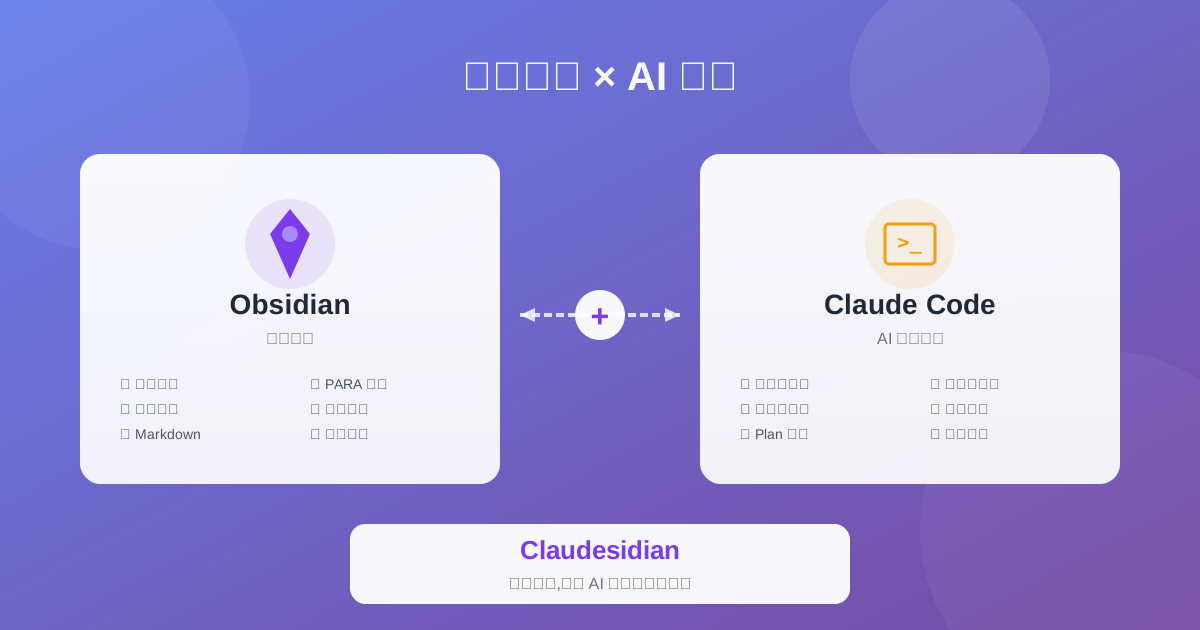
Claudesidian: Transform Obsidian into an AI-Powered Second Brain
Discover Claudesidian, an open-source project that perfectly integrates Obsidian with Claude Code. Built-in PARA method, custom commands, and automated workflows for a complete idea-to-implementation solution.
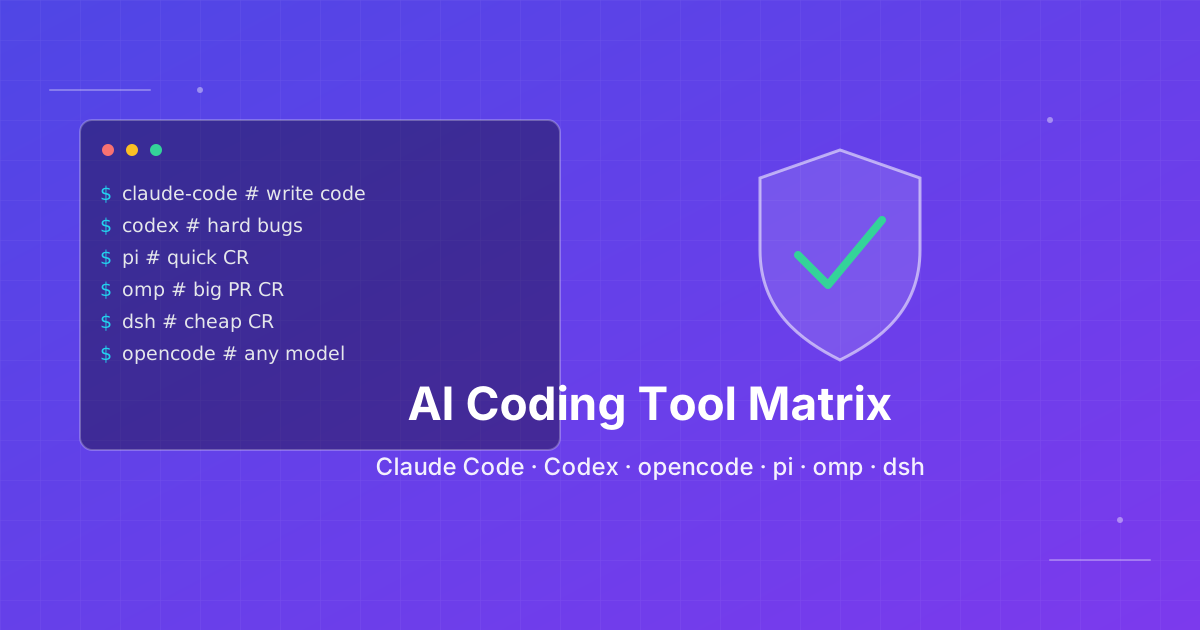
How to pick an AI coding CLI for your repo
Match Claude Code, Codex CLI, OpenCode, Pi, omp, DeepSeek Harness, and Grok Build to the work you actually run. Docs rechecked 2026-10-06.
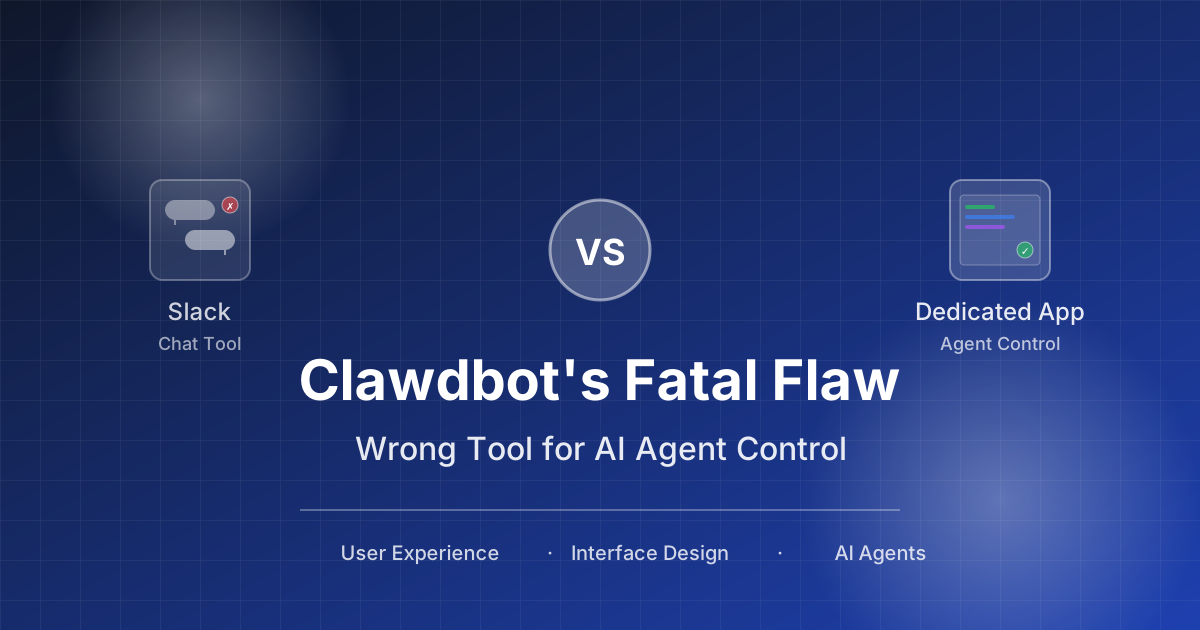
Stop Cramming AI Assistants into Chat Boxes: Clawdbot Picked the Wrong Battlefield
Clawdbot is convenient, but putting it inside Slack or Discord was the wrong design choice from day one. Chat tools are not for operating tasks, and AI isn't for chatting.
