

Prime Agent is PrimeIntellect's open-source coding agent built on a Recursive Language Model (RLM), a research direction where the agent treats context as variables and sub-agents as function calls inside a persistent REPL. Released on August 5, 2026, it is best known for the /refine command, which lets the agent read its own execution trajectory and apply CRUD edits to improve its own prompts, skills, and memory. With 15,000+ GitHub stars in its first months, it is the leading example of a self-improving agent you can run yourself.
Key Features
- Recursive Language Model: Context as variables and sub-agents as function calls in a persistent IPython kernel — the entire agent is programmatic Python.
/refineself-improvement: The agent reads its own trajectory and makes evidence-backed updates to its own configuration, skills, and memory.- Persistent kernel as the single tool: All operations go through one IPython kernel rather than dozens of bespoke tools.
- Daemon-backed sessions: Agents keep running after your terminal disconnects; reattach whenever you want.
- Agent-to-agent messaging: Running sessions can talk to each other directly.
- Executable skills: Skills are importable Python packages with typed callables, not just prompt text.
- Bounded autonomous mode: Persistent goals, heartbeats, schedules, and token budgets keep autonomous runs controlled.
- Long-running eval support: Designed for hours or days of operation with quality gates.
Use Cases
Who Should Use This Tool?
- Python developers: The whole agent is Python — state, tools, and skills are all programmatic and introspectable.
- Researchers: RLM is an active research area; this is a reference implementation you can actually run.
- Autonomous task runners: Daemon sessions and bounded autonomy suit long, unattended jobs.
Problems It Solves
- Static agents: Most agents never change how they work; Prime Agent's
/refinecloses that loop. - Tool sprawl: A persistent kernel replaces dozens of fragile tools with one typed execution surface.
- Session loss: Daemon-backed sessions survive terminal disconnects.
Pricing
| Component | Cost | Features |
|---|---|---|
| Software | $0 (MIT License) | Full agent, self-hosted, no usage limits |
| Models | Bring your own API key | OpenAI, Anthropic, or Prime Intellect inference |
Prime Agent is free and open source. You bring your own model API keys, or use PrimeIntellect's own inference service on a pay-per-token basis.
Advantages & Unique Selling Points
Compared to Competitors:
- Self-improvement:
/refinewith evidence-backed updates is unique among mainstream coding agents. - Single tool: One persistent IPython kernel instead of a sprawling tool API — simpler to audit and extend.
- Research pedigree: Built on published RLM work from Prime Intellect, with competitive results on ARC-AGI 3 and GPU kernel benchmarks.
What Makes It Stand Out:
- The agent's own prompts, skills, and memory are first-class objects it can edit.
- Agent-to-agent messaging enables novel multi-agent topologies.
- Bounded autonomous mode with budgets makes long unattended runs safe.
User Reviews
Community discussion in r/LocalLLaMA and r/ChatGPTCoding has centered on the novelty of self-improvement: watching the agent edit its own skills after a failure is the demo that gets shared most. Reviewers also note the kernel-based design makes it unusually transparent — every action is Python you can read. The main criticism is that it targets Python-centric workflows first, with other-language support still maturing.
Getting Started
Quick Start Guide
- Install:
pip install prime-agent. - Configure: Add your model API key (OpenAI, Anthropic, or Prime inference).
- Run a task: Start a session and describe a coding task.
- Refine: When it fails, run
/refineand watch it update its own skills and memory.
Integration
- Models: OpenAI, Anthropic, or Prime Intellect inference.
- Runtime: Any machine with Python 3.12+; daemon mode for headless operation.
Frequently Asked Questions
Is Prime Agent free?
Yes. It is MIT-licensed; you pay only for model inference.
Does it really improve itself?
Yes. /refine reads the agent's own trajectory and applies CRUD edits to its prompts, skills, and memory with evidence for each change.
Does it need a GPU?
No. It orchestrates remote model APIs; local inference is optional.
How does it compare to Claude Code?
Claude Code is a production-focused agent with a broad tool ecosystem; Prime Agent is a research-grade, Python-centric agent where the interesting part is self-modification.
Alternatives
If Prime Agent isn't the right fit, consider these alternatives:
- Claude Code: Anthropic's production terminal agent with a mature ecosystem.
- OpenHands: Open-source autonomous coding agent platform.
- Goose: Block's open-source local agent with an extensible toolkit.
Tips & Best Practices
- Use
/refineafter every failure: The agent's self-improvement is the core value; make it part of your loop. - Write skills as typed Python: Executable, typed skills are far more reliable than prompt-only skills.
- Set budgets in autonomous mode: Token and time budgets keep long unattended runs predictable.
Comments
No comments yet. Be the first to comment!
Related Tools


Related Insights

Skills + Hooks + Plugins: How Anthropic Redefined AI Coding Tool Extensibility
An in-depth analysis of Claude Code's trinity architecture of Skills, Hooks, and Plugins. Explore why this design is more advanced than GitHub Copilot and Cursor, and how it redefines AI coding tool extensibility through open standards.
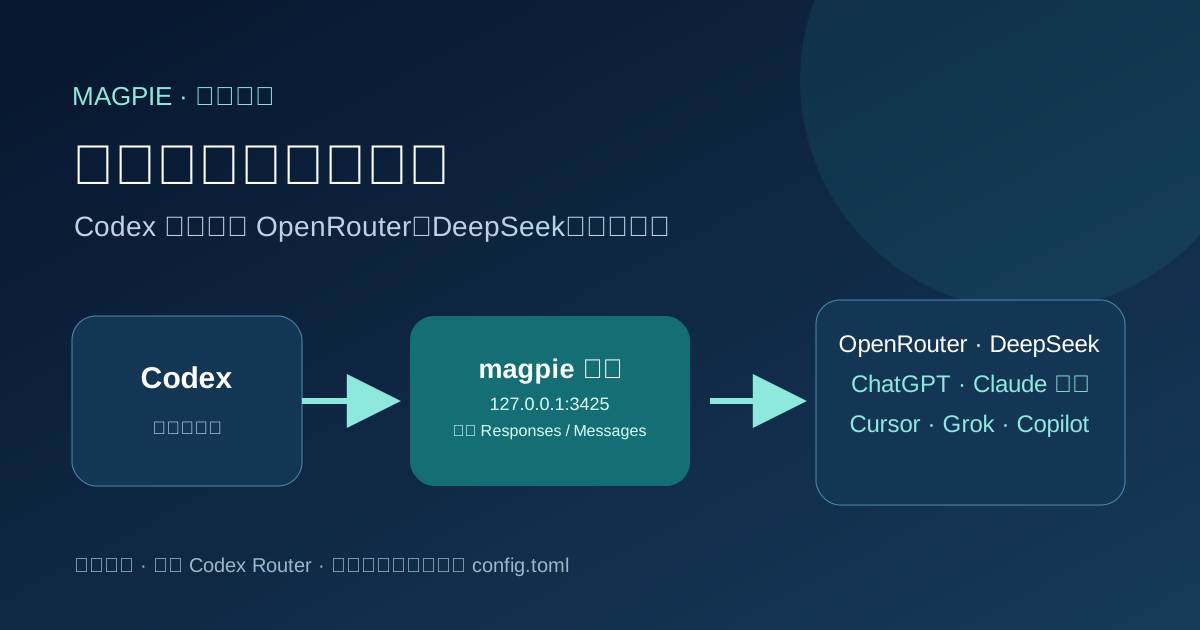
Codex on any model: magpie makes Codex Router unnecessary
magpie is a free, open-source menu bar app that runs a local gateway and puts OpenRouter, DeepSeek and your ChatGPT, Claude, Cursor, Grok and Copilot subscriptions right into Codex's own model picker, with one click and no Codex Router.
The Twilight of Low-Code Platforms: Why Claude Agent SDK Will Make Dify History
A deep dive from first principles of large language models on why Claude Agent SDK will replace Dify. Exploring why describing processes in natural language is more aligned with human primitive behavior patterns, and why this is the inevitable choice in the AI era.