

omp (Oh My Pi) is a batteries-included terminal AI coding agent by Can Bölük (can1357), forked from Mario Zechner's Pi and rewritten around a native Rust core. Its pitch is "a coding agent with the IDE wired in": hash-anchored edits that fail closed instead of corrupting files, LSP operations wired into every write, a real DAP debugger, browser automation, and first-class subagents. With 24k+ GitHub stars, an MIT license, 60+ providers, and 31 built-in tools, omp is one of the most feature-dense open-source agent harnesses shipping today.
Key Features
- Hashline edits: Files are presented with content-hash anchors and edits target exact lines by hash. If the file changed underneath, the edit fails closed before landing in the wrong place; in the author's benchmark, this edit format lifted one model from 6.7% to 68.3% task success and saved up to 61% of token usage.
- LSP in every write: 14 language-server operations (rename, references, workspace symbols) wired into edit flows, so renaming a module updates imports, re-exports, barrel files, and aliased references the way your IDE would.
- A real debugger: 28 DAP operations drive lldb, delve, and debugpy. The agent can attach to a segfaulting C binary, walk goroutines in a hanging Go service, or pause a wedged Python process and inspect stack frames — no print-statement archaeology.
- Subagents with boundaries: The task tool fans out parallel subagents in workspace-isolated worktrees and returns typed, schema-validated results to the parent session; Agent Hub (Alt+A) shows live transcripts, cost, and steering controls.
- Persistent eval kernels: Persistent Python and Bun JavaScript kernels with a shared prelude can call back into the agent's own tools over a loopback bridge.
- 60+ providers with role routing: Ten model roles (default, smol, slow, plan, commit, vision, designer, task, advisor, tiny) route work by intent; swap the active model mid-session with /model or cycle with Ctrl+P.
- Browser and desktop: A stealth Puppeteer browser drives headless Chromium or attaches to your own Chrome tabs; a computer tool operates the real desktop — windows, screenshots, native input, and the accessibility tree.
- Collab and voice: /collab shares a live session with teammates via link or QR (read-write or read-only); voice mode turns a session into a spoken back-and-forth.
- Package ecosystem: Inherits Pi's package system, so extensions, skills, prompts, and themes install from npm or git.
Use Cases
Who Should Use This Tool?
- Terminal-native developers: People who want IDE-grade code intelligence — refactors, debuggers, browser control — without leaving the command line.
- Teams fighting broken agent edits: Anyone whose patches fail to apply, land in the wrong range, or silently corrupt files will appreciate edits that fail closed.
- Multi-provider users: Shops that route cheap fan-out, deep reasoning, and vision to different models instead of locking into one vendor.
Problems It Solves
- Corrupted edits: Exact-string patches and diffs break on whitespace drift; hashline anchors make stale edits fail before they can corrupt the wrong range.
- Refactors that break imports: Plain string edits miss re-exports and barrel files; LSP-aware writes update the whole workspace symbol graph.
- Debugging loops: Adding print statements and re-running is replaced by a real DAP session with breakpoints, stepping, threads, and live variable evaluation.
Pricing
| Plan | Price | Features |
|---|---|---|
| Open Source | $0 | Full harness, 31 built-in tools, 60+ providers, packages. MIT License. |
omp is free and open source (MIT). Install with curl -fsSL https://omp.sh/install | sh (macOS/Linux), bun install -g @oh-my-pi/pi-coding-agent, or the PowerShell one-liner on Windows. Model usage is billed by your providers.
Advantages & Unique Selling Points
Compared to Competitors:
- Edit safety: Hash-anchored edits are unique to omp — other harnesses retype whole files or send large diffs that can silently land in the wrong place.
- IDE in the terminal: Native LSP and DAP operations give you workspace refactors and real debugging without switching to an IDE.
- No provider lock-in: 60+ providers with per-role routing, local model discovery (Ollama, llama.cpp, LM Studio), and OAuth sign-in.
What Makes It Stand Out:
- 24k+ GitHub stars within months of launch, MIT-licensed, ~80k lines of Rust core.
- Ships a stealth browser, desktop control, collab sharing, and voice mode out of the box.
- ACP support lets editors drive omp programmatically.
User Reviews
"This is one of the most powerful AI agent harnesses I've ever used. It treats your project like a living application runtime instead of a collection of flat text files." — Better Stack, YouTube review
"Sometimes the model knows the fix, but the harness makes the fix brittle. omp's answer is hashline editing — if the anchors no longer match, the edit fails closed. That is a narrow claim, not a victory lap." — Fluid Coding & AI, YouTube review
Getting Started
Quick Start Guide
- Install:
curl -fsSL https://omp.sh/install | sh(macOS/Linux) orirm https://omp.sh/install.ps1 | iex(Windows). - Authenticate: Sign in with a provider account (OAuth) or set an API key; omp can even port your Claude Code plugins and settings.
- Start: Run
ompin a project directory to launch the TUI. - Explore: Try /review for prioritized code review, /collab to share the session, and /model to route roles across providers.
Integration
- Providers: 60+ including Anthropic, OpenAI, Google, Groq, xAI, OpenRouter, Ollama, llama.cpp, LM Studio.
- Debuggers: lldb, delve (dlv), debugpy via DAP.
- Browser: Puppeteer, headless Chromium, CDP-attached apps, Chrome relay extension.
- Platforms: macOS, Linux, and Windows-native (no WSL required).
Frequently Asked Questions
Is omp free?
Yes. omp is MIT-licensed open source; you only pay for model usage through your chosen providers.
What makes hashline edits different?
Instead of reproducing exact old text, the agent edits against content-hash anchors. If the file changed and the anchors no longer match, the edit refuses to apply rather than silently corrupting the wrong range.
Can omp use my Claude Code setup?
In many cases yes — omp can sign in with Claude accounts and port existing plugins and settings, while remaining model-agnostic underneath.
Alternatives
If omp isn't the right fit, consider these alternatives:
- Pi: The minimal upstream harness omp is forked from.
- Claude Code: Anthropic's feature-rich agent with deep Claude integration.
- OpenCode: Open-source terminal agent with multi-provider support.
Tips & Best Practices
- Route roles deliberately: Assign cheap models to smol fan-out and stronger models to slow planning to cut costs without losing quality.
- Use workspace isolation for subagents: Parallel tasks on isolated worktrees avoid merge-conflict swamps.
- Review before you push: /review spawns reviewer subagents that rank issues P0-P3 so you fix release blockers first.
Comments
No comments yet. Be the first to comment!
Related Tools


Related Insights
Cursor vs GitHub Copilot: Complete Comparison 2026
In-depth comparison of Cursor and GitHub Copilot. Discover which AI coding assistant is best for your workflow with detailed feature analysis, pricing, and real-world testing.
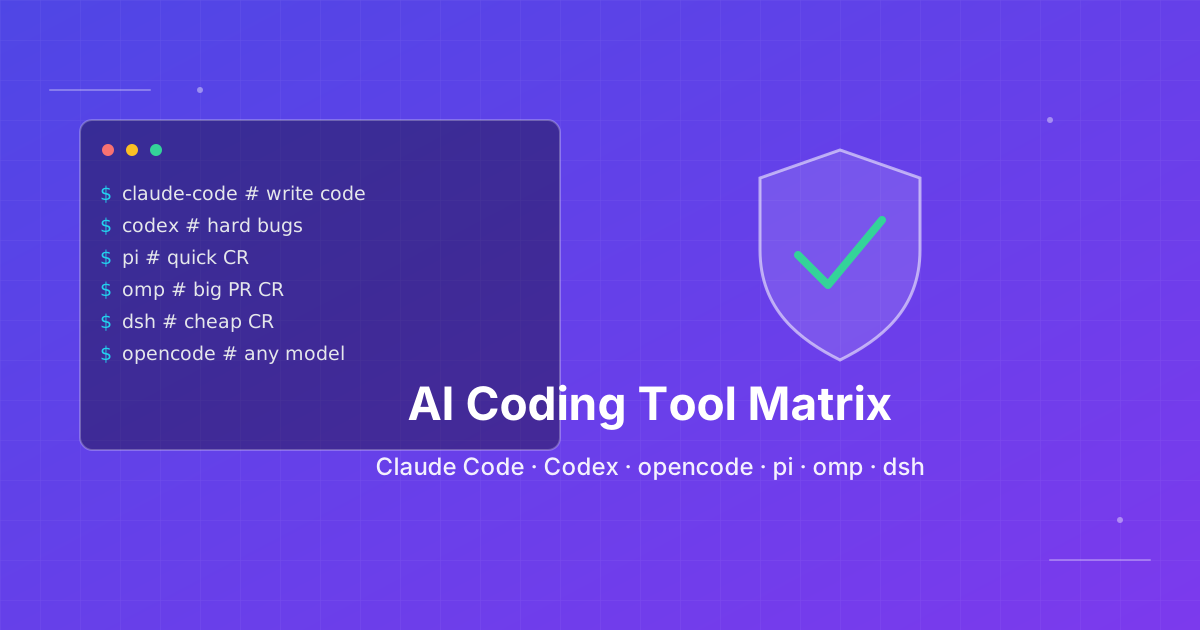
Seven AI Coding CLIs, Six Months: No Matter How Strong the Model, Work Needs Supervision
Claude Code, Codex, opencode, pi, omp and DeepSeek Harness all have personalities. After six months of deep use I run a division of labor: pi for the fastest cheapest reviews, omp for complex PRs, DeepSeek Harness on V4 Flash for high-frequency low-cost review, and Claude Code, Qoder and Cursor for writing. No matter how strong the model, work needs supervision — ideally from an independent third party.
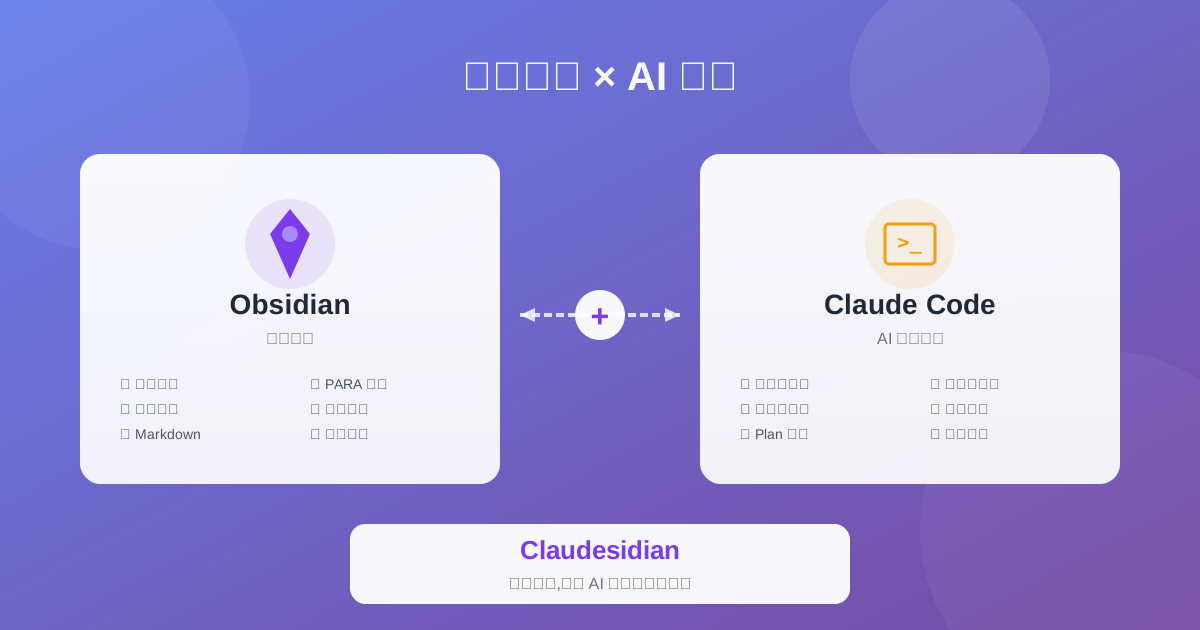
Claudesidian: Transform Obsidian into an AI-Powered Second Brain
Discover Claudesidian, an open-source project that perfectly integrates Obsidian with Claude Code. Built-in PARA method, custom commands, and automated workflows for a complete idea-to-implementation solution.