

DeepSeek V4 is anticipated to be the next major release in DeepSeek's flagship model series, following the highly successful V3 and V3.2 releases. While official details are yet to be announced, the model is expected to build upon DeepSeek's proven Mixture of Experts (MoE) architecture with significant improvements in reasoning capabilities, multimodal processing, and agent-based interactions.
Expected Key Features
Based on DeepSeek's development trajectory and community expectations, DeepSeek V4 is anticipated to include:
Advanced Reasoning Capabilities
Building on the thinking and reasoning features introduced in V3.2, V4 is expected to deliver even more sophisticated chain-of-thought processing and complex problem-solving abilities, potentially integrating learnings from the DeepSeek-R1 reasoning model.
Enhanced Multimodal Support
While V3 focused primarily on text, V4 is anticipated to introduce or significantly enhance multimodal capabilities, including vision and potentially audio processing, making it a truly comprehensive AI assistant.
Improved Agent Capabilities
Following V3.2's enhanced agent features, V4 is expected to excel at multi-step task execution, tool usage, and complex workflow automation with greater reliability and accuracy.
Architectural Innovations
Continuing DeepSeek's tradition of pushing the boundaries of MoE architectures, V4 may feature:
- Optimized parameter efficiency
- Improved inference speed
- Enhanced context window capabilities
- Better resource utilization
Technical Specifications (Anticipated)
While official specifications are pending, based on the evolution from V2.5 to V3, we can anticipate:
- Architecture: Advanced Mixture of Experts (MoE)
- Total Parameters: Likely exceeding 671B (V3's parameter count)
- Active Parameters: Optimized for inference efficiency
- Training Data: Expanded beyond V3's 14.8T tokens
- Precision: Continued support for FP8 and BF16
- Context Window: Potentially expanded from V3's capabilities
Expected Performance Improvements
DeepSeek has consistently delivered significant performance gains with each major version. V4 is anticipated to:
- Benchmark Performance: Surpass or match GPT-4o, Claude-3.5-Sonnet, and other leading models across major evaluations (MMLU, HumanEval, MATH, etc.)
- Generation Speed: Further improvements beyond V3's 60 TPS
- Code Generation: Enhanced performance in both algorithmic challenges (Codeforces) and engineering tasks (SWE-Bench)
- Mathematical Reasoning: Continued leadership in mathematical competitions and complex problem-solving
- Multilingual Capabilities: Improved performance across English, Chinese, and other languages
API and Accessibility
Following DeepSeek's commitment to accessibility, V4 is expected to be available through:
- Web Chat: chat.deepseek.com
- API Platform: platform.deepseek.com
- Mobile Apps: iOS and Android applications
- Open Source: Continued commitment to open-source model weights
Anticipated Pricing
While specific pricing details are not yet available, DeepSeek has maintained competitive pricing:
- Current V3 pricing: 0.5 CNY per million input tokens / 2 CNY per million output tokens
- V4 pricing is expected to remain competitive while potentially offering improved value
Development Timeline
DeepSeek has demonstrated a rapid development cadence:
- DeepSeek V2: Released May 2024
- DeepSeek V2.5: Released September 2024
- DeepSeek V3: Released December 2024
- DeepSeek V3.2: Released January 2025
Based on this pattern, V4 could be expected in mid-to-late 2025, though this is speculative.
DeepSeek's Vision
DeepSeek continues to pursue "inclusive AGI through open-source spirit and long-termism." V4 is expected to further this mission by:
- Narrowing the gap between open-source and closed-source models
- Providing state-of-the-art AI capabilities at accessible prices
- Contributing to the open-source AI community
- Advancing the frontier of AI research and applications
Community Expectations
The AI community has high expectations for DeepSeek V4, particularly in:
- Reasoning and Planning: More sophisticated multi-step reasoning
- Real-World Applications: Better performance in practical, production scenarios
- Efficiency: Improved cost-performance ratio
- Reliability: More consistent outputs and fewer hallucinations
- Integration: Enhanced compatibility with existing tools and frameworks
Staying Updated
For the latest official information about DeepSeek V4:
- Official Website: deepseek.com
- Twitter/X: @deepseek_ai
- GitHub: deepseek-ai
- Hugging Face: deepseek-ai
Note: This entry is based on expectations and analysis of DeepSeek's development trajectory. Official specifications, features, and release dates will be updated once announced by DeepSeek. For the most current information, please visit the official DeepSeek website.
Related: Claude 3.5 Sonnet and Claude 3 Haiku. Hub: models.
Comments
No comments yet. Be the first to comment!
Related Tools

Related Insights
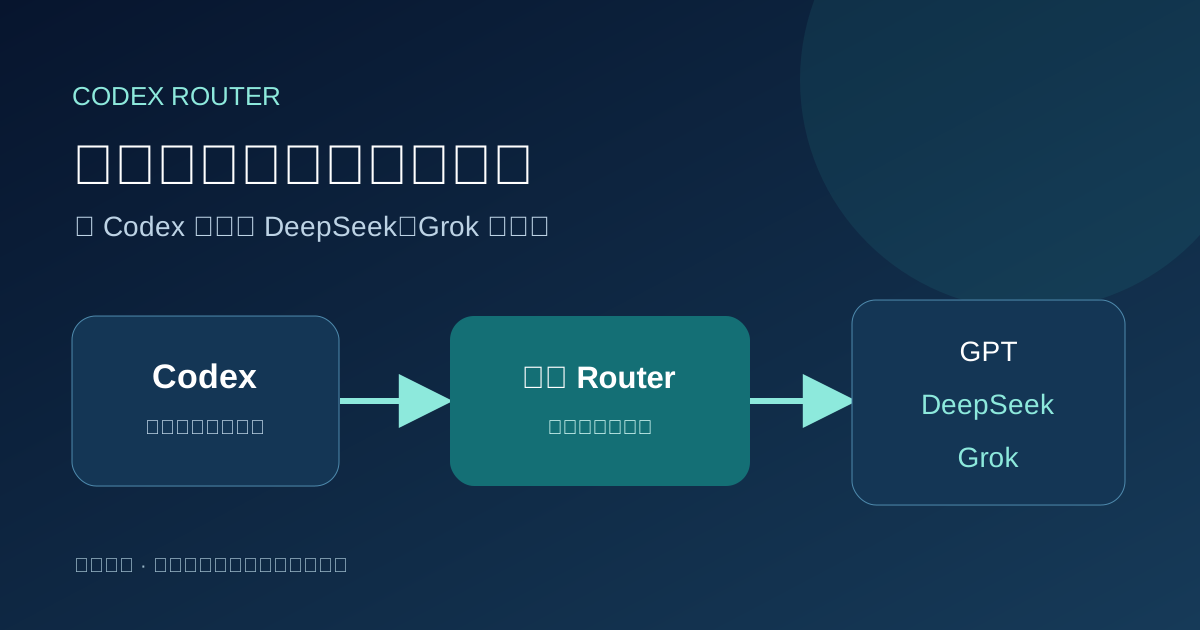
Running low on ChatGPT Codex quota? Switch to DeepSeek or Grok inside Codex
Codex Router lets you keep your Codex workspace while using DeepSeek, Grok, and other external models. A plain-English guide to routing, quotas, and network access.
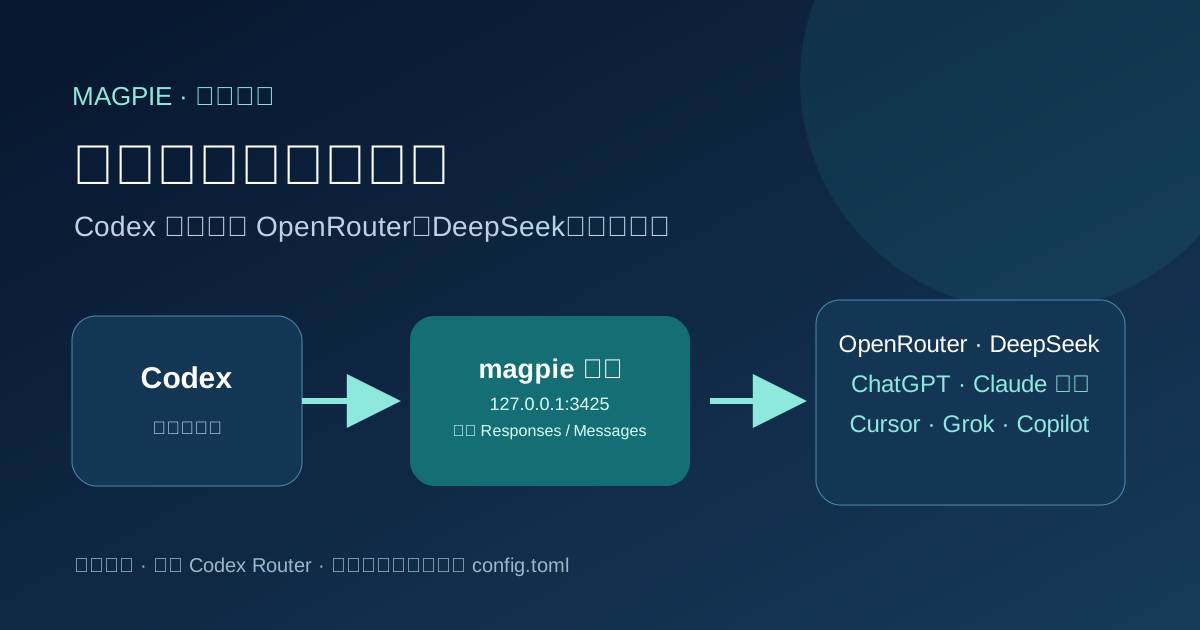
Point Codex at any model with magpie
Install magpie, add a local or signed-in provider, then switch Codex to that model. Rechecked against official magpie docs on 2026-10-06.
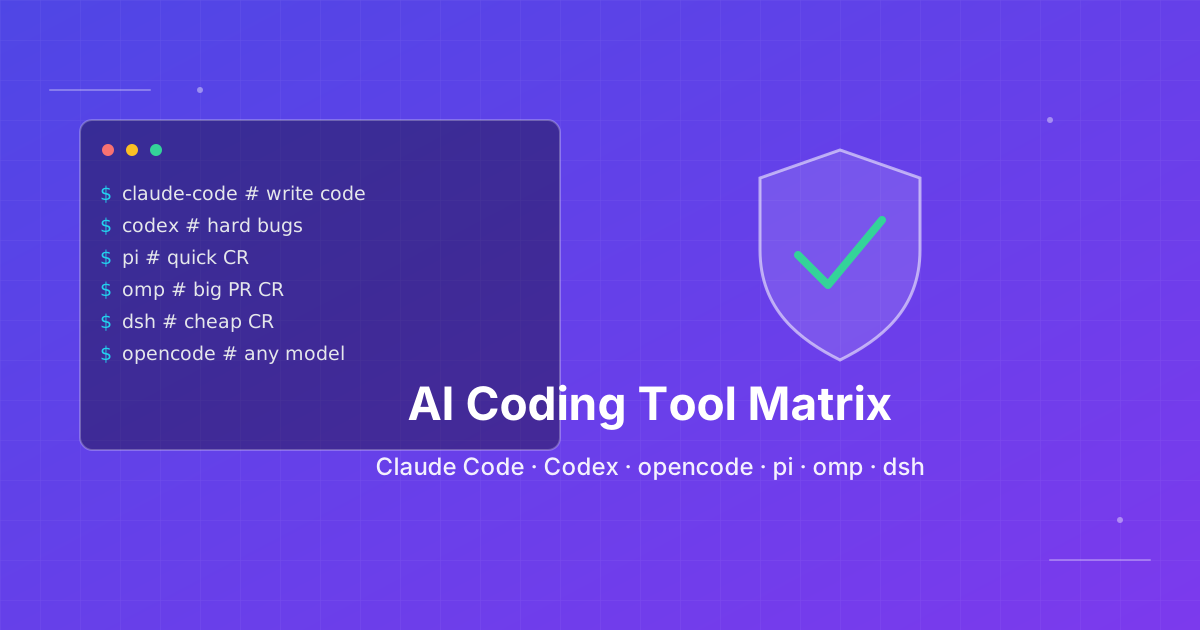
How to pick an AI coding CLI for your repo
Match Claude Code, Codex CLI, OpenCode, Pi, omp, DeepSeek Harness, and Grok Build to the work you actually run. Docs rechecked 2026-10-06.