

text-embedding-ada-002
text-embedding-ada-002 is OpenAI's older second-generation embedding snapshot, not the live embedding default. The same embeddings block lists text-embedding-3-small at $0.020 / 1M and text-embedding-3-large at $0.130 / 1M. developers.openai.com/api/docs/models still has a model card for ada-002.
Compare text-embedding-3-large if you wanted the still-listed larger v3 row, and text-embedding-3-small if you wanted the cheaper v3 row.
Key Features
- Previous generation, still billed: ada-002 remains on the pricing page at $0.100 / 1M.
- Not the 2026 default: v3 small / large are the current listed embedding pair.
- No invented MIRACL / MTEB: Do not paste leftover crowns unless you re-run a first-party card.
- Same 1536-d leftover story: Confirm the live model card before you quote dimensions or 8191 tokens as a 2026 spec sheet.
Use Cases
- People with an ada-002 bookmark who need the catalog corrected.
- People who were about to call ada-002 the latest embedding.
Limitation: We did not re-embed a corpus or re-run a retrieval board.
Pricing
openai.com/api/pricing on 2026-08-17.
| Piece | Price | Notes from that page |
|---|---|---|
| text-embedding-ada-002 | $0.100 / 1M tokens | Still listed. Previous snapshot. |
| text-embedding-3-small | $0.020 / 1M tokens | Cheaper current v3 row. |
| text-embedding-3-large | $0.130 / 1M tokens | Larger current v3 row. |
If a leftover blog still calls ada-002 the latest and cheapest embedding, treat the v3 rows as the correction.
Getting Started
- Open openai.com/api/pricing before you hard-code
text-embedding-ada-002. - Confirm text-embedding-3-small if you wanted the cheaper listed row.
- Confirm text-embedding-3-large if you wanted the larger listed row.
- Do not paste "replaces 16 first-gen models" into a 2026 deck.
Frequently Asked Questions
Is ada-002 still the OpenAI embedding default?
No. v3 small and v3 large are the current listed pair.
Is it still for sale?
Yes. The pricing page still prints $0.100 / 1M.
Same as text-embedding-3-large?
No. 3-large is the later, still-listed larger v3 row.
Alternatives
- text-embedding-3-small: Cheaper listed v3 row.
- text-embedding-3-large: Larger listed v3 row, not a 2026 MIRACL census.
- GPT-5.6 Sol: Live OpenAI frontier chat if you wandered here for a current model.
Tips
- Call ada-002 a previous snapshot that is still billed.
- Point new RAG work at v3 small or v3 large unless you must keep an old index.
- Confirm the pricing page before you invent a cheaper ada-002 dollar.
Conclusion
text-embedding-ada-002 is still listed at $0.100 / 1M, but it is not the 2026 OpenAI embedding default. Start at openai.com/api/pricing, then decide whether text-embedding-3-small or text-embedding-3-large already covers the row you need.
Comments
No comments yet. Be the first to comment!
Related Tools


Related Insights

Grok Bot and Hermes Bot: one person finally gets a think tank and a secretariat
Grok Bot now ships with Cursor Pro+. Hermes Bot runs on a VPS. They are not smarter chat boxes. The think tank advises, the secretariat executes, and you still make the call.
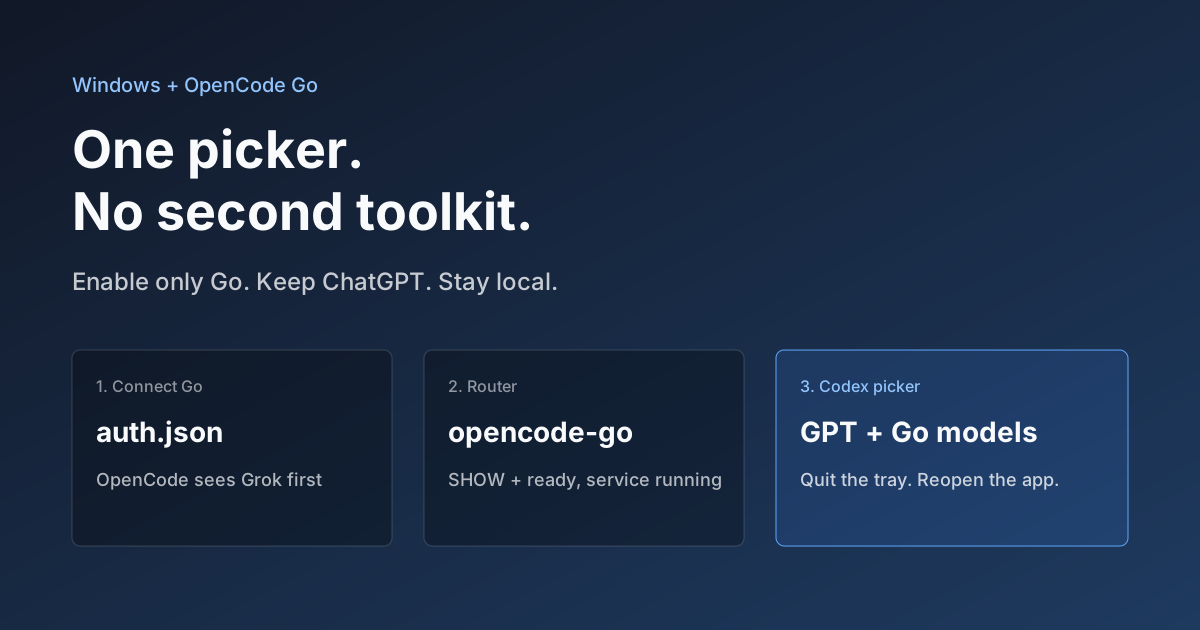
Hook OpenCode Go into Codex on Windows. Do Not Open a Second Toolkit.
A ChatGPT-signed Codex desktop app still shows mostly GPT in the picker. On Windows, enable only OpenCode Go and the Grok, GLM, Kimi, DeepSeek, and MiniMax models you already pay for appear in the same selector. Keys stay local. Native GPT stays put.
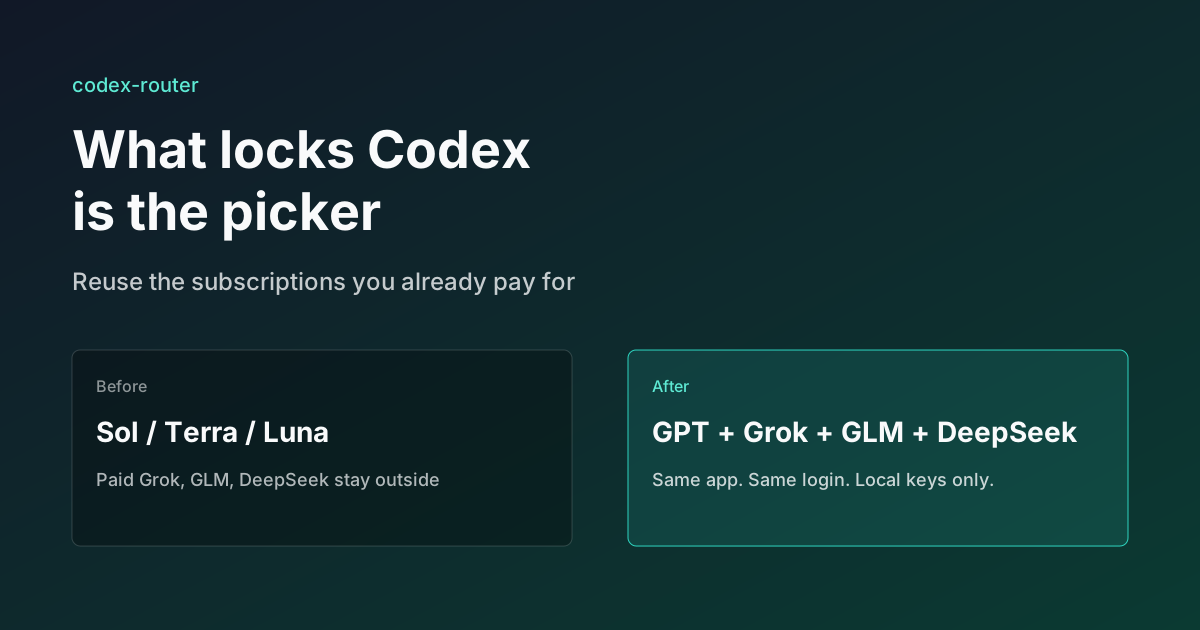
What Locks Codex Is the Picker, Not the Models
You already pay for OpenCode Go, Grok, and Z.ai, but the Codex picker still shows mostly GPT. The community project codex-router does not teach another install ritual. It puts subscriptions you already bought back into the selector, keeps keys on the machine, and leaves native GPT alone.