
Subagent-Driven Development is a skill from Superpowers (skill source). It executes a plan from Writing Plans by dispatching a fresh implementer subagent for each task, a task review covering spec compliance and code quality after each one, and a broad whole-branch review at the end. The README describes agents working autonomously this way for a couple of hours without drifting from the plan.
Core principle: fresh subagent per task, task review, broad final review.
Key Features
- Crafted context: subagents never inherit the session's history; each gets a brief file with exactly what it needs.
- Two verdicts per task: every review must report spec compliance and task quality; implementer self-review never replaces it.
- Review packages: a
review-packagescript writes the commit list, stats and full diff into one file for the reviewer. - Fix loop: Critical or Important findings trigger fixes; Minor findings are logged for the final review; after several rounds the fixer moves up a model tier.
- Model selection: cheap models for mechanical tasks, standard ones for integration work, and the most capable model for architecture and the final review. The model is always named explicitly.
- Rulings and a ledger: ambiguities become recorded rulings, and the four hard stops match Executing Plans.
- One fix wave: final-review findings go to a single fix subagent, then one scoped re-review.
Use Cases
- Long plans where later tasks would otherwise run on a compacted context.
- Work where you want a review gate on every task.
- Mixing cheap and expensive models to control cost.
Pricing
Free and open source under the MIT license. Prime Radiant, the company behind Superpowers, sells commercial support to enterprises. The practical cost is tokens: process skills add questions, reviews and subagent runs.
Getting Started
Superpowers installs as one plugin, so this skill arrives with the rest of the library (15 skills in v6.4.1). In Claude Code run /plugin install superpowers@claude-plugins-official. Cursor uses /add-plugin superpowers, Gemini CLI uses gemini extensions install https://github.com/obra/superpowers, and the README lists commands for Codex, GitHub Copilot CLI, OpenCode, Pi and other harnesses. Skills trigger on their own; you can also ask for one by name. Choose subagent-driven execution at the plan handoff, then let it run.
Limitation: every task costs a fresh implementer and reviewer context, so it is the most expensive way to execute a plan. It needs a harness with subagents; without them the skill points to inline execution.
FAQ
How is it different from parallel agents?
Tasks run one after another with reviews between them; Dispatching Parallel Agents fans out independent problems at once.
Will it merge my branch?
No. Merges and pushes are hard stops; Finishing a Development Branch handles integration.
Alternatives
- Claude Subagents: the Claude Code primitive this skill builds on.
- Agent Dispatcher: routes tasks to specialist roles.
- Multica: assigns issues to coding agents as teammates.
Conclusion
The most thorough way to let agents build from a plan, and the most expensive. Use it when review gates matter. More in the skills hub.
Comments
No comments yet. Be the first to comment!
Related Tools

Related Insights
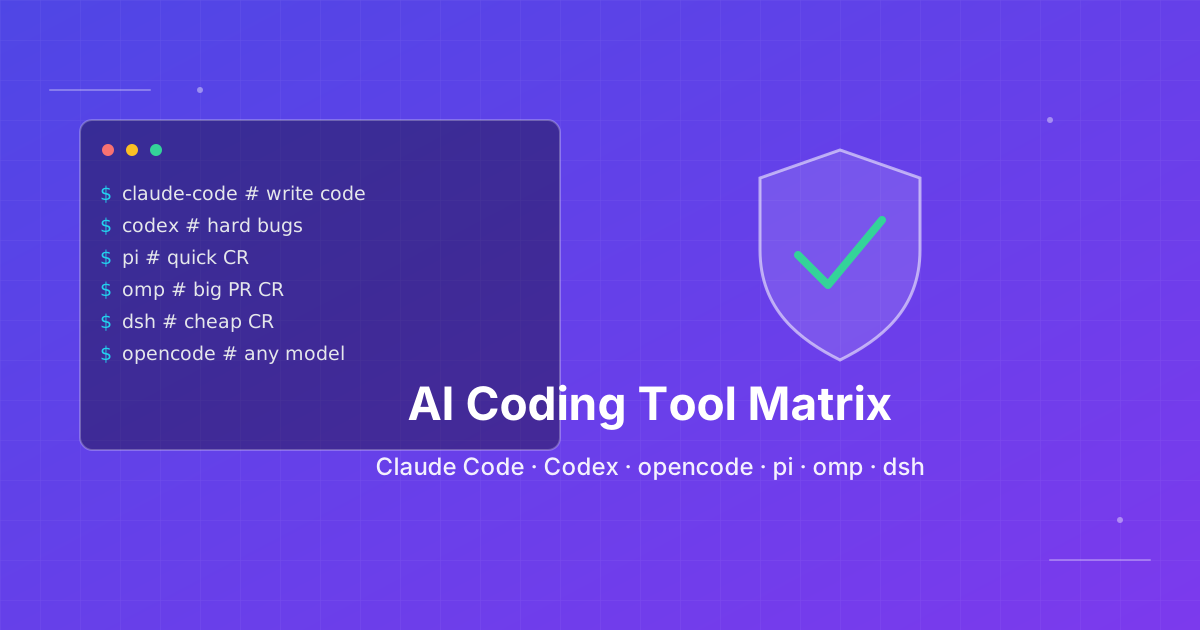
How to pick an AI coding CLI for your repo
Match Claude Code, Codex CLI, OpenCode, Pi, omp, DeepSeek Harness, and Grok Build to the work you actually run. Docs rechecked 2026-10-06.

Anthropic Subagent: The Multi-Agent Architecture Revolution
Deep dive into Anthropic multi-agent architecture design. Learn how Subagents break through context window limitations, achieve 90% performance improvements, and real-world applications in Claude Code.

Skills + Hooks + Plugins: How Anthropic Redefined AI Coding Tool Extensibility
An in-depth analysis of Claude Code's trinity architecture of Skills, Hooks, and Plugins. Explore why this design is more advanced than GitHub Copilot and Cursor, and how it redefines AI coding tool extensibility through open standards.