

unlazy is a completion-discipline skill for substantial agent work. You write an acceptance ledger first. The agent executes reviewed checks, reverifies returned work, and may report only what the evidence supports. The repo Leonxlnx/unlazy is JavaScript, created 2026-08-09, MIT. On 2026-09-17 GitHub listed 3,410 stars and 236 forks. The source targets 2.1.0 and is not a tagged GitHub release; pin a commit if you need an immutable install. 3,410 stars is a heat signal, not traffic.
Install with the skills CLI: npx skills add Leonxlnx/unlazy. Manual paths: ~/.claude/skills/unlazy or ~/.codex/skills/unlazy. Invoke /unlazy in Claude Code or $unlazy in Codex. Compare Agent Skills for a broader pack, Cachebeat if you only needed a cache keepalive, or Claude Code for the host.
Key Features
- Gate contract:
GATES.mdlists runnable checks. A gate passes only on exit0plus anEXPECT:match on combined output. Evidence is a versioned SHA-256 of the check definition, not a prose checkbox. - Depth Tree: split a task N layers deep and give every leaf the full time budget of the whole task. Method notes live in
references/method.md. - Checker:
scripts/gate-check.mjs(Node 16+, no third-party runtime packages).--statusnever executes. Normal mode can run a check after you--approvethe exact oracle. - Scoped pipelines:
.unlazy/<scope>/with PLAN, parent gates, and leaf ledgers. Leaves claim disjointOWNS:paths.--jobs 1-64is opt-in; checks are sequential by default. - Optional Claude Code Stop hook: blocks exit while gates or dispatch waves are unmet. Install only with consent.
Limitation: CHECK: lines are shell. Approval is consent, not a sandbox. The checker cannot prove that an English title and a script mean the same thing. Research citations motivate the design; they do not prove a fixed quality gain. Earlier README ratios are called historical and not reproducible from this repo.
Use Cases
- Refactors and migrations where "looks done" is not enough.
- Parallel subagents that must not overwrite each other's files.
- People who should skip it: tiny one-file edits. The ledger overhead is the point, and it is cost.
Pricing
| Piece | Price | Notes from first-party pages 2026-09-17 |
|---|---|---|
| Skill | $0 | MIT. npx skills add Leonxlnx/unlazy. About 3,410 stars. |
| Host / models | Your plan | Claude Code, Codex, or any skills-CLI agent. |
Getting Started
npx skills add Leonxlnx/unlazy(add-gfor user-level).- Ask
/unlazy tree 5 refactor the payment module and verify every migration path. - Copy
templates/gates-leaf.mdtoGATES.md, fill placeholders, thennode .../gate-check.mjs --status GATES.md. - Read every
CHECK:line.--approveonly after that.--reverifybefore you trust a parent.
First-party start: the README and SKILL.md.
Frequently Asked Questions
Does this make the model less lazy by itself?
No. It adds structure and runnable gates. Papers cited in the README describe laziness and underthinking; they are not a benchmark of unlazy.
Will --status run my tests?
No. --status is non-executing. After approval, a normal run can execute the oracle.
Is 2.1.0 released?
The README says the current source targets 2.1.0 and is not identified as a tagged release. Pin a commit.
Alternatives
- Agent Skills: a wider engineering skill pack, not a gate checker.
- Cachebeat: keeps Claude Code's prompt cache warm; does not verify work.
- Claude Code: the usual host for
/unlazy.
Tips
- Put success-only markers in check scripts. Do not copy the expected number into
EXPECT:. - Keep approval storage outside the repo (
~/.unlazy/approved). - Use separate worktrees when
OWNS:paths would collide.
Conclusion
unlazy is a strict, open skill for agents that stop too early. Install it, write the ledger, and refuse "done" without evidence. Skip it for small edits, and never treat approval as a sandbox.
Comments
No comments yet. Be the first to comment!
Related Tools


Related Insights

Skills + Hooks + Plugins: How Anthropic Redefined AI Coding Tool Extensibility
An in-depth analysis of Claude Code's trinity architecture of Skills, Hooks, and Plugins. Explore why this design is more advanced than GitHub Copilot and Cursor, and how it redefines AI coding tool extensibility through open standards.
Seven AI Coding CLIs, Six Months: No Matter How Strong the Model, Work Needs Supervision
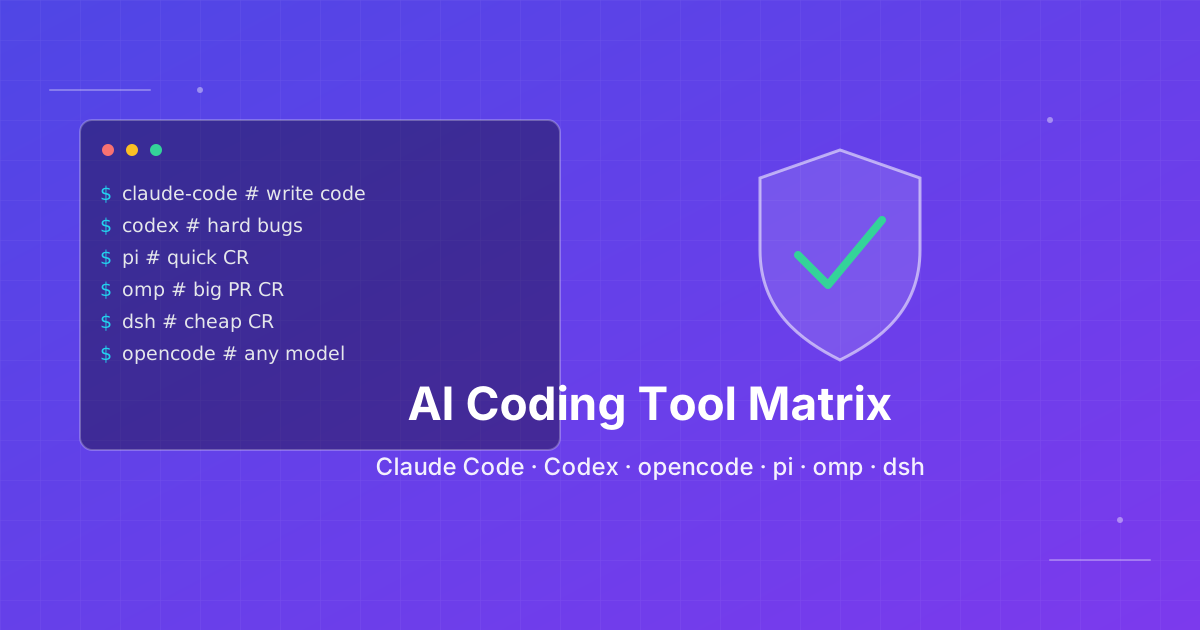
Claude Code, Codex, opencode, pi, omp and DeepSeek Harness all have personalities. After six months of deep use I run a division of labor: pi for the fastest cheapest reviews, omp for complex PRs, DeepSeek Harness on V4 Flash for high-frequency low-cost review, and Claude Code, Qoder and Cursor for writing. No matter how strong the model, work needs supervision — ideally from an independent third party.
Claudesidian: Transform Obsidian into an AI-Powered Second Brain
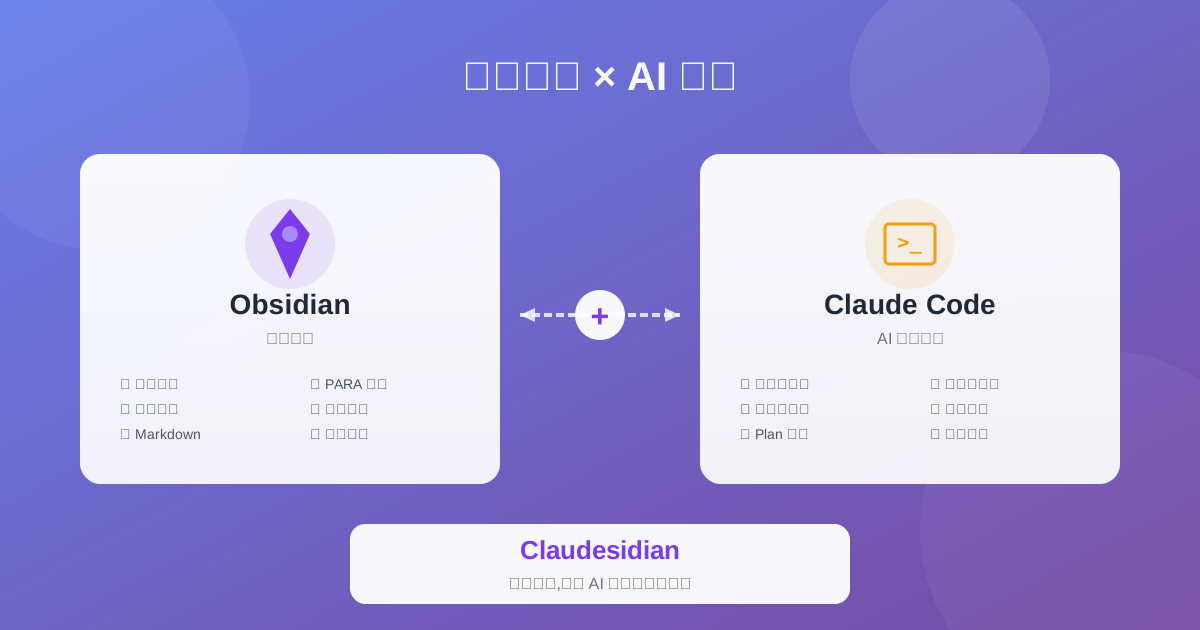
Discover Claudesidian, an open-source project that perfectly integrates Obsidian with Claude Code. Built-in PARA method, custom commands, and automated workflows for a complete idea-to-implementation solution.