
Anthropic Subagent: The Multi-Agent Architecture Revolution
When Single Agents Hit the Ceiling
If you've recently used Claude Code or Deep Research, you might have noticed something: these tools seem noticeably smarter than before.
It's not your imagination. Anthropic quietly launched a multi-agent architecture in 2025, with internal testing showing performance improvements exceeding 90%. But there's an obvious cost—token consumption is 15 times that of single agents.
This raises an interesting question: why use multi-agent systems? Isn't a single AI enough?
The answer lies in an oft-discussed but genuinely critical problem: context windows.
Context: The Achilles' Heel of AI Agents
Let's go back to first principles: an AI model is essentially a function where the input is context and the output is a response. Context includes conversation history, tool call results, external documents, intermediate reasoning... As task complexity increases, context grows longer.
The problems arise:
Context Rot: When the context window fills up, LLM performance degrades significantly. While vendors advertise support for 200k or 500k tokens, effective context is often < 256k tokens.
Cost Explosion: Under token-based pricing, unchecked context growth means costs increase linearly or even super-linearly.
Information Noise: When you ask an AI to perform a complex task (like code review), it needs to read dozens of files and run multiple checking tools. All this intermediate information gets stuffed into the context, and when you want to ask a simple question, the AI gets lost in a pile of irrelevant details.
This is why single agents hit a ceiling.
Subagent: Partitioning the Brain
Anthropic's answer is simple: If one brain can't hold it all, split it into multiple smaller brains.
This is the core idea behind Subagents. The architecture looks roughly like this:
User Request
    ↓
Lead Agent
    ↓ Task Decomposition
    ├─→ Subagent 1: Search relevant code
    ├─→ Subagent 2: Analyze security vulnerabilities
    ├─→ Subagent 3: Check test coverage
    └─→ Subagent 4: Review code style
         ↓ Parallel Execution
    ← ← ← ← Aggregate Results
    ↓
Lead Agent Synthesis
    ↓
Return to User
Key Design Principles
- Task Decomposition: Lead Agent breaks complex requests into multiple subtasks
- Parallel Execution: Multiple Subagents work simultaneously, each with their own context window
- Context Isolation: Subagent work details don't pollute the Lead Agent's context
- Result Compression: Subagents return only the most important findings, not the entire intermediate process
Here's a practical example. Suppose you're using Claude Code for code review:
Single Agent Mode: Read file A, read file B, read file C... Context grows longer and longer, potentially abandoning some files due to token limits.
Multi-Agent Mode:
- Subagent 1 handles files A-D, finds security issues → Returns 3 critical vulnerabilities
- Subagent 2 handles files E-H, checks performance → Returns 2 performance bottlenecks
- Subagent 3 handles test files, evaluates coverage → Returns coverage report
- Lead Agent synthesizes these compressed results to produce a complete review
From the Lead Agent's perspective, it only receives a few hundred tokens of summary, not tens of thousands of tokens of raw data.
From Theory to Practice: Subagents in Claude Code
If you're a Claude Code user, you've likely already been using Subagents without knowing it.
Claude Code invokes Subagents through the Task tool. For example, when you ask Claude to "research this project's authentication flow," it might:
- Main agent analyzes your request
- Launches an
Exploretype Subagent via the Task tool - Subagent explores the codebase, reads relevant files, understands auth logic
- Subagent returns a summary: "This project uses JWT + OAuth2, core logic in
auth/service.ts:120, with a potential token refresh issue" - Main agent continues the conversation based on this summary
During this process, the Subagent might have read 20 files, but the main agent's context only increased by a few hundred tokens.
Practical Tips
If you want to better leverage Subagents, here are some tips:
Clear Subtask Boundaries: Give the AI clear instructions, like "use Subagent to analyze security issues, use another Subagent to check performance."
Parallel Thinking: List out parallelizable tasks, let multiple Subagents run simultaneously. Code review going from "several minutes" to "seconds" is the secret.
Tool Permission Separation: Different Subagents can have different tool access permissions. For example, security review Subagents can access sensitive APIs, while code style checking Subagents don't need that.
Costs and Trade-offs
After all these benefits, let's pour some cold water: multi-agent is not a silver bullet.
The most direct issue is cost. 15x token consumption means if you're using the Claude API, your bill will skyrocket.
Anthropic themselves admit: multi-agent systems are best suited for tasks where result value far exceeds cost.
What qualifies as "result value far exceeds cost"?
- ✅ Complex technical research (Deep Research)
- ✅ Comprehensive review of large codebases
- ✅ Decision analysis requiring multiple data sources
- ❌ Simple code completion
- ❌ Casual conversation
- ❌ Single file modifications
Another challenge is orchestration complexity. You need to design:
- Lead Agent's task decomposition strategy
- Subagent responsibility boundaries
- How to aggregate and deduplicate results
- Error handling and fallback mechanisms
This isn't simply "turning on multi-agent" to solve—it requires deep understanding of the task.
The Future of Multi-Agent: Evolution of Orchestration Patterns
Taking a higher-level view, Anthropic's Subagent is just one implementation of multi-agent orchestration. The industry is exploring orchestration patterns including:
- Orchestrator-Worker Pattern (Anthropic's approach): Central orchestrator + parallel workers
- Group Chat Pattern: Multiple agents solving problems through shared dialogue
- Hierarchical Pattern: Multi-layer agents, higher levels supervising lower levels
- Event-Driven Pattern: Event-driven agent collaboration
Each pattern suits different scenarios. For example, Group Chat is better for creative tasks requiring "debate" and "discussion," while Hierarchical is better for large-scale enterprise workflows.
Microsoft is also pushing Model Context Protocol (MCP), allowing agents from different platforms to securely share context. Imagine: your personal AI assistant can delegate tasks to specialized code review AI, specialized data analysis AI, each with independent contexts and expertise.
This direction is interesting: The future of AI agents isn't solo performance, but teamwork.
Final Thoughts
Anthropic's Subagent architecture is essentially answering one question: How can AI handle complex tasks that exceed a single context window?
The answer is divide and conquer:
- Use Lead Agent for strategic planning
- Use Subagents for tactical execution
- Use context isolation to protect main conversation clarity
- Use parallel execution to improve efficiency
This isn't revolutionary innovation—it's more like applying software engineering concepts of microservices and distributed systems to AI. But it's precisely this "migrating mature paradigms to new domains" approach that makes multi-agent systems truly practical.
Of course, 15x cost is no joke. This means multi-agent is currently a "luxury product," suitable for high-value tasks. But as model inference costs continue to drop (which is nearly inevitable), multi-agent will become more widespread.
Perhaps in the near future, we'll look back at single agents like we now view single-threaded programs: functional, but why not parallel?
References:
- Anthropic Engineering Blog: Multi-Agent Research System
- Microsoft Learn: AI Agent Orchestration Patterns
- Claude Code Documentation: Subagents
- Industry Research: Context Window Management 2025
Related Reading:
Comments
No comments yet. Be the first to comment!
Related Tools


Related Articles
Stop Cramming AI Assistants into Chat Boxes: Clawdbot Picked the Wrong Battlefield
Clawdbot is convenient, but putting it inside Slack or Discord was the wrong design choice from day one. Chat tools are not for operating tasks, and AI isn't for chatting.

Skills + Hooks + Plugins: How Anthropic Redefined AI Coding Tool Extensibility
An in-depth analysis of Claude Code's trinity architecture of Skills, Hooks, and Plugins. Explore why this design is more advanced than GitHub Copilot and Cursor, and how it redefines AI coding tool extensibility through open standards.
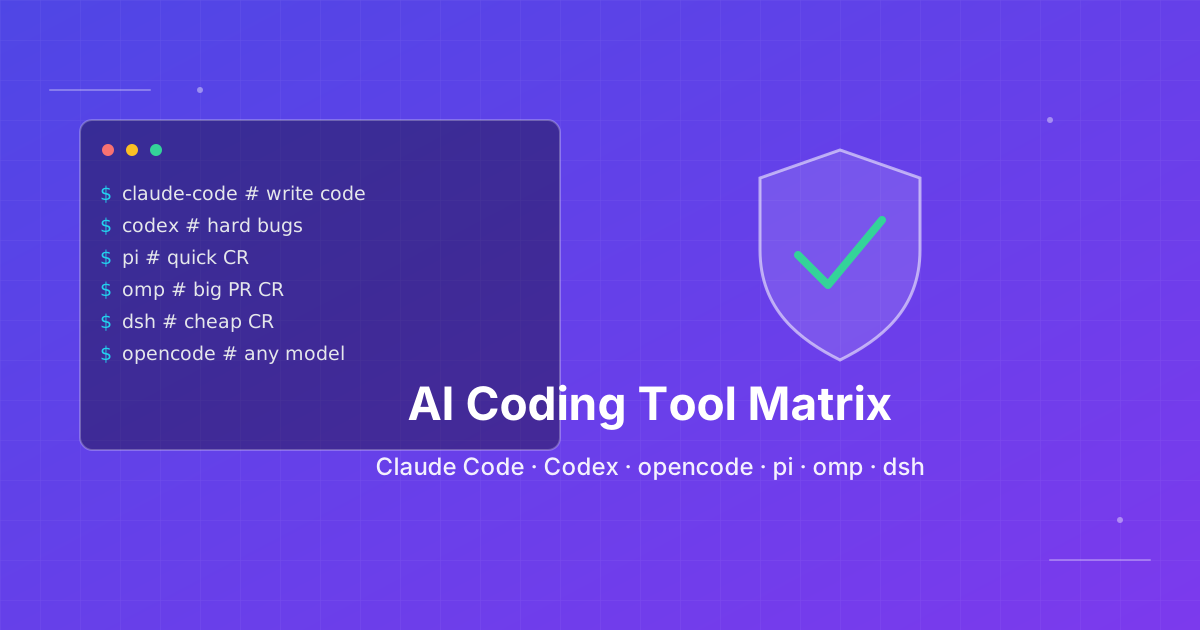
Seven AI Coding CLIs, Six Months: No Matter How Strong the Model, Work Needs Supervision
Claude Code, Codex, opencode, pi, omp and DeepSeek Harness all have personalities. After six months of deep use I run a division of labor: pi for the fastest cheapest reviews, omp for complex PRs, DeepSeek Harness on V4 Flash for high-frequency low-cost review, and Claude Code, Qoder and Cursor for writing. No matter how strong the model, work needs supervision — ideally from an independent third party.
