

Letta
Letta is the company and runtime behind MemGPT-style stateful agents. letta-ai/letta is Apache-2.0 and showed about 20,488 stars. The old "Free + paid, unspecified" cloud line is stale.
Compare LangGraph if you wanted a graph, and Langfuse if you only needed traces.
Key Features
- Memory blocks: Core in-context memory plus external store, still the product idea.
- Self-host: Docker / OSS server remains documented.
- Letta Cloud: Hosted ADE and agents, billed per project.
- Not just a paper demo: Treat MemGPT as the origin story, not the SKU name.
Use Cases
- Companions and support bots that must remember a user across weeks.
- Teams that will self-host Postgres-backed memory.
- People comparing $20/project vs LangSmith $39/seat.
Limitation: included usage on Pro/Max was not fully copied. Confirm the meter. Sleep-time compute should be confirmed in current docs.
Pricing
letta.com/pricing on 2026-08-17:
| Plan | Price | Notes from that page |
|---|---|---|
| Free | $0 | Limited cloud / OSS self-host. |
| Pro | $20 / project / month | Then usage. |
| Max | $200 / project / month | Higher included usage. |
| Enterprise | Custom | Sales. |
Getting Started
- Read docs.letta.com.
dockerthe OSS server, or create a Free cloud project.- Create one agent with a memory block before you buy Pro.
- Confirm whether you are paying per project or per seat. The page we used is per project.
Frequently Asked Questions
Is it still called MemGPT?
The company is Letta. MemGPT is the paper / history.
20k stars still right?
About 20,488 on 2026-08-17.
Cloud still "contact us"?
No. $20 and $200 per project are public.
Alternatives
- LangGraph: Durable graphs, different memory model.
- Langfuse: Tracing, not an agent runtime.
- OpenAI Agents SDK: Official OpenAI loop with sessions.
Tips
- Quote $20 / $200 per project, not "cloud paid tiers".
- Keep the GitHub star count dated.
- Confirm ADE vs API. They are one product with two doors.
Conclusion
Letta is still the MemGPT memory runtime, now with a public $0 / $20 / $200 cloud grid and ~20k GitHub stars. Start at letta.com/pricing or docs.letta.com.
Comments
No comments yet. Be the first to comment!
Related Tools


Related Insights

Anthropic Subagent: The Multi-Agent Architecture Revolution
Deep dive into Anthropic multi-agent architecture design. Learn how Subagents break through context window limitations, achieve 90% performance improvements, and real-world applications in Claude Code.
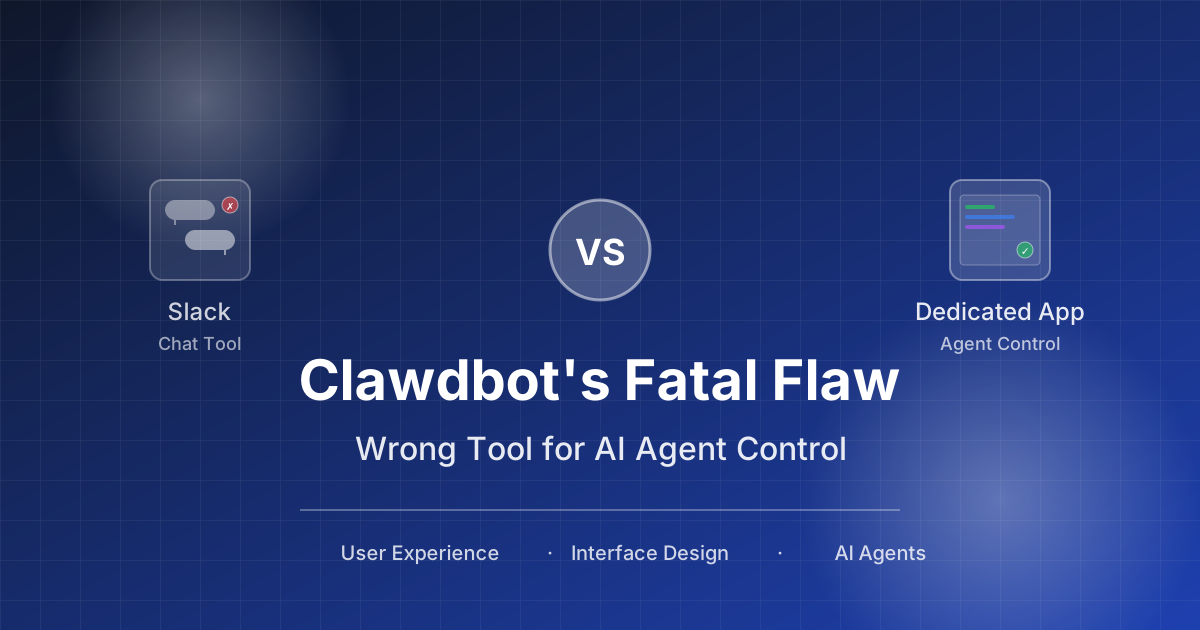
Stop Cramming AI Assistants into Chat Boxes: Clawdbot Picked the Wrong Battlefield
Clawdbot is convenient, but putting it inside Slack or Discord was the wrong design choice from day one. Chat tools are not for operating tasks, and AI isn't for chatting.

Grok Bot and Hermes Bot: one person finally gets a think tank and a secretariat
Grok Bot now ships with Cursor Pro+. Hermes Bot runs on a VPS. They are not smarter chat boxes. The think tank advises, the secretariat executes, and you still make the call.