

Mastra
Mastra is an open-source TypeScript framework for building AI agents and agentic applications. The core framework is free and Apache-2.0 licensed (with a separate commercial license for ee/ enterprise modules), and the GitHub repo mastra-ai/mastra showed 27,437 stars when we checked on 2026-08-25. It is popular on social feeds as a fast way to ship agents, workflows, RAG, and evaluations without leaving the TypeScript ecosystem.
Key Features
- Agents: Combine an LLM with tools, memory, and instructions in one primitive, with streaming and structured output.
- Workflows: Deterministic, graph-based orchestration for multi-step pipelines where you control the order of execution.
- RAG: Built-in retrieval, with vector store integrations and reranking for grounded answers.
- Memory: Working memory and long-term memory, including the Observational Memory pattern referenced widely in community posts.
- MCP support: Model Context Protocol servers and clients work out of the box, so you can plug in external tools.
- Eval and observability: Built-in evaluation harness plus metrics, logs, and traces that you can view in the hosted platform.
Use Cases
- Customer-facing agents: Agents that act inside your own product and return complete deliverables.
- Internal agents: Bots in Slack or other internal systems that summarize, triage, and automate.
- Developer platforms: Let other product teams build agents on top of your primitives.
- Prototyping to production: Teams that want one TypeScript codebase for both experiments and deployment.
Pricing
The framework is open source and free. mastra.ai/pricing offers a hosted platform with the following plans (checked 2026-08-25):
| Plan | Price | Included |
|---|---|---|
| Starter | $0/month | 100K observability events, 24 CPU hours, 15-day retention |
| Teams | $250/month | 1M events, 250 CPU hours, 6-month retention, SSO and SOC 2 docs |
| Enterprise | Custom | Custom volume, RBAC, audit logs, SLA, dedicated engineer |
Usage-based add-ons (events, CPU time, memory tokens, retrieval storage) apply beyond plan limits. Persistent 24/7 server deployments are a $100/project add-on.
Advantages & Unique Selling Points
Compared to competitors:
- TypeScript native: End-to-end types from agent definition to tools, which fits teams already on Node.
- Everything in one repo: Agents, workflows, RAG, memory, eval, and deployment are first-party, so you do not stitch five libraries together.
- MCP first: Native Model Context Protocol support makes the growing MCP tool ecosystem immediately usable.
What makes it stand out: it treats observability and evaluation as core features, not afterthoughts, which is why community posts compare it favorably to stitching raw LangChain calls.
Getting Started
Quick Start Guide
- Scaffold:
npm create mastra@latestand follow the CLI prompts. - Build an agent: Give it a model, tools, and instructions, then stream responses.
- Add memory or RAG: Wire in long-term memory or a vector store for grounded answers.
- Deploy: Push to Mastra Server (self-hosted) or the hosted platform and watch traces.
Integration
Integrates with 100+ LLM providers, OpenAI-compatible endpoints, vector databases (including LibSQL/Postgres), and MCP servers.
Frequently Asked Questions
Is Mastra free?
The framework is open source and free. The hosted platform has a $0 Starter tier and paid Teams/Enterprise tiers.
What license is it under?
Core is Apache-2.0; ee/ enterprise modules are under a separate commercial license (see LICENSE.md in the repo).
Does it support MCP?
Yes, MCP servers and clients are supported out of the box.
Alternatives
If Mastra is not the right fit, consider these alternatives:
- LangGraph: Lower-level graph runtime from the LangChain ecosystem.
- LangChain: Broader ecosystem with more integrations.
- Google ADK: Google's agent development kit.
- DeepSeek Harness: A plugin-based runtime from DeepSeek.
Tips & Best Practices
- Start with a workflow before reaching for free-form agents when the task is a fixed pipeline.
- Use built-in eval early; it is cheaper to catch regressions on a small set than to re-run a big harness.
- Watch observability events on the free tier, since overage is metered per 100K events.
Comments
No comments yet. Be the first to comment!
Related Tools


Related Insights

Anthropic Subagent: The Multi-Agent Architecture Revolution
Deep dive into Anthropic multi-agent architecture design. Learn how Subagents break through context window limitations, achieve 90% performance improvements, and real-world applications in Claude Code.
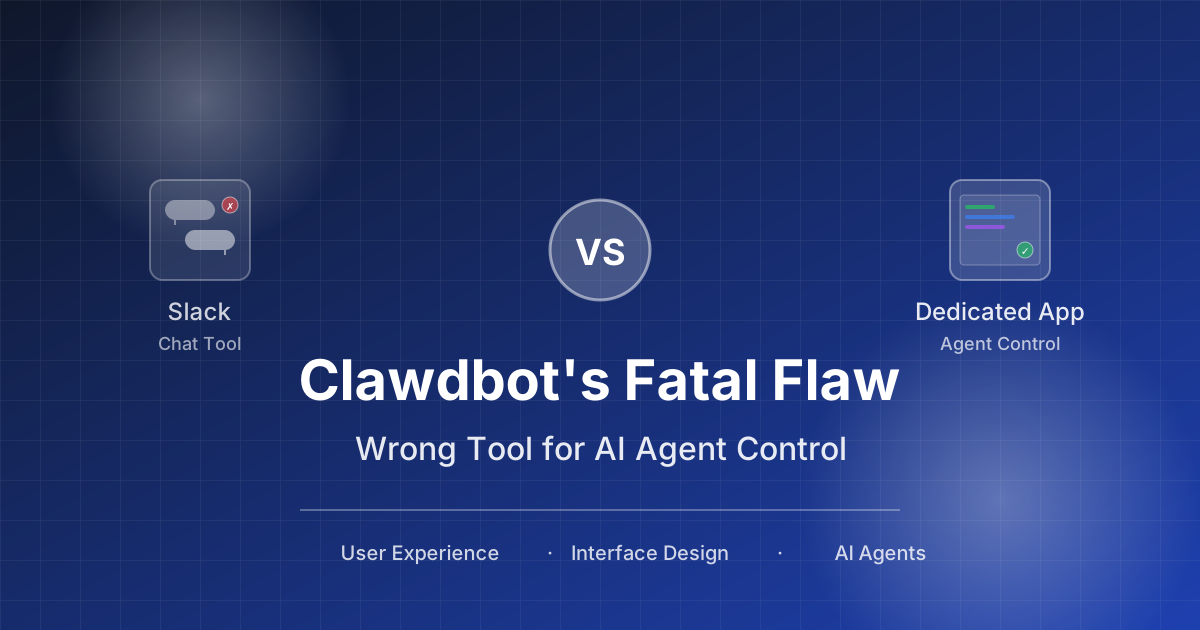
Stop Cramming AI Assistants into Chat Boxes: Clawdbot Picked the Wrong Battlefield
Clawdbot is convenient, but putting it inside Slack or Discord was the wrong design choice from day one. Chat tools are not for operating tasks, and AI isn't for chatting.

Grok Bot and Hermes Bot: one person finally gets a think tank and a secretariat
Grok Bot now ships with Cursor Pro+. Hermes Bot runs on a VPS. They are not smarter chat boxes. The think tank advises, the secretariat executes, and you still make the call.