
Claude Security
Claude Security is Anthropic's code security scanning service for Claude Enterprise. On August 21, 2026, Anthropic announced that scans now run on Claude Mythos 5, its most capable security model, in public beta for all Claude Enterprise customers. You point it at a GitHub repository and Mythos traces how data flows across files, reasons about how components interact, and returns findings with a CWE category, confidence and severity ratings, and a suggested fix. No separate model access is required.
Key Features
- Deep cross-file analysis: Mythos traces data flow across files instead of checking lines in isolation, catching vulnerabilities that surface only when multiple components interact.
- CWE-tagged findings: Every result comes back with a CWE category, a confidence score, a severity rating, and a concrete remediation suggestion.
- No model access needed: Enterprise teams do not provision or pay for Mythos separately; scans are available through Claude Security in the Claude Enterprise product.
- GitHub repo integration: Point Claude Security at a repository and get a security review without moving your code to another tool.
- Public beta for all Enterprise customers: Previously restricted to approved partners, Mythos-backed scanning is now generally offered to the whole Claude Enterprise base.
Use Cases
Who Should Use This Tool?
- Security teams: Get a first-pass, model-powered review of a codebase before or between human audits.
- Engineering leads: Run scans on open-source dependencies and internal monorepos to prioritize fixes by severity.
- Enterprise developers: Catch injection, data-flow, and component-interaction issues early without changing the coding workflow.
Problems It Solves
- Slow manual triage: Model-driven scanning triages findings and ranks them before a human looks.
- Cross-file blind spots: Traditional scanners miss bugs that only appear when files interact; Mythos reasons across the whole repo.
- Missing remediation guidance: Findings ship with suggested fixes, not just a description.
Pricing
Claude Security is part of the Claude Enterprise plan. Anthropic also announced a $35 million Defender Advantage Fund to support open-source bug hunting alongside the Mythos-powered scanning launch. Check current Anthropic enterprise pricing for the exact plan tier.
Advantages & Unique Selling Points
- Frontier security model: Claude Mythos 5 is Anthropic's most capable security model, previously gated behind the restricted Project Glasswing program.
- No separate model access: Unlike running a security model yourself, Enterprise customers get the capability through the product.
- Fix-oriented output: Findings include CWE category, confidence, severity, and remediation, so results are actionable in one pass.
Getting Started
Quick Start Guide
- Verify eligibility: Confirm your organization is on a Claude Enterprise plan with Claude Security enabled.
- Connect a repository: Add a GitHub repo from the Claude Enterprise admin flow.
- Run a scan: Trigger a scan through the Claude Security interface; Mythos analyzes the repo.
- Review findings: Triage by severity, read the CWE category and confidence, then apply the suggested fix.
Integration
Integrates with:
- Claude Enterprise platform
- GitHub repositories
- Claude Code workflows for acting on suggested fixes
Frequently Asked Questions
Do I need separate access to Claude Mythos 5?
No. The announcement explicitly states scans run on Mythos 5 with no separate model access needed; the capability ships inside Claude Security.
Is this generally available?
It launched as a public beta for all Claude Enterprise customers on August 21, 2026, after being limited to approved partners.
Does it fix the code itself?
It produces a suggested fix per finding; teams review and apply changes, typically via their existing coding agent workflow.
How does it differ from a SAST scanner?
SAST tools analyze syntax and patterns; Mythos reasons about data flow and component interaction across files, which catches interaction-level bugs that pattern matching misses.
Alternatives
- Garak: open-source LLM red-teaming and assessment kit, useful for testing model and agent security rather than codebases.
- Claude Code: Anthropic's agentic coding tool, useful when you want to apply and verify fixes yourself.
- Claude Fable 5: the broadly available Mythos-class model for general coding and agentic work.
Tips & Best Practices
- Pair with human review: Use scans as a triage layer, then let a security engineer confirm the top-severity findings.
- Scan dependencies too: Run the scanner over vendored or open-source components where interaction bugs hide.
- Track the fund: The Defender Advantage Fund can offset costs of community bug research around open-source projects.
Comments
No comments yet. Be the first to comment!
Related Tools


Related Insights

Anthropic Subagent: The Multi-Agent Architecture Revolution
Deep dive into Anthropic multi-agent architecture design. Learn how Subagents break through context window limitations, achieve 90% performance improvements, and real-world applications in Claude Code.
Complete Guide to Claude Skills - 10 Essential Skills Explained
Deep dive into Claude Skills extension mechanism, detailed introduction to ten core skills and Obsidian integration to help you build an efficient AI workflow
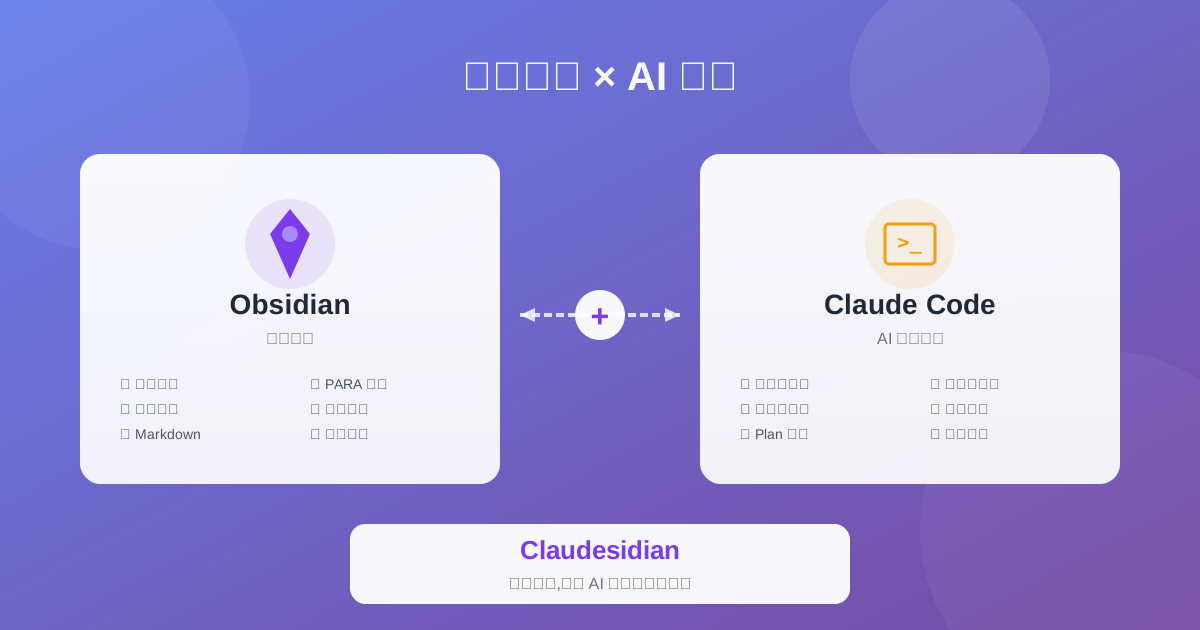
Claudesidian: Transform Obsidian into an AI-Powered Second Brain
Discover Claudesidian, an open-source project that perfectly integrates Obsidian with Claude Code. Built-in PARA method, custom commands, and automated workflows for a complete idea-to-implementation solution.