
Claude Fable 5 is Anthropic's most capable model ever made generally available, launched June 9, 2026. It is a Mythos-class model wrapped in safety classifiers, giving the public access to capabilities that previously lived behind the restricted Project Glasswing program. Fable 5 excels at software engineering, knowledge work, vision, and long-horizon agentic tasks, and it can work autonomously for days at a time in harnesses like Claude Code. High-risk queries in cybersecurity, biology, chemistry, and distillation are routed to Claude Opus 4.8 instead, keeping the safest-possible release surface.
Core Features
- Mythos-class intelligence: State of the art on nearly all tested benchmarks, with the lead growing as tasks get longer and more complex.
- Safeguarded by design: Classifiers route cyber, bio, and chemistry queries to Opus 4.8; over 95% of sessions run entirely on Fable 5.
- Days-long autonomy: Runs in agent harnesses like Claude Code for multi-stage, asynchronous work with subagent delegation.
- Frontier vision: State of the art on vision tasks, including rebuilding a web app's source code from screenshots alone.
- Persistent memory: File-based memory and self-written notes improve long-running task performance dramatically.
Model Specifications
| Specification | Claude Fable 5 |
|---|---|
| Context | 1M tokens (default) |
| Max output | 128,000 tokens |
| Thinking | Always on; control depth via effort parameter |
| API model | claude-fable-5 |
| Restricted tier | Claude Mythos 5 (same model, safeguards lifted, limited access) |
Pricing
| Item | Price per 1M tokens |
|---|---|
| Input | $10.00 |
| Output | $50.00 |
Available on the Claude API, Amazon Bedrock, Google Cloud Vertex AI, and Microsoft Foundry. Subscription access (Pro, Max, Team, Enterprise) rolled out in stages from June 2026.
Benchmark Highlights
- FrontierCode Diamond: 29.3% versus 13.4% for Claude Opus 4.8 and 5.7% for GPT-5.5 on high-quality agentic coding.
- GDPval-AA: 1,932 points, versus 1,890 for Opus 4.8.
- Coding at scale: Stripe reported a codebase-wide migration in a 50-million-line Ruby codebase in a day that would otherwise take a team over two months.
Use Cases
- Large migrations and refactors: Codebase-wide work that previously needed dedicated engineering teams.
- Multi-day autonomous agents: Sessions spanning days in Claude Code or Claude Managed Agents with subagent delegation.
- Knowledge work: Document-heavy finance, legal, analytics, and architecture tasks with chart and table interpretation.
- Vision-driven development: Rebuilding interfaces from screenshots and validating output against designs.
Advantages
- Capability frontier with guardrails: Mythos-class performance without unrestricted access to the riskiest capabilities.
- Long-horizon reliability: The longest sustained autonomy of any Anthropic model, with persistent memory.
- Token efficiency: Highest FrontierCode scores even at medium effort, cutting cost per completed task.
Tips
- Plan for fallbacks: If your work touches cyber, bio, or chemistry, responses may silently route to Opus 4.8; build around that behavior.
- Give it memory: File-based notes materially improve multi-session performance, more than for earlier models.
- Use effort controls: Reduce thinking depth for routine tasks while keeping frontier quality on hard ones.
Conclusion
Claude Fable 5 brings Mythos-class capability to general use for the first time, setting the standard for agentic coding, vision, and long-running autonomous work. If your hardest problems involve sustained reasoning over large codebases, it is the model to test first.
Alternatives
- GPT-5.6 Sol: OpenAI's frontier flagship with a comparable context window and reasoning depth.
- GLM-5.3: Open-weight coding leader approaching Fable-level agent performance.
- Claude Opus 5: Near-Fable intelligence at Opus pricing when cost matters more.
Comments
No comments yet. Be the first to comment!
Related Tools

Related Insights

Anthropic Subagent: The Multi-Agent Architecture Revolution
Deep dive into Anthropic multi-agent architecture design. Learn how Subagents break through context window limitations, achieve 90% performance improvements, and real-world applications in Claude Code.
Complete Guide to Claude Skills - 10 Essential Skills Explained
Deep dive into Claude Skills extension mechanism, detailed introduction to ten core skills and Obsidian integration to help you build an efficient AI workflow
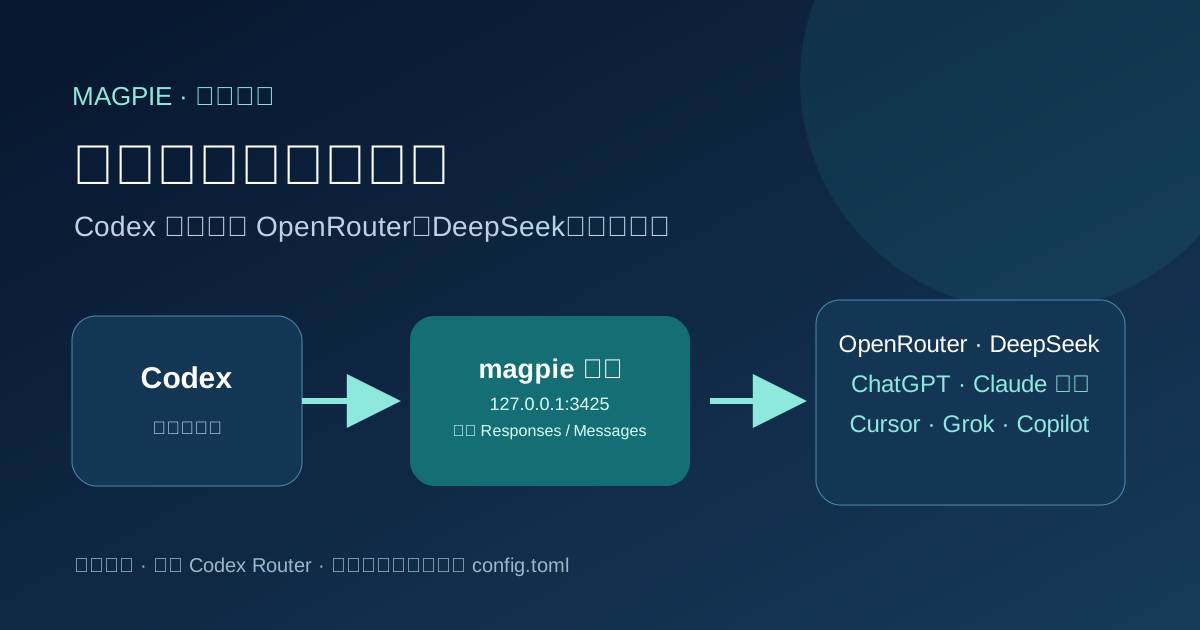
Codex on any model: magpie makes Codex Router unnecessary
magpie is a free, open-source menu bar app that runs a local gateway and puts OpenRouter, DeepSeek and your ChatGPT, Claude, Cursor, Grok and Copilot subscriptions right into Codex's own model picker, with one click and no Codex Router.