

ToolJet is an open-source platform for building internal tools, and the AI pivot is now the centre of the product rather than a bolt-on. The first-party repository was created on 2021-03-30 and GitHub listed 40,961 stars and 5,449 forks on 2026-09-22, with the latest LTS release (v3.20.230-lts) tagged on 2026-09-18. It is licensed AGPL-3.0, which is permissive to read and self-host but carries network copyleft obligations if you modify it and expose it as a service. ToolJet sits in the same space as Bolt but targets internal operations software rather than throwaway prototypes.
What Ships in the Box
| Module | What it does |
|---|---|
| App Builder | Drag-and-drop front ends for internal applications, or generate one from a prompt |
| Workflow Automation | Orchestrate multi-step business processes with retries and scheduling |
| Agent Builder | Wire AI agents into a process instead of scripting each step |
| ToolJet Database | A no-code data layer built on PostgreSQL |
| ToolJet MCP | Connect Claude Code, Codex, or Cursor to build and modify apps |
The platform is meant to cover the whole path: build the UI, connect the data source (REST, PostgreSQL, Sheets, Supabase, and others), keep credentials server-side rather than in the browser, and manage promotion across environments.
The MCP Angle
The interesting recent move is ToolJet MCP, which exposes ToolJet's app model to coding agents. Instead of pasting generated React into an internal repo, you point Claude Code, Codex, or Cursor at ToolJet and let the agent create or edit an app that already has authentication, permissions, and a deployment path attached. That is a meaningfully different bet from the usual "AI writes the front end and you wire it up later" flow, because the governance layer is what the agent is generating into.
Pricing
Published list prices per builder per month, checked on 2026-09-22:
| Plan | Price | Notes |
|---|---|---|
| Free | $0 | 2 builders, 100 AI credits per month, community support |
| Basic | $23 | 2,000 AI credits per builder, 2 apps, 50 end users |
| Pro | $79 | 5 apps, 50 end users, custom styling, version control |
| Team | $199 | Unlimited apps, 100 end users, SSO, custom user groups |
Self-hosting has its own Free and Team tiers, and AI credits can be topped up pay-as-you-go beyond the bundled allowance. Annual billing is advertised at a 20% discount.
Deployment and Governance
ToolJet runs from Docker and Kubernetes for self-hosted installs, with a multi-environment promotion path across dev, staging, and production. Compliance claims on the vendor's own site cover SOC 2, GDPR, and ISO. If your organisation cannot send internal data to an app builder's cloud, the self-hosted path is the reason to look here, and it is also the path where the AGPL terms actually matter.
Limitations
- AGPL-3.0 is a real constraint. Offering a modified ToolJet as a network service triggers copyleft obligations that teams evaluating "open source" casually often miss.
- No-code ceilings still exist. Highly custom interactions eventually want raw code, and the escape hatch is thinner than a pure framework.
- AI credits meter the interesting features. Agent Builder and prompt-driven generation consume credits, so costs scale with use rather than with seats alone.
- Vendor positioning, not neutral review. Feature and compliance claims here come from ToolJet's own material.
FAQ
Is ToolJet free?
The open-source edition is AGPL-3.0 and self-hostable at no licence cost. Cloud and licensed self-hosted plans start at $0 for 2 builders and step up to $23, $79, and $199 per builder per month.
Can I use it with Claude Code or Codex?
Yes. ToolJet MCP is the supported integration for connecting those agents to the app model.
Is it a replacement for Retool?
It occupies the same category: internal tools and admin panels. The difference that matters is that you can run ToolJet yourself and read the source.
Alternatives
- Bolt: better when you want a quick browser prototype than a governed internal app.
- Dify: stronger on the LLM application side, weaker on internal CRUD tooling.
- Replit Agent: a hosted route if you would rather not run infrastructure at all.
Conclusion
ToolJet is a mature internal-tooling platform that has repositioned around AI app generation and agent access, and it is still genuinely self-hostable. The decision is mostly about governance: if internal apps need to stay inside your perimeter, and you are comfortable with AGPL-3.0, it is a strong fit. If you want a throwaway prototype, lighter tools will get you there faster.
Comments
No comments yet. Be the first to comment!
Related Tools


Related Insights
Stop Cramming AI Assistants into Chat Boxes: Clawdbot Picked the Wrong Battlefield
Clawdbot is convenient, but putting it inside Slack or Discord was the wrong design choice from day one. Chat tools are not for operating tasks, and AI isn't for chatting.
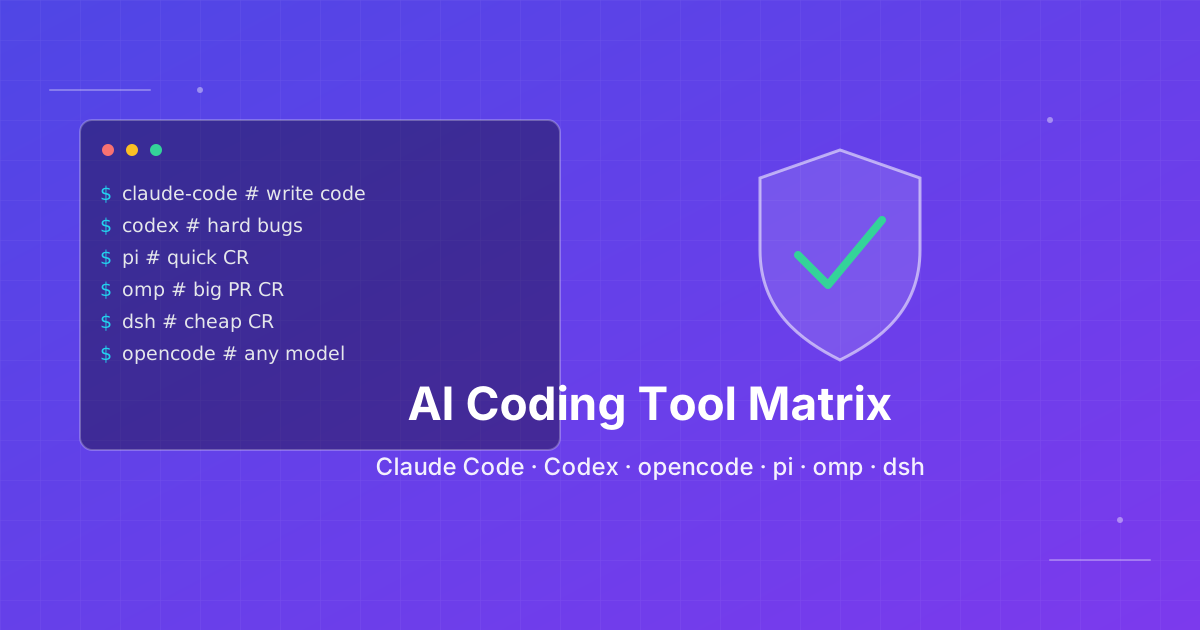
Seven AI Coding CLIs, Six Months: No Matter How Strong the Model, Work Needs Supervision
Claude Code, Codex, opencode, pi, omp and DeepSeek Harness all have personalities. After six months of deep use I run a division of labor: pi for the fastest cheapest reviews, omp for complex PRs, DeepSeek Harness on V4 Flash for high-frequency low-cost review, and Claude Code, Qoder and Cursor for writing. No matter how strong the model, work needs supervision — ideally from an independent third party.
The Twilight of Low-Code Platforms: Why Claude Agent SDK Will Make Dify History
A deep dive from first principles of large language models on why Claude Agent SDK will replace Dify. Exploring why describing processes in natural language is more aligned with human primitive behavior patterns, and why this is the inevitable choice in the AI era.