

Upstage: Solar Mini 4
Upstage released Solar Mini 4 on 2026-09-22 as solar-mini4-260922, the compact tier of its Solar family. The pitch is specific rather than generic: a 35B mixture-of-experts model with only 3B active parameters, aimed at agent workloads where you call the model constantly and the bill scales with frequency. It is a notable step up in context for a small model, and it is the first Solar release covered on this site.
Model Specifications
| Specification | Solar Mini 4 |
|---|---|
| Architecture | Mixture of experts |
| Parameters | 35B total, 3B active |
| Context window | 512K tokens |
| Max output | 128K tokens |
| Input | Text |
| Output | Text |
| Training data cutoff | February 2026 |
| Version | solar-mini4-260922, alias solar-mini4 |
| Released | 2026-09-22 |
Upstage publishes the active-parameter count rather than hiding behind total size, and 3B active is the number that matters when you are estimating serving cost and latency. The model card also states that API input data is not used for training and is not stored unless required for service delivery.
Capabilities
- Reasoning mode: available and toggleable, which matters for a small model because you can decide per call whether the extra tokens are worth it.
- Tool calling and structured outputs: both are listed as supported, which is what makes the agent framing credible rather than aspirational.
- Trilingual strength: Upstage describes fluent Korean alongside strong English and Japanese. That combination is the company's home market advantage, and it is unusual to see all three treated as first-class rather than English plus translations.
- Long context at this size: 512K tokens with up to 128K output is a large window for a 3B-active model.
The natural fit is high-frequency agent work: routing decisions, document classification, structured extraction, and long-document reasoning where you would rather run many cheap calls than one expensive one.
Pricing
Upstage lists these rates, with a launch promotion running until 2026-10-23 UTC.
| Item | List price | Promotion |
|---|---|---|
| Input | $0.10 / 1M tokens | $0.05 / 1M tokens |
| Cached input | $0.01 / 1M tokens | $0.005 / 1M tokens |
| Output | $0.40 / 1M tokens | $0.20 / 1M tokens |
The cached input price is the one to design around. At $0.01 per million tokens for cache reads, an agent that reuses a long system prompt or a stable document prefix pays almost nothing for the repeated portion, which is exactly the pattern this class of model is built for.
How It Compares
Upstage's own framing against its sibling is straightforward: Solar Pro 4 is the agentic LLM for multi-step work, terminal tasks, and long-document reasoning, while Solar Mini is the lightweight model for fast, efficient use. Solar Mini 4 sits between them, which is a sensible place for a 3B-active model with a 512K window.
The relevant external comparison is the same one every small model faces in 2026: whether a compact open-weight model served on your own hardware beats a cheap hosted API once you count engineering time. If you need multilingual Korean or Japanese production support with an SLA, the hosted route usually wins.
Getting Started
- Create a key in the Upstage Console and confirm your account has access to the
solar-mini4alias. - Start with the Playground to sanity-check Korean, English, and Japanese quality on your own content rather than on sample text.
- Test with reasoning mode both on and off, then route by task type. Turning it off on simple extraction is where the cost advantage shows up.
- Structure your prompts so the stable prefix sits at the front and gets cached, since the cache rate is an order of magnitude below the input rate.
Limitations
- 3B active parameters means limited headroom. It is not a frontier model, and hard multi-step reasoning should go elsewhere.
- Text only. No image, audio, or video input.
- February 2026 training cutoff. Facts after that date need retrieval rather than recall.
- No independent index score located. Upstage's comparison tools are self-reported, and no third-party score was found for Solar Mini 4 at the time of writing.
- Promotional pricing ends 2026-10-23. Model your costs on the list price.
FAQ
Is Solar Mini 4 open weights?
Upstage ships Solar through its own API, Playground, on-premises deployment, and cloud marketplaces rather than as a public checkpoint download. Confirm the licensing terms for the on-premises route before you plan around self-hosting.
What is the difference from Solar Pro 4?
Solar Pro 4 is the larger agentic model for multi-step and long-document work. Solar Mini 4 trades capability for a much lower price and a 3B active footprint.
Which languages does it handle well?
Upstage positions Korean as fluent, with strong English and Japanese. For other languages, test before committing.
Alternatives
- Mercury 2.5: faster, similar price band, weaker on context and multilingual depth.
- Qwen3.8-Flash-Next: higher-throughput option with broader language coverage.
- Cohere Command A+: enterprise-focused alternative with 48 languages and open weights, at a much higher parameter count.
Conclusion
Solar Mini 4 is a well-specified small model: 3B active parameters, a 512K window, tool calling, structured outputs, and a cached-input rate that makes agent loops affordable. Upstage is not pretending it is a frontier model, and the trilingual Korean, English, and Japanese positioning is a real differentiator for teams shipping into those markets. Evaluate it on your own Korean and Japanese content, and design the prompt prefix around the cache price.
Comments
No comments yet. Be the first to comment!
Related Tools


Related Insights

Anthropic Subagent: The Multi-Agent Architecture Revolution
Deep dive into Anthropic multi-agent architecture design. Learn how Subagents break through context window limitations, achieve 90% performance improvements, and real-world applications in Claude Code.
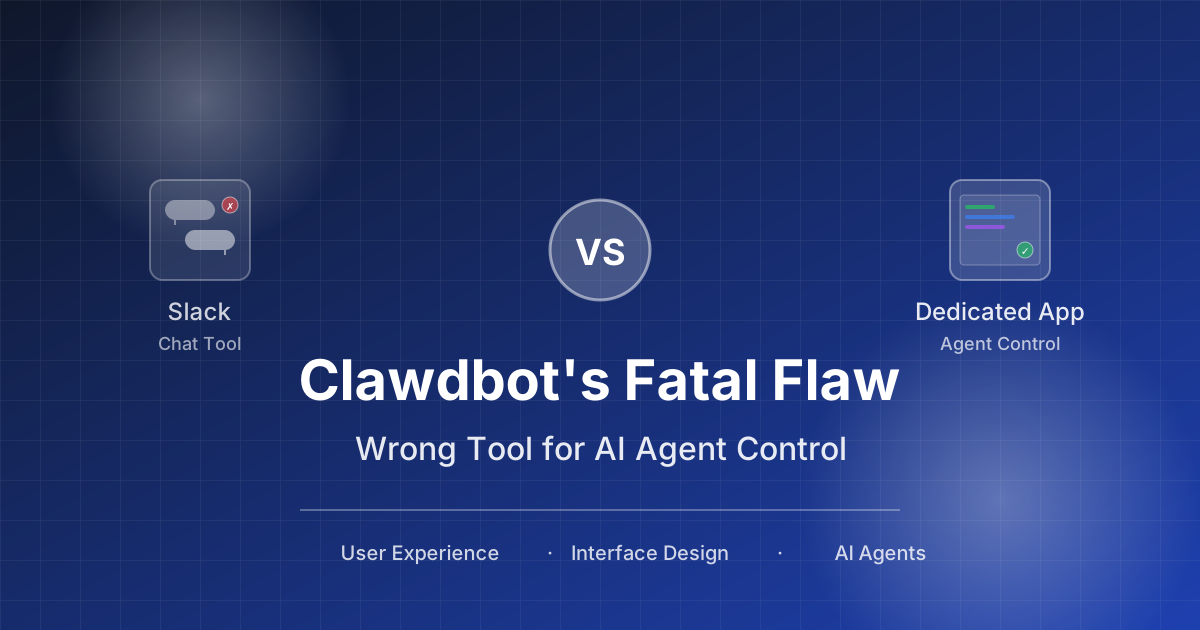
Stop Cramming AI Assistants into Chat Boxes: Clawdbot Picked the Wrong Battlefield
Clawdbot is convenient, but putting it inside Slack or Discord was the wrong design choice from day one. Chat tools are not for operating tasks, and AI isn't for chatting.

Grok Bot and Hermes Bot: one person finally gets a think tank and a secretariat
Grok Bot now ships with Cursor Pro+. Hermes Bot runs on a VPS. They are not smarter chat boxes. The think tank advises, the secretariat executes, and you still make the call.