
DeerFlow is ByteDance's open-source SuperAgent harness, built on LangGraph and LangChain, that researches, codes, and creates across long-horizon tasks lasting from minutes to hours. Version 2.0, released in February 2026, was a ground-up rewrite that shot to the top of GitHub Trending. It orchestrates sub-agents, memory, sandboxes, skills, and tools through a message gateway, and its 79,000+ GitHub stars make it one of the most-starred agent frameworks in the ecosystem.
Key Features
- Sub-agent orchestration: Coordinator, planner, researcher, and reporter agents cooperate on complex workflows.
- AIO Sandbox: A Docker-based isolated environment with a browser, shell, file system, MCP servers, and a VSCode server.
- Long and short-term memory: Persistent context carries across sessions and long-running tasks.
- Extensible skills: Plug-in architecture with SKILL.md definitions that agents load on demand.
- Multi-model support: Works with Doubao, DeepSeek, OpenAI, Gemini, or local Ollama models.
- Message gateway: Integrates IM channels like Slack, Telegram, Discord, Feishu, and WeChat.
- Task decomposition: Automatic planning with parallel or sequential sub-task execution.
- Claude Code integration: Can leverage Claude Code as a coding engine inside the harness.
Use Cases
Who Should Use This Tool?
- Agent framework builders: Teams wanting a production-grade, self-hostable harness without lock-in to a single vendor.
- Research automation: Long-horizon tasks like literature review, data collection, and report generation.
- Enterprise R&D: ByteDance's backing and MIT license make it a safe foundation for internal agent platforms.
Problems It Solves
- Long-horizon fragility: Memory and sub-agent orchestration keep multi-hour tasks on track.
- Sandboxing: The AIO Sandbox gives agents a browser and shell without touching your machine.
- Vendor lock-in: Multi-model support means you can swap backends as pricing and quality shift.
Pricing
| Component | Cost | Features |
|---|---|---|
| Software | $0 (MIT License) | Full harness, self-hosted, no usage limits |
| Models | Bring your own API key | Doubao, DeepSeek, OpenAI, Gemini, or Ollama |
DeerFlow is completely free and open source. You pay only for the model APIs you connect and the infrastructure you choose to run it on.
Advantages & Unique Selling Points
Compared to Competitors:
- Scale of community: ~80,000 stars is among the highest for any agent framework.
- Production maturity: 1,500+ commits, 40+ contributors, and a ground-up 2.0 rewrite.
- Sandbox depth: The AIO Sandbox bundles browser, shell, files, and MCP in one Docker image.
What Makes It Stand Out:
- Built on the battle-tested LangGraph/LangChain stack rather than a new runtime.
- IM-channel message gateway (Slack, Telegram, Feishu, WeChat) is rare in open-source harnesses.
- ByteDance engineering credibility behind an MIT-licensed project.
User Reviews
DeerFlow 2.0's launch put it at the top of GitHub Trending, and community reception centers on its completeness: memory, sandboxing, skills, and sub-agents all in one package. Developers frequently note the value of being able to inspect and extend every layer, since it is built on LangGraph rather than a proprietary runtime. The 4.9K stars gained in the last month reflect sustained interest beyond the initial spike.
Getting Started
Quick Start Guide
- Clone:
git clone https://github.com/bytedance/deer-flowand follow the setup docs. - Configure models: Add API keys for Doubao, DeepSeek, OpenAI, Gemini, or point it at local Ollama.
- Start the sandbox: Spin up the Docker AIO Sandbox with browser and shell access.
- Describe a task: Give the harness a research or coding goal and let the sub-agents plan and execute.
Integration
- Orchestration: LangGraph and LangChain.
- Models: Doubao, DeepSeek, OpenAI, Gemini, Ollama.
- Channels: Slack, Telegram, Discord, Feishu, WeChat via the message gateway.
Frequently Asked Questions
Is DeerFlow free?
Yes. It is MIT-licensed open source; you pay only for model APIs and your own infrastructure.
Does it need a GPU or special hardware?
No. It orchestrates remote model APIs; the Docker sandbox runs on any machine with Docker installed.
Can I use it with Claude Code?
Yes. DeerFlow 2.0 includes Claude Code integration as one of its coding engines.
How does it compare to CrewAI?
Both orchestrate multiple agents, but DeerFlow adds memory, sandboxing, and a message gateway while CrewAI focuses on role-based team workflows.
Alternatives
If DeerFlow isn't the right fit, consider these alternatives:
- LangGraph: The lower-level orchestration framework DeerFlow itself is built on, for maximum control.
- OpenAI Agents SDK: OpenAI's lightweight multi-agent framework.
- CrewAI: Role-based agent teams with a focus on simplicity.
Tips & Best Practices
- Start with the sandbox: Let agents browse and run code in the Docker sandbox before granting any host access.
- Use the message gateway early: Connecting Slack or Feishu makes long tasks observable without watching logs.
- Compose skills: Package recurring capabilities as SKILL.md files so agents can load them on demand.
Comments
No comments yet. Be the first to comment!
Related Tools


Related Insights

Anthropic Subagent: The Multi-Agent Architecture Revolution
Deep dive into Anthropic multi-agent architecture design. Learn how Subagents break through context window limitations, achieve 90% performance improvements, and real-world applications in Claude Code.
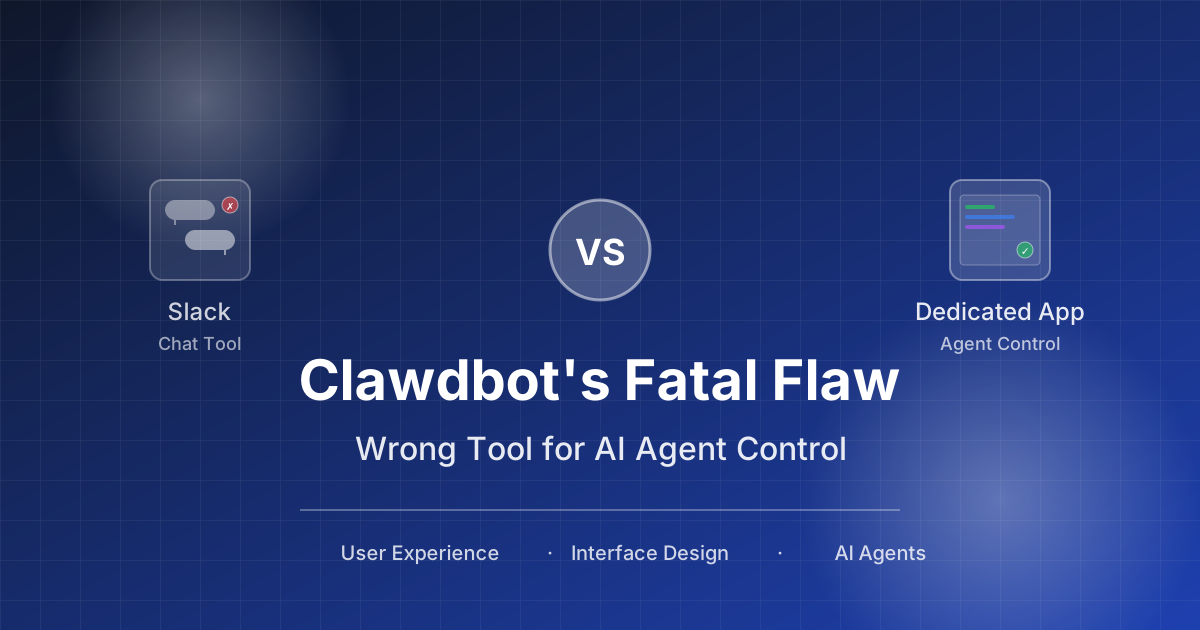
Stop Cramming AI Assistants into Chat Boxes: Clawdbot Picked the Wrong Battlefield
Clawdbot is convenient, but putting it inside Slack or Discord was the wrong design choice from day one. Chat tools are not for operating tasks, and AI isn't for chatting.

Grok Bot and Hermes Bot: one person finally gets a think tank and a secretariat
Grok Bot now ships with Cursor Pro+. Hermes Bot runs on a VPS. They are not smarter chat boxes. The think tank advises, the secretariat executes, and you still make the call.