

Modal
Modal is a Python-first serverless compute platform. The product that matters for this catalog is the Sandbox API: define an image, create a sandbox, then exec untrusted agent commands inside it. The same account also runs functions, cron, notebooks, and GPUs.
This page used to lead with a $355M Series C, $4.65B valuation, ~$300M ARR, and "1B+ sandboxes" as verified facts first-party metrics.
Key Features
- Sandbox API:
Sandbox.create(.)thensb.exec(.). Docs also describe filesystem and memory snapshots. - Compute as code:
modal.App, images, functions, and sandboxes live in Python. - Scale to zero: Idle compute is billed at $0. Workspace storage is not free. The pricing page lists $0.000347 / GiB-month for workspace storage.
- GPU menu: Live price table includes T4, L4, A10, L40S, A100-40GB, A100-80GB, H100, H200, B200, and a $0.049 / s B300. Confirm the SKU before you quote a GPU.
- Not the only agent sandbox: Compare E2B if you want Firecracker microVMs instead of Modal's isolation story.
Use Cases
- Agent tool loops that need a container and maybe a GPU in the same bill.
- Teams already running Modal functions who do not want a second sandbox vendor.
- Burst jobs that should drop to zero between runs.
Limitation: Modal is managed SaaS. The docs we used do not offer self-host or BYOC. Isolation is Modal's container/sandbox stack, not E2B's Firecracker guest kernel. Do not call gVisor or "1B sandboxes" a current first-party claim unless you re-verify it.
Pricing
Seat and compute from modal.com/pricing on 2026-08-17. Compute rates below are on-demand / reserved.
| Plan | Workspace / month | Credits in plan | Compute discount | Notes |
|---|---|---|---|---|
| Starter | $0 | $30 / month free credits | none | 3 seats. $0.000347 / GiB-month storage after the free compute credits |
| Team | $250 | $100 / month included | 10% reserved | 50 seats, $0.10 / extra seat-hour, HIPAA, SSO, 90-day audit |
| Enterprise | Custom | Custom | Custom reserved | Unlimited seats, 180-day audit, TAM |
Selected on-demand compute (reserved is cheaper on the same page):
| Resource | On-demand |
|---|---|
| CPU | $0.0000131 / core / s ($0.0474 / core / h) |
| Memory | $0.00000222 / GiB / s ($0.0080 / GiB / h) |
| T4 | $0.000164 / s ($0.59 / h) |
| A100-80GB | $0.000694 / s ($2.50 / h) |
| H100 | $0.001097 / s ($3.95 / h) |
| B200 | $0.001736 / s ($6.25 / h) |
Getting Started
- Read the sandbox guide.
pip install modaland authenticate.- Create an image, then
Sandbox.createandexec. - Attach a GPU only after you have read the live SKU price.
Frequently Asked Questions
Is Modal only a sandbox?
No. Sandboxes sit next to functions, cron, and GPU jobs on the same platform.
Can I self-host it?
Not from the pages we used. Treat it as SaaS.
Are the old $250 Team and $30 free-credit numbers still right?
Yes, on the 2026-08-17 pricing page. The rest of the old writeup (valuation, ARR, 1B sandboxes) is not repeated here.
Alternatives
- E2B: Firecracker microVMs purpose-built for agent exec.
- Cloudflare Computer: Edge isolates if you are already on Cloudflare.
- OpenAI Agents SDK: Agent runtime. Use Modal under it if you need the sandbox.
Tips
- Model CPU, memory, GPU, and storage as four meters. Seats are a fifth.
- Confirm reserved vs on-demand before you screenshot a GPU hour.
- Do not keep a sandbox warm "just in case". Scale to zero is the point.
Conclusion
Modal is still the Python serverless box with a first-class sandbox and a public GPU price list. Start at the sandbox guide and the pricing page, then compare E2B if you need a microVM instead of a Modal container.
Comments
No comments yet. Be the first to comment!
Related Tools


Related Insights

Anthropic Subagent: The Multi-Agent Architecture Revolution
Deep dive into Anthropic multi-agent architecture design. Learn how Subagents break through context window limitations, achieve 90% performance improvements, and real-world applications in Claude Code.
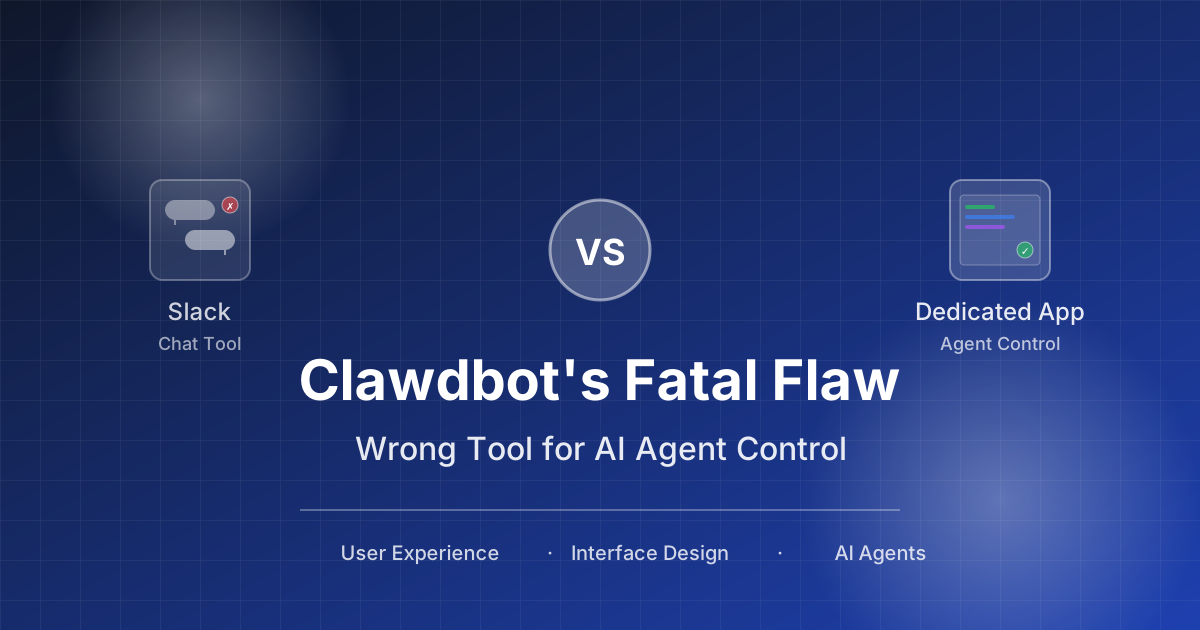
Stop Cramming AI Assistants into Chat Boxes: Clawdbot Picked the Wrong Battlefield
Clawdbot is convenient, but putting it inside Slack or Discord was the wrong design choice from day one. Chat tools are not for operating tasks, and AI isn't for chatting.

Grok Bot and Hermes Bot: one person finally gets a think tank and a secretariat
Grok Bot now ships with Cursor Pro+. Hermes Bot runs on a VPS. They are not smarter chat boxes. The think tank advises, the secretariat executes, and you still make the call.