

Trigger.dev is an open-source (Apache 2.0) platform for building and deploying AI agents and workflows in TypeScript. It runs tasks with no timeouts — surviving crashes, deploys, and idle gaps via a checkpoint-resume system — so agent runs can last minutes or hours without you managing infrastructure. Its chat.agent product turns an AI conversation into a single durable task that wakes when a message arrives and freezes when none do, having already served millions of sessions and more than 84 years of compute in production.
Key Features
- No timeouts: Tasks run as long as they take — a slow tool, a long chain, or a sub-agent thinking is just work, not a reason to fail.
- Checkpoint-resume durability: Processes are snapshotted (CRIU today, Firecracker microVMs in private beta), so a crashed run resumes exactly where it parked.
chat.agentdurable chat: One long-lived task per conversation, with durable streams that replay from the last read chunk on refresh — no re-running the model.- Retries, queues, and idempotency: Production primitives for building rock-solid agents.
- Human-in-the-loop: Pause a task until a human approves, rejects, or gives feedback — the wait is free because compute is freed.
- Built-in observability: Every turn is a span; an AI metrics dashboard tracks cost, tokens, and latency.
- Full runtime freedom: Install packages, run ffmpeg, drive a headless browser — the machine is a real Linux environment.
Use Cases
Who Should Use This Tool?
- TypeScript teams building AI agents: Durable tasks for agent loops that must survive production reality.
- Chat product builders: Multi-turn AI chat that resumes across refreshes, redeploys, and crashes.
- Developers replacing fragile serverless workflows: No timeout walls like Lambda or Vercel functions.
Problems It Solves
- Serverless timeouts: Background jobs and long agent runs that fail mid-way on traditional platforms.
- State loss: Agents that forget everything when the process dies — solved with checkpointing and durable sessions.
- Cost of waiting: Agents sitting idle for human approval or an external event no longer burn compute.
Pricing
| Plan | Price | Features |
|---|---|---|
| Free | $0 | Start free, invite your team, DEV environment runs not charged |
| Cloud | Usage-based | From $0.0000169/sec (Micro, 0.25 vCPU); $0.000025 per run |
| Self-hosted | Free (Apache 2.0) | Run the whole platform yourself |
Trigger.dev is billed as compute time when tasks are actually executing. A suspended conversation isn't running, which is why waiting for human approval is free.
Advantages & Unique Selling Points
Compared to Competitors:
- AI-native and TypeScript-first: Unlike Temporal or Vercel Workflows, it's built around AI SDK integration with end-to-end type safety.
- Checkpoint-resume over replay: Snapshots the whole VM state (CPU, memory, file system) instead of re-executing steps — faster and cheaper for long runs.
- Open source: Apache 2.0, with a self-hosting guide — no lock-in.
What Makes It Stand Out:
chat.agentmakes the API route betweenuseChatandstreamTextdisappear.- Real Linux machines (not restricted runtimes) with dedicated CPU, memory, and disk.
- One in twenty production agent runs exceeds 36 minutes — past where a request would have been cut off elsewhere.
User Reviews
Trigger.dev is widely covered in the dev-tools community — the Scaling DevTools podcast's durable-agents episode with CEO Matt Aitken, and multiple 2026 reviews ("My Long-Running AI Workflows Finally Stopped Failing") highlight how it fixes timeout-induced job failures. The chat agent launch (announced August 10, 2026, GA since July 2) drew attention for its "durable streams" design and for production customers like Arena running Agent Mode on it at scale.
Getting Started
Quick Start Guide
- Create an account: Start at cloud.trigger.dev and follow the onboarding.
- Install the SDK: Run the CLI setup command inside your project.
- Write a task: Define a
task()orchat.agent()in your codebase — standard AI SDK code. - Deploy and observe: Trigger from the dashboard, watch tracing, retries, and metrics per run.
Integration
- Vercel AI SDK (
useChatclient-side,streamTextserver-side). - Any LLM provider (OpenAI, Anthropic, and more).
- Node.js SDKs, Python scripts, ffmpeg, and browser automation.
Frequently Asked Questions
Is Trigger.dev open source?
Yes. Trigger.dev is Apache 2.0, self-hostable, and chat.agent is part of the core platform.
How is it different from AWS Lambda or Vercel functions?
Trigger.dev tasks have no timeouts and survive crashes via durable execution — serverless functions die at the platform limit.
What does "durable chat" mean?
A conversation is a session that outlives the process serving it. Refresh mid-response and the stream replays from where you stopped reading, without re-running the model.
Do I pay for idle time?
No. A suspended conversation isn't running compute, so waiting for a human approval or an overnight gap costs nothing.
Alternatives
If Trigger.dev isn't the right fit, consider these alternatives:
- n8n: No-code workflow automation with AI agent nodes.
- LangGraph: Graph-based agent orchestration framework.
- [Temporal]: The classic durable workflow engine (see the Temporal site for details).
Tips & Best Practices
- Put irreplaceable state in a database: Memory lasts the conversation, but the heap resets on crash — keep what you can't afford to lose in your DB.
- Use
onBootfor initialization: Fresh workers fireonBoot, notonChatStart— the right place forchat.localsetup. - Leverage free waits: Design flows around human-in-the-loop approvals; suspended compute costs nothing.
Comments
No comments yet. Be the first to comment!
Related Tools


Related Insights

Anthropic Subagent: The Multi-Agent Architecture Revolution
Deep dive into Anthropic multi-agent architecture design. Learn how Subagents break through context window limitations, achieve 90% performance improvements, and real-world applications in Claude Code.
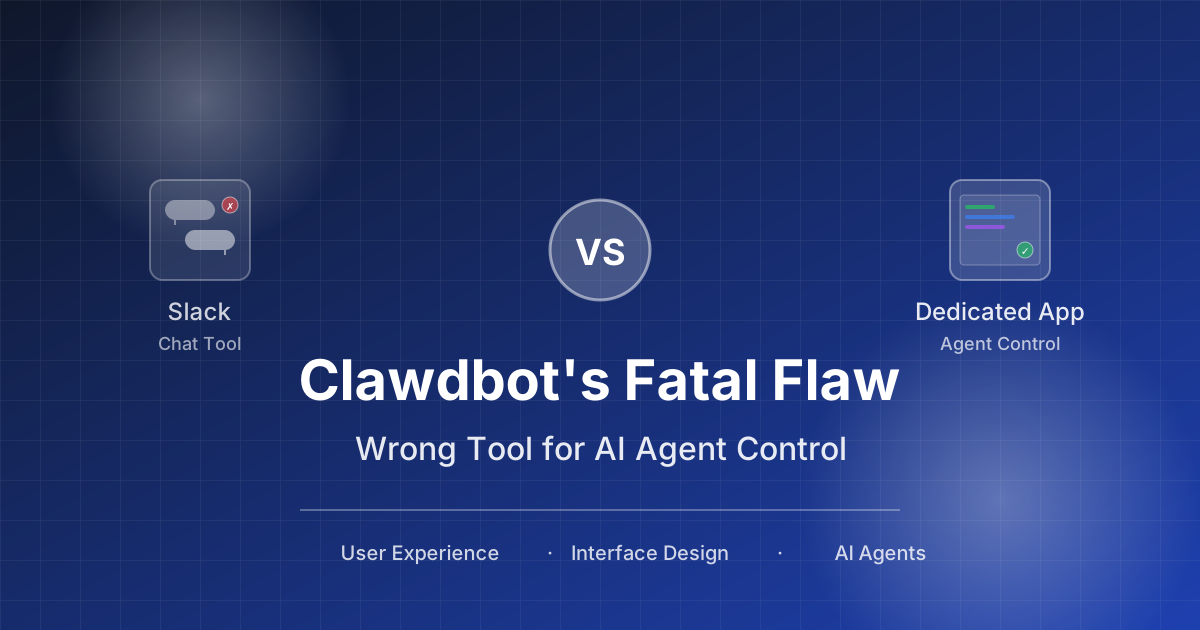
Stop Cramming AI Assistants into Chat Boxes: Clawdbot Picked the Wrong Battlefield
Clawdbot is convenient, but putting it inside Slack or Discord was the wrong design choice from day one. Chat tools are not for operating tasks, and AI isn't for chatting.

Grok Bot and Hermes Bot: one person finally gets a think tank and a secretariat
Grok Bot now ships with Cursor Pro+. Hermes Bot runs on a VPS. They are not smarter chat boxes. The think tank advises, the secretariat executes, and you still make the call.