

Zoro is a control plane for agentic spending. Rather than replacing payment networks, it evaluates intent, applies constraints, executes approved transactions across payment rails, and returns signed receipts. Its policies connect each agent payment to a task, tool, and mandate.
Key Features
- Programmable Mandates: Define revocable budgets, merchants, and expiration.
- Agent Attribution: Trace agent, task, tool, and mandate for every action.
- Cross-Rail Execution: Govern ACP, TAP, AP2, x402, and crypto wallets.
- Kill Switches: Stop an agent, session, or organization globally.
- Signed Receipts: Return an auditable record after approved execution.
- Normalized Liability: Present consistent controls across different rails.
Use Cases
Who Should Use This Tool?
- Multi-Rail Agent Platforms operating across payment protocols.
- Governance Teams requiring attribution and revocation controls.
- Enterprises standardizing agent payment policy across applications.
Problems It Solves
- Protocol fragmentation: One layer normalizes authorization and execution.
- Weak attribution: Payments remain linked to agents and tasks.
- Slow incident response: Kill switches revoke authority at several scopes.
Pricing
| Plan | Price | Features |
|---|---|---|
| SaaS | Usage-based | Authorization, execution, mandates, and signed receipts. |
| Enterprise | Contact Zoro | Organization-wide governance and cross-rail deployment. |
Advantages & Unique Selling Points
Compared to Competitors:
- Rail-neutral governance: Zoro sits above networks instead of requiring one rail.
- End-to-end control: It evaluates, executes, and records transactions.
- Granular shutdown: Revocation can target an agent, session, or organization.
What Makes It Stand Out:
- Attribution from agent through task, tool, and mandate.
- Signed receipts suitable for audit workflows.
- APIs for authorization, execution, and revocation.
User Reviews
"A single policy layer is easier to govern than separate controls for every payment protocol." Illustrative platform-architect perspective, editorially composed
"Task-level attribution makes the receipt useful to both engineering and finance." Illustrative operations-lead perspective, editorially composed
Getting Started
Quick Start Guide
- Map payment rails: List protocols and wallets used by agents.
- Authorize an agent: Call
zoro.authorize(agent, policy)with a mandate. - Execute tasks: Use
zoro.execute(task, limits)for approved spending. - Prepare revocation: Connect
zoro.revoke(agent)to incident procedures.
Integration
Integrates with:
- ACP, TAP, AP2, and x402
- Crypto wallets and other payment rails
- Audit, policy, and incident-response systems
Frequently Asked Questions
Is Zoro a payment network?
No. It governs and executes across existing payment networks and protocols.
Can mandates be revoked?
Yes. Policies are revocable, with global kill switches at multiple scopes.
What does a receipt contain?
Zoro returns a signed, auditable record connected to the agent's execution context.
Alternatives
- Delegare: Signed mandates with Stripe or USDC settlement.
- Signets: Cards, accounts, policies, and reconciliation.
- FluxA: Intent-based non-custodial commerce.
Tips & Best Practices
- Preserve task identifiers: Keep attribution complete across tools and payments.
- Test kill switches: Include revocation drills in operational readiness.
- Normalize policies early: Define shared limits before adding new rails.
Comments
No comments yet. Be the first to comment!
Related Tools


Related Insights

Anthropic Subagent: The Multi-Agent Architecture Revolution
Deep dive into Anthropic multi-agent architecture design. Learn how Subagents break through context window limitations, achieve 90% performance improvements, and real-world applications in Claude Code.
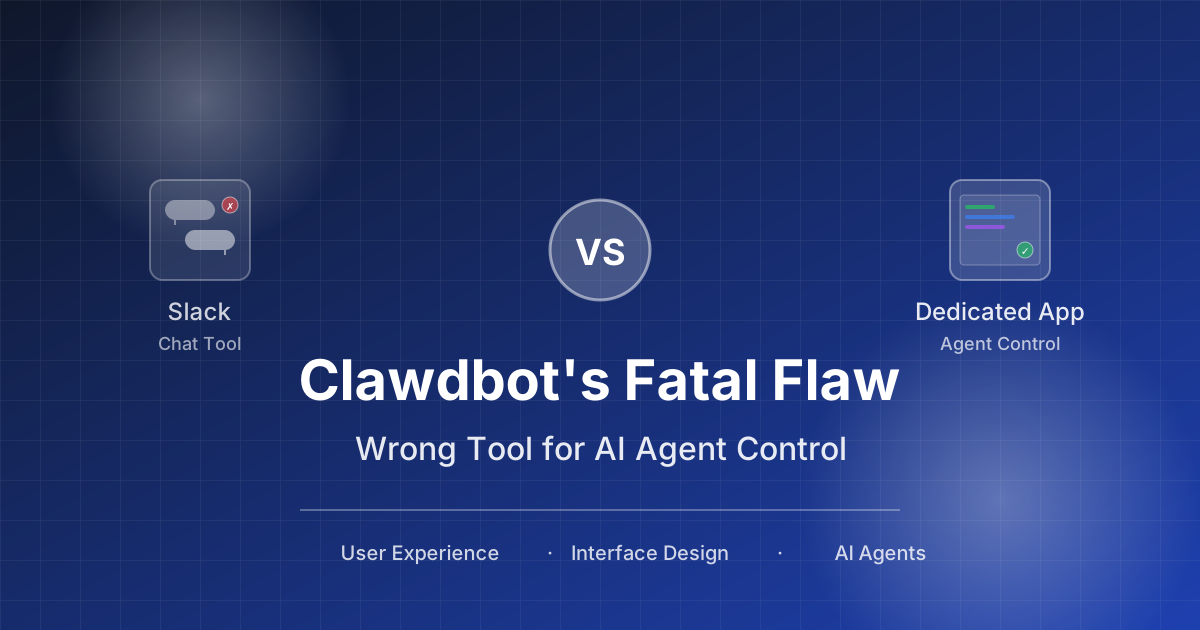
Stop Cramming AI Assistants into Chat Boxes: Clawdbot Picked the Wrong Battlefield
Clawdbot is convenient, but putting it inside Slack or Discord was the wrong design choice from day one. Chat tools are not for operating tasks, and AI isn't for chatting.

Grok Bot and Hermes Bot: one person finally gets a think tank and a secretariat
Grok Bot now ships with Cursor Pro+. Hermes Bot runs on a VPS. They are not smarter chat boxes. The think tank advises, the secretariat executes, and you still make the call.