

Signets is a payment stack for adding purchasing, collections, payouts, and money movement to AI workflows. It creates cards, wallets, and accounts on demand while enforcing budgets, vendor restrictions, and approvals inside the payment path rather than relying on model instructions.
Key Features
- Controlled Card Issuance: Create cards for agent purchases and browser checkout.
- Virtual Accounts: Support collections, payouts, and agent-directed money movement.
- Policy-Bound Purchasing: Enforce budgets, vendor allowlists, and approval workflows.
- Unified Reconciliation: Connect intent, authorization, execution, and reconciliation.
- Multiple Rails: Work with stablecoins and traditional bank rails.
Use Cases
Who Should Use This Tool?
- Agent Platforms adding payments without building financial infrastructure.
- Operations Teams managing automated purchasing and reconciliation.
- Finance Leaders seeking controlled agent access to cards and accounts.
Problems It Solves
- Fragmented payment systems: One stack covers issuance, movement, and records.
- Prompt-only controls: Policies are enforced during payment execution.
- Reconciliation gaps: Each payment remains connected to its original intent.
Pricing
| Plan | Price | Features |
|---|---|---|
| Platform Access | Contact Signets | Cards, accounts, wallets, controls, and reconciliation. |
| Custom Deployment | Custom | Workflow-specific policies and payment-rail configuration. |
Advantages & Unique Selling Points
Compared to Competitors:
- End-to-end coverage: Supports both outgoing purchases and incoming funds.
- Enforced controls: Rules live in the payment path, not the system prompt.
- Operational continuity: Reconciliation is part of the same transaction record.
What Makes It Stand Out:
- Cards, wallets, and accounts created on demand.
- Stablecoin and bank-rail support in one stack.
- Clear intent-to-reconciliation traceability.
User Reviews
"Having authorization and reconciliation in one record is exactly what our finance workflow needed." Illustrative finance-operator perspective, editorially composed
"The agent can check out in a browser, but the vendor and budget rules still apply at payment time." Illustrative platform-developer perspective, editorially composed
Getting Started
Quick Start Guide
- Map payment flows: Identify purchases, collections, and payouts.
- Define policies: Set budgets, approved vendors, and review thresholds.
- Issue resources: Create the required cards, wallets, or accounts.
- Connect records: Link agent intent to authorization and reconciliation.
Integration
Integrates with:
- Agent purchasing and browser-checkout workflows
- Stablecoin and bank payment rails
- Finance approval and reconciliation processes
Frequently Asked Questions
Does Signets rely on prompt instructions for controls?
No. Merchant restrictions, budgets, and approvals are enforced in the payment path.
Can agents receive money?
Yes. Virtual accounts support collections, payouts, and money movement.
Does it support cards and stablecoins?
Yes. Signets supports controlled cards alongside stablecoin and bank rails.
Alternatives
- Payman AI: Isolated agent wallets and policy controls.
- Skyfire: Agent identity and payment tokens.
- Delegare: Signed merchant-specific mandates.
Tips & Best Practices
- Separate agent roles: Issue distinct resources for purchasing and collections.
- Start with allowlists: Expand vendor access only after observing real usage.
- Reconcile by intent: Preserve task context throughout the payment lifecycle.
Comments
No comments yet. Be the first to comment!
Related Tools


Related Insights

Anthropic Subagent: The Multi-Agent Architecture Revolution
Deep dive into Anthropic multi-agent architecture design. Learn how Subagents break through context window limitations, achieve 90% performance improvements, and real-world applications in Claude Code.
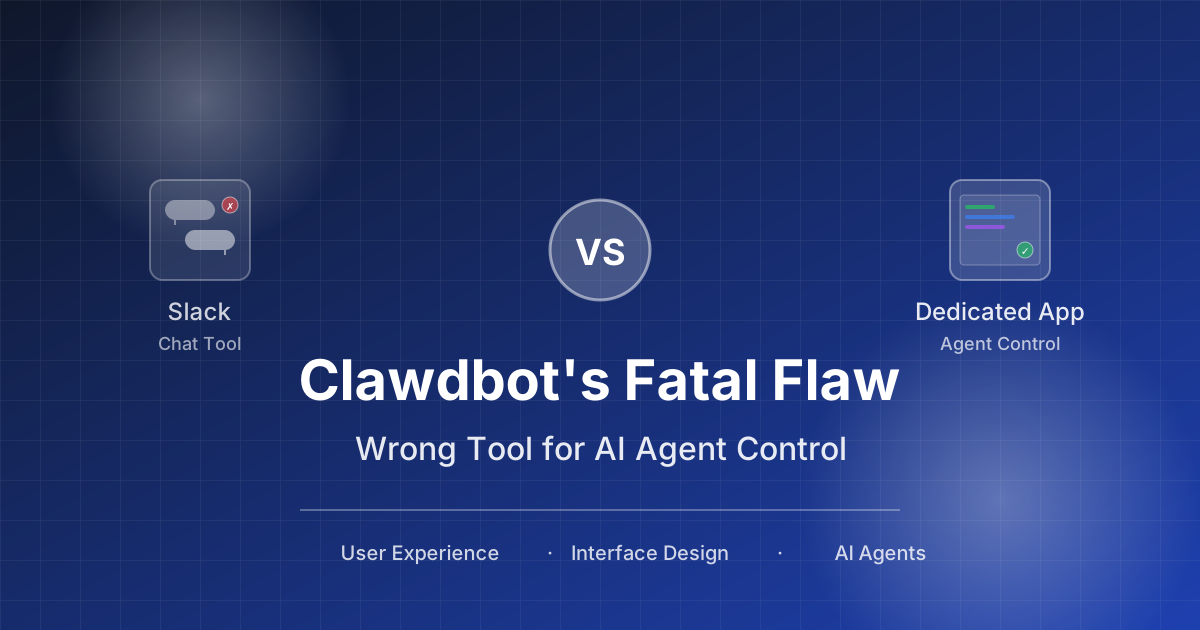
Stop Cramming AI Assistants into Chat Boxes: Clawdbot Picked the Wrong Battlefield
Clawdbot is convenient, but putting it inside Slack or Discord was the wrong design choice from day one. Chat tools are not for operating tasks, and AI isn't for chatting.

Grok Bot and Hermes Bot: one person finally gets a think tank and a secretariat
Grok Bot now ships with Cursor Pro+. Hermes Bot runs on a VPS. They are not smarter chat boxes. The think tank advises, the secretariat executes, and you still make the call.