

oMLX is a macOS-native MLX inference server for Apple Silicon. The product site is omlx.ai. The repo jundot/omlx is Apache-2.0, created 2026-02-13, language Python. On 2026-09-12 GitHub listed 21,647 stars and 1,859 forks, last push 2026-09-11. Latest GitHub release checked the same day was v0.6.4 (published 2026-08-29). r/LocalLLaMA's home feed and the r/oMLX community surfaced it next to Qwen3.8-Flash-Next local runs.
Compare mlx-serve if you wanted a Zig binary with no Python, Ollama if you needed multi-OS plus a cloud seat, or Claude Code if you only needed the agent that can point at localhost.
Key Features
- Paged SSD KV cache: cache blocks persist to disk as safetensors. Hot blocks stay in RAM, cold blocks go to SSD with LRU. Prefixes restore across requests and restarts instead of being recomputed.
- Continuous batching: mlx-lm
BatchGenerator. First-party table on an M3 Ultra 512 GB, Qwen3-Coder-Next 8bit, pp1024/tg128, no cache reuse: 1x 58.7 tok/s, 8x 243.3 tok/s (4.14x). - Native menu bar app: signed and notarized, in-app auto-update, not Electron. Web dashboard for models, chat, and metrics. Homebrew tap
jundot/omlx. - OpenAI + Anthropic drop-in:
/v1/chat/completionsand/v1/messagesonhttp://localhost:8000. Dashboard copies the config command for Claude Code, Cursor, OpenClaw, OpenCode, Codex. - Shared model dirs: reads
~/.cache/huggingface/hub, LM Studio folders, and custom directories. LLM, VLM, embedding, and reranker models can load together.
Limitation: 21,647 stars is a heat signal, not an audit. Speed tables are first-party benches on an M3 Ultra 512 GB, not a third-party study. Needs macOS 15+ and Apple Silicon. Site says 16 GB RAM minimum, 64 GB+ recommended. Source installs need Python 3.11-3.13. GLM-5.2 / MiniMax fused kernels need full Xcode or the official DMG; a plain pip install silently falls back.
Use Cases
- Claude Code / Cursor / OpenClaw on a Mac where agent sessions keep invalidating KV cache and Ollama/LM Studio recompute 30-90 seconds of prompt.
- People already holding Hugging Face or LM Studio weights who do not want a second download.
- People who should use mlx-serve instead if they wanted a Zig binary and Anthropic dialect on port 11234 with no Python.
Pricing
| Piece | Price | Notes from first-party pages 2026-09-12 |
|---|---|---|
| oMLX app, CLI, server | $0 | Apache-2.0. About 21,647 stars. DMG from GitHub Releases. |
| Host machine | Your Mac | Apple Silicon, macOS 15+. No cloud inference fee. |
Getting Started
- Download the DMG from github.com/jundot/omlx/releases and drag it to Applications, or
brew tap jundot/omlx https://github.com/jundot/omlx && brew install jundot/omlx/omlx. - Launch the app. The welcome screen sets the model directory, starts the server, and can download a first model.
- Point Claude Code or Cursor at
http://localhost:8000. The dashboard prints the exact export command. - Optional CLI:
omlx serve --model-dir ~/models.
First-party resource: the README and omlx.ai.
Frequently Asked Questions
Is this the same as mlx-serve?
No. mlx-serve is a Zig server on port 11234 with embedded llama.cpp. oMLX is Python/MLX on port 8000 with SSD-tier KV cache and a menu bar app.
Do I need to re-download models?
No. It reads the standard Hugging Face hub cache and LM Studio folders.
Does it need a GPU server?
No. Apple Silicon only. Not Windows, not Linux, not Intel Macs.
Alternatives
- mlx-serve: Zig, no Python, GGUF plus MLX.
- Ollama: multi-OS local runner.
- Claude Code: the agent you point at this localhost.
Tips
- Prefer the signed DMG if you serve GLM-5.2 or MiniMax. Custom kernels are precompiled there.
- 64 GB+ RAM is the comfortable daily-coding floor on the site's own FAQ.
- After the second turn, the site's claim is TTFT under 5 seconds when the prefix hits SSD cache. First turn still pays prefill.
Conclusion
oMLX is the Mac-local server to try when coding agents keep blowing in-memory KV cache. Start at omlx.ai, then keep mlx-serve in the shortlist if you wanted no Python.
Comments
No comments yet. Be the first to comment!
Related Tools


Related Insights
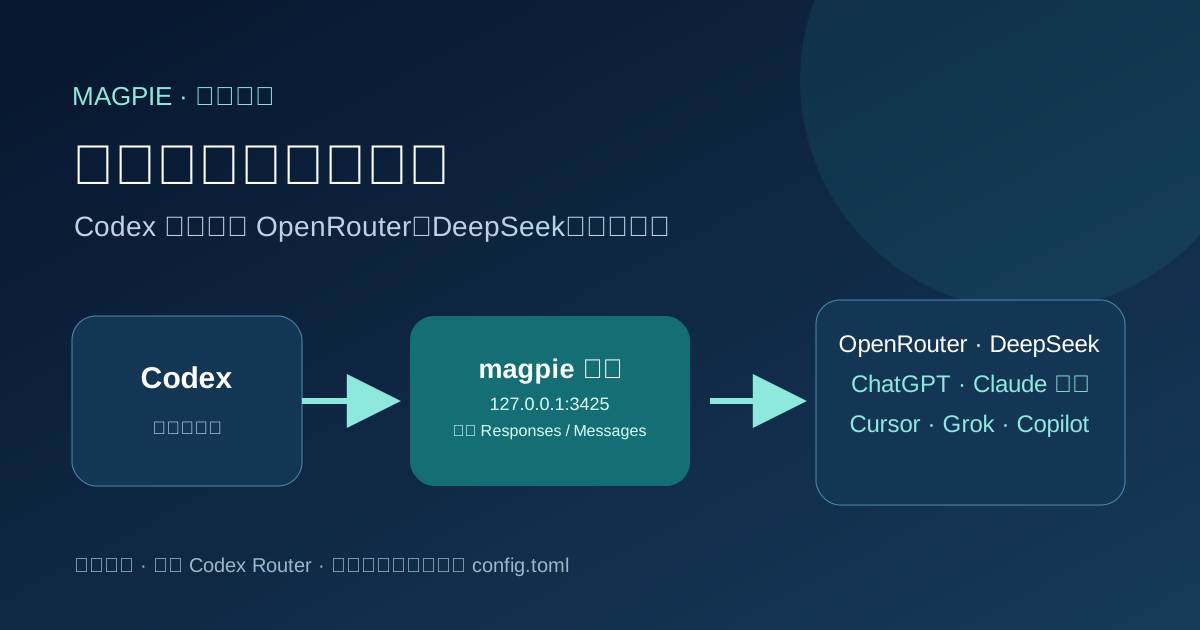
Point Codex at any model with magpie
Install magpie, add a local or signed-in provider, then switch Codex to that model. Rechecked against official magpie docs on 2026-10-06.
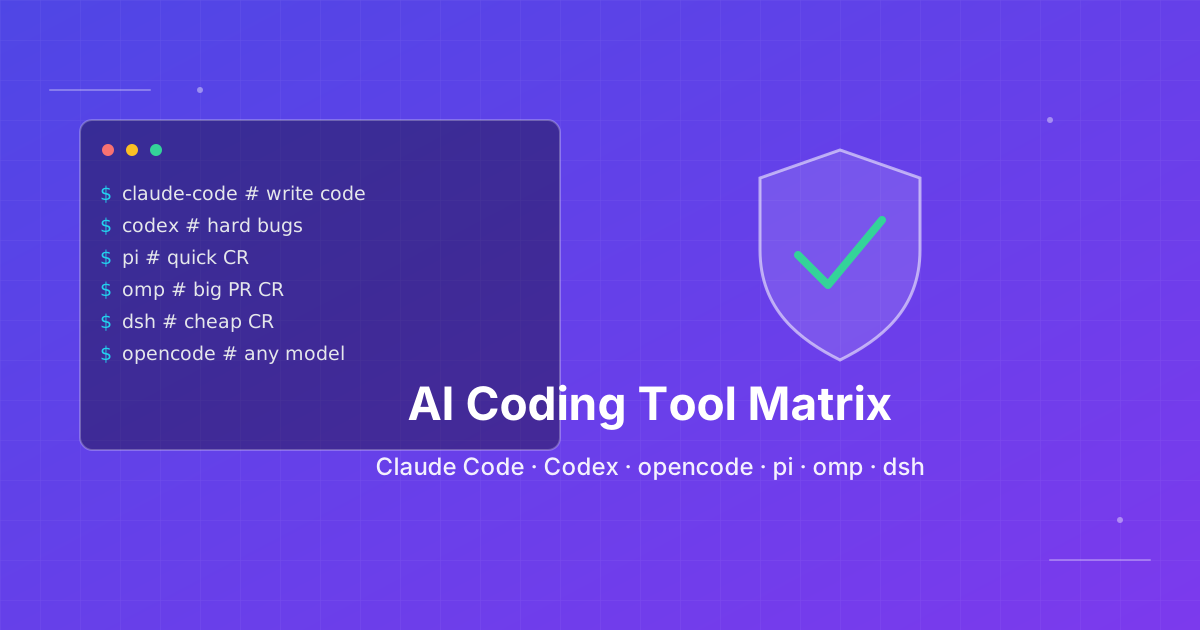
How to pick an AI coding CLI for your repo
Match Claude Code, Codex CLI, OpenCode, Pi, omp, DeepSeek Harness, and Grok Build to the work you actually run. Docs rechecked 2026-10-06.

Anthropic Subagent: The Multi-Agent Architecture Revolution
Deep dive into Anthropic multi-agent architecture design. Learn how Subagents break through context window limitations, achieve 90% performance improvements, and real-world applications in Claude Code.