
ToAPIs is an OpenAI-compatible AI API gateway that unifies 60+ models from GPT, Claude, Gemini, DeepSeek, Sora, and VEO behind one base URL and one API key. Teams migrate existing OpenAI SDK workloads in about five minutes by changing the endpoint to https://toapis.com/v1; text, image, and video generation all share the same auth and billing model, with multi-provider routing and graceful failover.
Key Features
- One endpoint, many providers: A single
https://toapis.com/v1surface routes to 60+ models across 9 providers, including GPT-5 series, Claude Sonnet/Haiku, Gemini, DeepSeek, Sora, and VEO. - Drop-in OpenAI compatibility: Keep your existing OpenAI SDK and request shape; only the base URL and API key change.
- Text, image, and video: Chat completions, image generation (GPT-Image-2, Gemini image), and video generation (Sora, VEO) under one interface.
- Routing and failover: Multi-provider routing balances capability, availability, and policy, with retries and timeout budgets for transient provider failures.
- Unified billing: One account, one invoice for all providers; transparent per-model pricing.
- Task webhooks: Asynchronous image/video tasks support callback URLs with HMAC-signed verification and Retry-After handling.
Use Cases
Who Should Use This Tool?
- Teams migrating from OpenAI: Products already on the OpenAI SDK that need multi-model coverage with minimal code change.
- Multi-modal products: Applications needing text, image, and video APIs under a single auth and billing model.
- Ops teams: Engineers who want routing, observability, and graceful provider failover without building it themselves.
Problems It Solves
- Provider switching cost: Every new model used to mean rewriting code, reconfiguring endpoints, and reworking billing; ToAPIs collapses this to a base URL change.
- Single-provider risk: One model outage used to take your product down; automatic routing and failover keep requests flowing.
- Billing fragmentation: Separate invoices per provider are replaced by one unified account.
Pricing
| Plan | Price | Features |
|---|---|---|
| Pay-as-you-go | Per-token | Transparent per-model rates; free trial credit available; enterprise SLA and global CDN acceleration on request. |
Advantages & Unique Selling Points
Compared to Competitors:
- True OpenAI drop-in: Unlike custom gateways, existing SDKs keep working with only a base URL change, typically a 5-minute migration.
- Broad multimodal coverage: Text, image, and video (including Sora and VEO) behind one key, not just chat models.
- Aggregation economics: One account and invoice across providers, with routing tuned for latency and uptime.
What Makes It Stand Out:
- 63 models, 9 providers, one API.
- Official SDKs for Python, Node.js, and Java, all OpenAI-compatible.
- Model marketplace with capability-tiered migration guide.
Getting Started
- Sign up at toapis.com and create an API key in the console.
- Change the base URL to
https://toapis.com/v1in your existing OpenAI SDK client. - Replace the API key with your ToAPIs key.
- Pick a model:
gpt-5.6-terrafor balanced chat,gpt-image-2for images,sora-2-vvipfor video.
Frequently Asked Questions
Do I need to rewrite my code?
No. Keep your OpenAI SDK; only the base URL and API key change, so most calls remain unchanged.
Which models are available?
60+ models across 9 providers: GPT-5 series, Claude Sonnet 4.5 and Haiku, Gemini, DeepSeek, Sora, VEO, Whisper, and TTS.
How do I migrate from OpenAI?
Update base_url to https://toapis.com/v1, replace the key, map model names by capability tier, and enable retries; typical migration takes under 5 minutes.
Alternatives
If ToAPIs isn't the right fit, consider these alternatives:
- OpenRouter: Unified LLM router focused on text chat models.
- SiliconFlow: Chinese model inference platform with many open-weight models.
- DeepSeek: Direct API from the DeepSeek model provider.
Tips & Best Practices
- Map models by capability tier: Define default fallbacks per tier (chat/image/video) so routing stays predictable.
- Enable retries with timeouts: Provider-level transient failures are absorbed by retry budgets.
- Use task webhooks for media: Prefer signed callback URLs over polling for image/video tasks, honoring Retry-After on 429.
Conclusion
ToAPIs delivers multi-provider AI access with the least possible integration friction: one OpenAI-compatible endpoint, one key, and 60+ text, image, and video models. If your team wants model diversity without gateway engineering, it is a fast, unified path forward.
Comments
No comments yet. Be the first to comment!
Related Tools


Related Insights
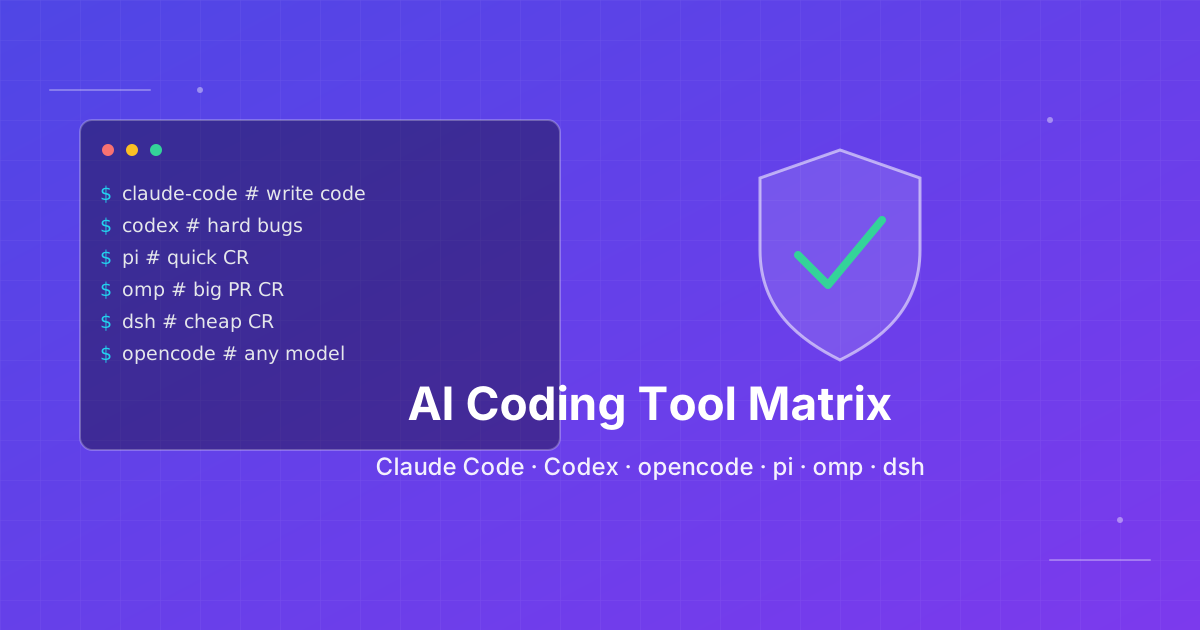
Seven AI Coding CLIs, Six Months: No Matter How Strong the Model, Work Needs Supervision
Claude Code, Codex, opencode, pi, omp and DeepSeek Harness all have personalities. After six months of deep use I run a division of labor: pi for the fastest cheapest reviews, omp for complex PRs, DeepSeek Harness on V4 Flash for high-frequency low-cost review, and Claude Code, Qoder and Cursor for writing. No matter how strong the model, work needs supervision — ideally from an independent third party.

Anthropic Subagent: The Multi-Agent Architecture Revolution
Deep dive into Anthropic multi-agent architecture design. Learn how Subagents break through context window limitations, achieve 90% performance improvements, and real-world applications in Claude Code.
Complete Guide to Claude Skills - 10 Essential Skills Explained
Deep dive into Claude Skills extension mechanism, detailed introduction to ten core skills and Obsidian integration to help you build an efficient AI workflow