

treg
treg describes itself in one line: "OpenRouter, but for agent tools instead of models." Point an agent at one base URL with one token and it can call catalogued third-party endpoints for SEO, backlinks, social listening, people and company enrichment, ads, scraping, and media generation, without your team holding accounts at each vendor. The project is built and maintained by the Superdesign team, is live at treg.to, and can be self-hosted.
The motivating observation is concrete: the tools an agent needs for real work sit behind subscriptions nobody buys for a single run. Semrush at $139/month, Moz at $99/month, Crunchbase at $99/month, Apollo at $59 per seat, plus a long tail of invite-only, partner-only, or app-review-gated APIs. treg carries those accounts and bills fractions of a cent per call instead.
Key Features
- One key, one MCP server: the site advertises 3,600+ endpoints across 97 providers behind a single credential. The repository README states a more conservative "3,000+ catalogued endpoints across 60+ providers", which is the safer number to plan against while the catalog grows.
- Two kinds of tool, one vocabulary: the catalog holds third-party endpoints treg serves with its own key or through a verified public route. Your own tools are anything a teammate registered: a paid API account, an OAuth connection, a vendor CLI (stripe, gh, vercel), or a
SKILL.mdbundle with its secrets and tools. - Relay, never model: the proxy forwards the upstream request verbatim and injects auth server-side, so callers never hold keys. The project's stated benefit is that this survives upstream API changes, and that a team's own key always wins over treg's when both exist.
- Predictable billing: catalog calls are metered from a prepaid balance at the provider's own rate with 0% markup (the promise is written into the terms), and the first $1.00 is free. Calls made with your own key or your own tools are never metered. When the balance runs dry, metered calls stop with a clear error while your own-key calls keep working.
- Agent-first discovery:
treg catalog search "backlinks for a domain"finds a tool by what it does rather than by vendor name, andhttps://treg.to/llms.txtexposes the catalog for LLM clients.
Use Cases
- Agents that need commercial data: SEO and backlink checks, keyword volumes, AI-visibility citations, TikTok and X trends, or company enrichment, all without procuring a vendor account.
- Teams standardizing tool access: register the company's existing paid keys once and let every teammate's agent call them without copying secrets onto laptops.
- Prototyping workflows where paying for a monthly seat to test a single API call is not viable.
- Self-hosted deployments that want the registry inside their own network perimeter.
Pricing
treg is open source (the LICENSE names Superdesign and reproduces Apache License 2.0) and self-hostable; treg.to is the hosted instance. Pricing is a prepaid balance metered per call at the provider's own rate with no markup, $1.00 free to start, and no per-seat charge. Tools you register with your own credentials are not metered at all.
The project is careful to separate the cost of a raw call from the cost of a usable result: on per-success tools a miss settles at $0.00, while on per-call tools every attempt costs regardless of what comes back. Before wiring an agent into a metered workflow, read the receipts on the pricing page, which are taken from real runs rather than a rate card.
Quick Start
# 1. install the CLI, which also points it at the registry
curl -fsSL https://treg.to/install.sh | sh

# 2. sign in (GitHub by default, --email for a one-time code, --token for agents/CI)
treg login

# 3. do something useful immediately, with no key registered
treg catalog search "backlinks for a domain"
treg call tikhub.tiktok.user.profile --query uniqueId=tiktok
treg balance
treg onboard runs a guided walkthrough, and the same registry is reachable over MCP if you would rather connect an agent than a shell.
Limitations and Risks
- Per-call costs are hard to forecast. Multi-step agent loops multiply calls, and on per-call tools a miss is still billed. The project publishes example receipts for exactly this reason; build spend limits anyway.
- Your agent's reliability is now partly the upstream's. If a provider changes or rate-limits a route, the call fails even though the relay itself is neutral.
- Reselling access has terms-of-service exposure. Several catalog entries are described upstream as invite-only, partner-only, or app-review-gated. Verify each provider's terms before shipping a production workflow on top of it.
- Young project. The repository was created 2026-07-15 and had no tagged releases on 2026-09-25, so expect the API and catalog to move.
FAQ
How is it different from an MCP gateway?
An MCP gateway usually organizes servers you already host or subscribe to. treg also carries the credentials for commercial data vendors you do not have accounts with, and meters those calls per use.
Do I have to send my own API keys to it?
No. Registering a key lets treg use it server-side so no teammate holds the secret, and your key always takes precedence over treg's own. Self-hosting keeps everything inside your network.
What does a call cost?
The provider's own rate with no markup, deducted from a prepaid balance, with $1.00 free to start. Your own tools and own-key calls are not metered.
Can I use it from an agent rather than a shell?
Yes. The registry is exposed over MCP, and https://treg.to/llms.txt gives LLM clients the catalog they need to pick tools.
Alternatives
- OpenRouter: the same one-key idea applied to models rather than tools, and the project's own stated reference point.
- Cloudflare AI Gateway: routing, caching, and observability in front of model providers.
- 9Router and OmniRoute: alternative router layers for multi-provider model access.
- Firecrawl: a single-purpose alternative when all you need is fetching and scraping.
Conclusion
treg applies a proven idea to a messier problem. Models are easy to route because the providers all speak HTTP and most accept a card; commercial data vendors do not, which is why agents keep stalling at a $99/month paywall to check a backlink. If your agents need third-party data, start from the free $1.00 balance and treg catalog search, measure the real cost per finished task rather than per call, and only then decide whether to self-host.
The treg repository documents the registry vocabulary, the proxy rule, and the self-hosting path.
Comments
No comments yet. Be the first to comment!
Related Tools


Related Insights
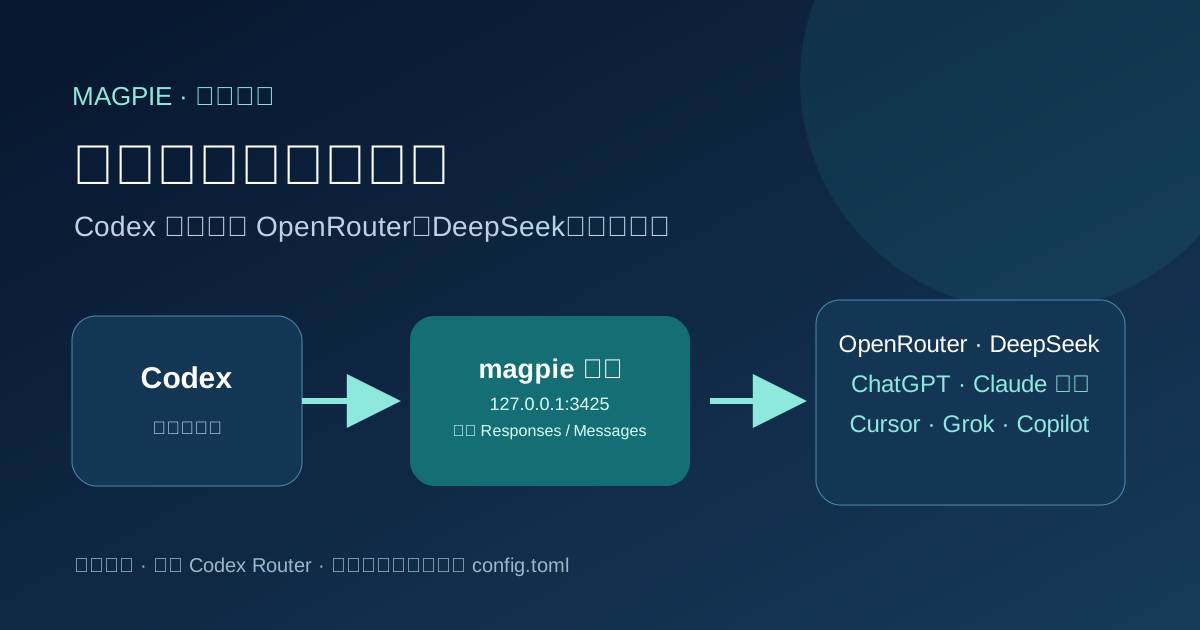
Codex on any model: magpie makes Codex Router unnecessary
magpie is a free, open-source menu bar app that runs a local gateway and puts OpenRouter, DeepSeek and your ChatGPT, Claude, Cursor, Grok and Copilot subscriptions right into Codex's own model picker, with one click and no Codex Router.
After I Connected Obsidian to OpenClaw, It Started Helping Me Make Decisions
Once Obsidian stopped being just a place to store notes and started working with OpenClaw, it began helping me organize context, connect information, and improve real decisions.

Anthropic Subagent: The Multi-Agent Architecture Revolution
Deep dive into Anthropic multi-agent architecture design. Learn how Subagents break through context window limitations, achieve 90% performance improvements, and real-world applications in Claude Code.