

9Router
9Router is an MIT-licensed, self-hosted gateway between coding tools and model providers. Its official documentation describes protocol translation, quota-aware fallback, and RTK compression. These features need validation with your own client and workload; this entry does not report an independent performance benchmark.
Getting Started
The documented npm installation is npm install -g 9router, followed by 9router. Open the dashboard at http://localhost:20128, connect an account you are authorized to use, and copy the gateway key into your client. The documented API base is http://localhost:20128/v1. Use the model identifier shown in your dashboard.
Before moving an existing project, save its current endpoint and model configuration. Test a small disposable repository: ask the agent to read a file, make one edit, and run a test. A model appearing in a list does not establish that streaming, tool calls, or long conversations work.
Pricing and Limits
The gateway software is free under MIT; upstream usage and hosting can still cost money. A subscription does not automatically grant permission for every integration. Check the provider's current account terms and quotas.
Self-hosting controls where the gateway runs. Prompts and credentials needed for authentication still reach the selected upstream provider. Review logs, retention, and access controls before using private repositories. Fallback cannot guarantee uninterrupted service when every configured provider is unavailable.
Alternatives
- OmniRoute: another self-hosted gateway. Consider it when evaluating routing controls; compare the exact client, authentication method, and model you need using its official documentation.
- OpenRouter: a hosted API option. Consider it if you prefer a managed endpoint; its quickstart explains API access. Review current model prices and provider routing before migrating.
Choose by operating model first: who maintains the gateway, where requests go, and how failures are handled. Provider counts alone cannot answer those questions. See the 9Router alternatives page and the API tools hub for related listings.
Migration Checklist
- Keep the old configuration and a tested way to restore it.
- Use the same small task for each candidate; record completion, latency, billed usage, and manual fixes.
- In a test configuration, make the primary route unavailable and observe whether the fallback finishes correctly.
- Check that logs identify the selected provider without revealing keys or private source code.
- Move one project first. Expand only after tool calls, costs, and recovery behave as expected.
These are suggested acceptance checks, not claimed test results. Next step: follow the 9Router README for your client, then complete one end-to-end task before adding fallback routes.
Documentation reviewed: September 27, 2026.
Comments
No comments yet. Be the first to comment!
Related Tools


Related Insights

Anthropic Subagent: The Multi-Agent Architecture Revolution
Deep dive into Anthropic multi-agent architecture design. Learn how Subagents break through context window limitations, achieve 90% performance improvements, and real-world applications in Claude Code.

Claude Code account precautions: before you spend $200, do these six things
Gmail plus Apple private sign-in, Cliproxy residential routing for CC and emulators, IP/DNS checks, gradual upgrades, and history-preserving sign-out. Includes a profile and script.
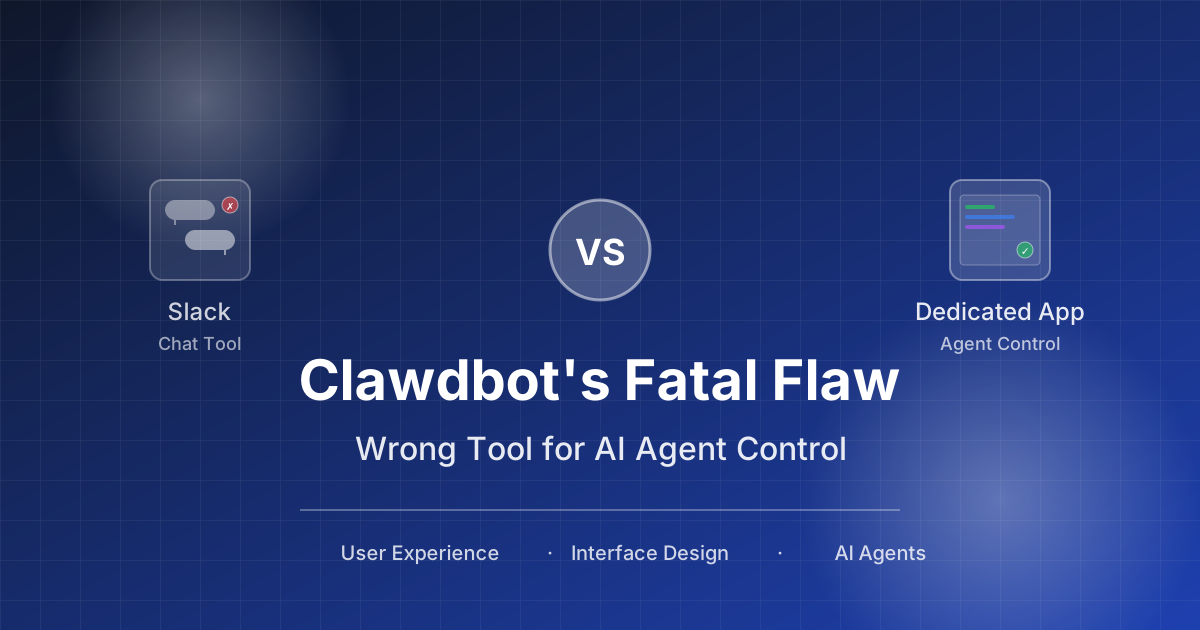
Stop Cramming AI Assistants into Chat Boxes: Clawdbot Picked the Wrong Battlefield
Clawdbot is convenient, but putting it inside Slack or Discord was the wrong design choice from day one. Chat tools are not for operating tasks, and AI isn't for chatting.