

aiXcoder
aiXcoder is a Chinese AI coding assistant from Beijing Silicon Heart. Do not quote ¥99 / month or ¥999 / year from the old page. The open weights that still exist are aiXcoder-7B on github.com/aixcoder-plugin/aiXcoder-7B (Apache-2.0, about 2,271 stars when we fetched the repo). That 2024 base model is not a live seat price.
Compare GitHub Copilot if you wanted a priced GitHub-native suite, Cursor if you wanted an agent IDE with public $20 / $40 seats, and Aider if you wanted Apache-2.0 BYOK in the terminal.
Key Features
- IDE plugins: First-party links still point at the VS Code extension and the JetBrains completer. Eclipse was on older marketing; recheck the live download page before you assume it.
- Completion plus search: The commercial site still talks about line and method completion, generation, and code search. Treat the installed plugin as the catalog, not a 2018 slogan.
- aiXcoder-7B Base: The GitHub README says the base model trained on 1.2T unique tokens and was built for fill-in-the-middle completion. Hugging Face weights live at aiXcoder/aixcoder-7b-base.
- Paper, not a live leaderboard: The same repo cites arxiv.org/pdf/2410.13187 and claims the 7B beat CodeLlama 34B and StarCoder2 15B on their 2024 nl2code / completion tables. That is a 2024 vendor paper, not a 2026 SaaS benchmark.
- Local inference: The repo documents Python, Docker, and bitsandbytes quantization. We did not re-verify "8-12 GB CPU laptop" as a first-party limit.
Use Cases
- People who want a China-market IDE plugin and will apply on aixcoder.com.
- Teams that want local 7B completion from the Apache-2.0 weights, not a Copilot seat.
- Researchers citing the 2024 7B paper, not buyers looking for a public dollar table.
Limitation: Cloud price, "130 countries," and "beats every open model" are not on the pages we used. The 7B README itself says that base checkpoint is for completion and generation, not instruct-tuned test or debug work.
Pricing
No public recurring table on aixcoder.com on 2026-08-17.
| Surface | What we could verify |
|---|---|
| Website / plugins | Cloud assistant plus IDE plugins. Seats are sales-quoted. |
| aiXcoder-7B | Apache-2.0 weights. You pay your own GPU or CPU, not a published ¥99 SKU. |
| Old Professional row | ~¥99 / month is out. Do not paste it. |
If a leftover blog still lists Free / Professional / Enterprise RMB rows, treat the live site as the source.
Getting Started
- Open aixcoder.com and install only the plugin listed today.
- If you want local weights, clone aiXcoder-7B and read the Docker / bitsandbytes notes.
- Ask sales only if you need a private cloud seat.
- Confirm Copilot or Cursor if you already pay for an English-first agent IDE.
Frequently Asked Questions
Is it still ¥99 / month?
Treat cloud seats as quoted.
Is the 7B model the same product as the SaaS?
No. The 7B repo is an Apache-2.0 2024 base model. The website is a commercial assistant. Do not price one with the other.
How many GitHub stars?
About 2,271 on 2026-08-17. Do not keep a 3.1k figure.
Same as Copilot or Cursor?
No. Those have public USD seats. aiXcoder's public artifact is the 7B repo plus China-market plugins.
Alternatives
- GitHub Copilot: Priced completions and a cloud agent inside GitHub.
- Cursor: Agent IDE with public Individual $20 / Pro $40 seats.
- Aider: Apache-2.0 terminal agent if you only wanted local BYOK.
Tips
- Quote the 7B license and star count from GitHub, not from an old catalog row.
- Do not paste 130-country or HumanEval slogans into a slide.
- Confirm the JetBrains / VS Code listing before you tell a team Eclipse is required.
Conclusion
aiXcoder is a China-market coding assistant plus an Apache-2.0 7B completion model, not a public ¥99 SaaS with a live 34B-beating scoreboard. Start at aixcoder.com or the 7B repo, then decide whether GitHub Copilot or Aider already covers the seat you need.
Comments
No comments yet. Be the first to comment!
Related Tools


Related Insights

Skills + Hooks + Plugins: How Anthropic Redefined AI Coding Tool Extensibility
An in-depth analysis of Claude Code's trinity architecture of Skills, Hooks, and Plugins. Explore why this design is more advanced than GitHub Copilot and Cursor, and how it redefines AI coding tool extensibility through open standards.
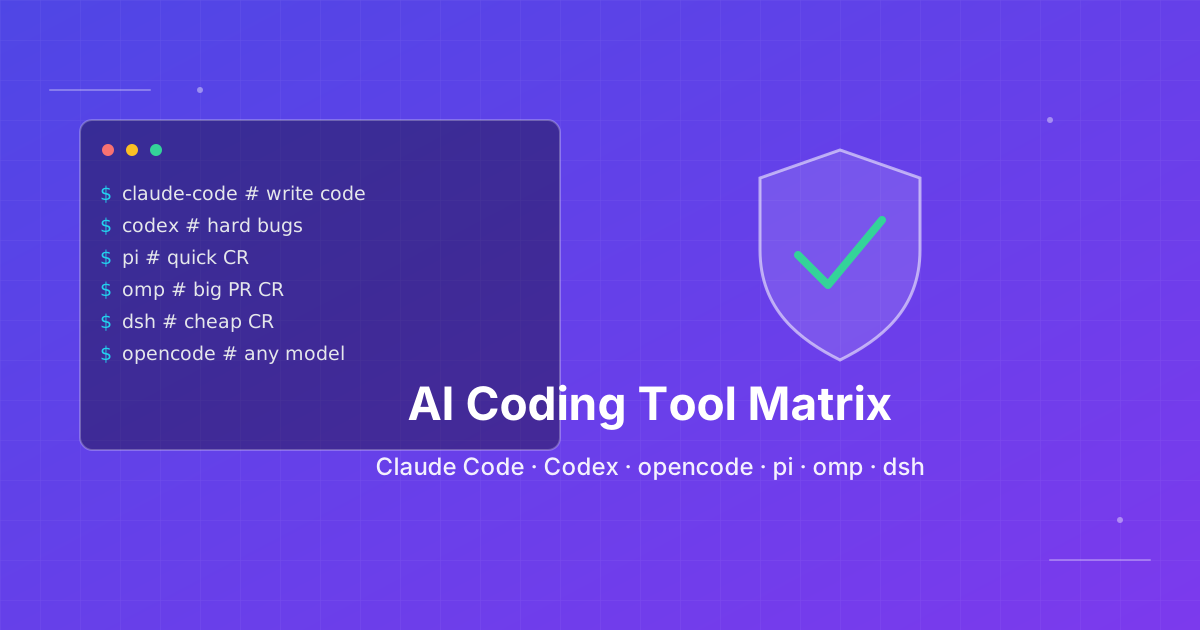
Seven AI Coding CLIs, Six Months: No Matter How Strong the Model, Work Needs Supervision
Claude Code, Codex, opencode, pi, omp and DeepSeek Harness all have personalities. After six months of deep use I run a division of labor: pi for the fastest cheapest reviews, omp for complex PRs, DeepSeek Harness on V4 Flash for high-frequency low-cost review, and Claude Code, Qoder and Cursor for writing. No matter how strong the model, work needs supervision — ideally from an independent third party.
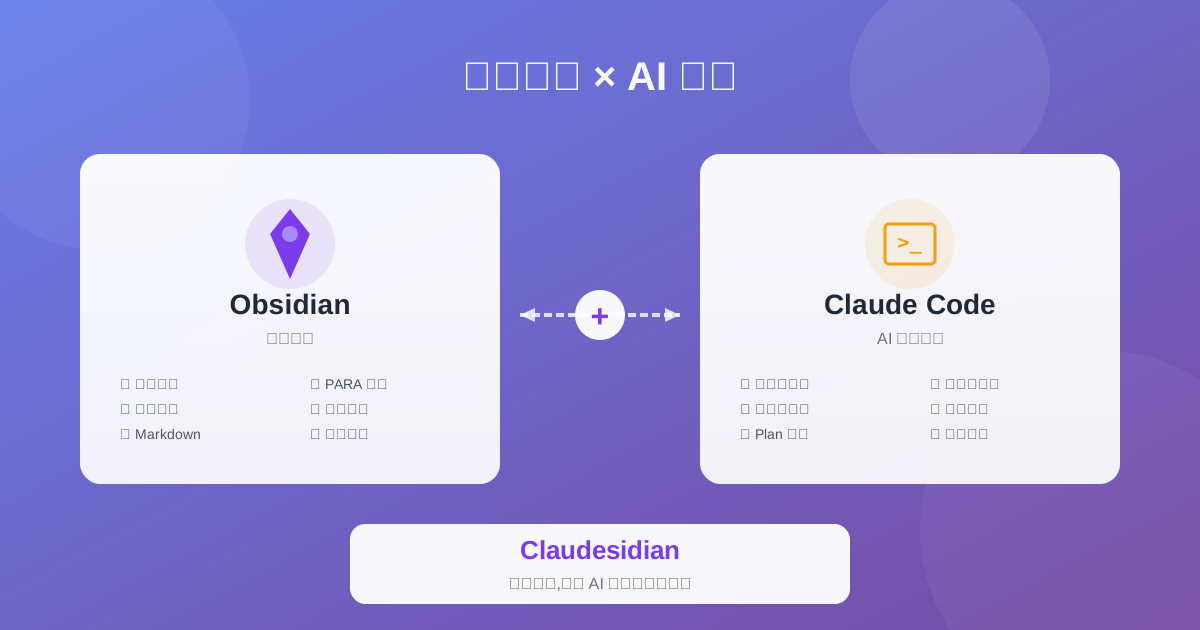
Claudesidian: Transform Obsidian into an AI-Powered Second Brain
Discover Claudesidian, an open-source project that perfectly integrates Obsidian with Claude Code. Built-in PARA method, custom commands, and automated workflows for a complete idea-to-implementation solution.