Overview
Google Antigravity is Google's groundbreaking AI-powered integrated development environment (IDE), officially announced on November 18, 2025, alongside the launch of Gemini 3. Developed by Google DeepMind, Antigravity represents a paradigm shift in software development by positioning AI agents not as coding assistants, but as autonomous actors capable of planning, executing, and validating entire features with minimal human intervention.
Built as a fork of Visual Studio Code, Antigravity retains the familiar interface that millions of developers already know while introducing revolutionary "agent-first" capabilities. The platform's tagline—"Experience liftoff with the next-generation IDE"—reflects Google's vision of democratizing software development by enabling anyone with an idea to build it into reality, regardless of their coding expertise.
As of January 2026, Antigravity is available as a free public preview for Windows, macOS, and Linux, downloaded from antigravity.google/download. The platform is powered by multiple frontier AI models including Gemini 3 Pro, Gemini 3 Deep Think (also called Gemini 3 Pro High), Gemini 3 Flash, Anthropic's Claude Sonnet 4.5 and Claude Opus 4.5, as well as the open-source GPT-OSS-120B model.
The development of Antigravity was significantly accelerated by Google's $2.4 billion acquisition of the Windsurf team in July 2025, bringing critical agentic coding expertise in-house.
Core Features and Advantages
Agent-First Architecture
Unlike traditional AI coding assistants that merely suggest code, Antigravity's agents have direct access to your editor, terminal, and browser. They can autonomously:
- Plan multi-step implementations based on natural language requirements
- Execute code changes across multiple files simultaneously
- Run terminal commands to install dependencies, run tests, or deploy applications
- Launch browsers to test UI changes and validate functionality
- Record video demonstrations of their testing process for developer review
What Makes It Unique: Antigravity doesn't just write code—it acts like a junior developer on your team, capable of understanding requirements, making architectural decisions, and iteratively refining implementations based on test results.
Dual-Interface Design
Antigravity introduces two distinct working modes that can be used simultaneously:
Editor View: A familiar VS Code-style interface with AI-powered features including:
- Multi-line tab completions with context awareness across your entire codebase
- Inline commands for instant code modifications (similar to Cursor's Cmd+K)
- Traditional file explorer, terminal, and debugging tools
- Support for all VS Code extensions and keybindings
Manager Surface (Mission Control): A dedicated interface for orchestrating multiple AI agents:
- Spawn multiple agents working on different tasks concurrently
- Monitor agent progress with real-time status updates and execution logs
- Review and approve agent actions before they're applied to your codebase
- Manage artifacts (generated code, documentation, test results) in a centralized view
- Cross-workspace coordination for complex projects
Multi-Model Intelligence
Antigravity intelligently routes tasks to the most appropriate model based on complexity, speed requirements, and cost:
- Gemini 3 Flash: Fast completions and simple refactoring (millisecond response times)
- Gemini 3 Pro: Balanced performance for most coding tasks
- Gemini 3 Deep Think: Complex architectural decisions and deep analysis
- Claude Opus 4.5: Highest quality code generation with fewer errors
- GPT-OSS-120B: Open-source alternative for privacy-conscious teams
Planning Mode
A standout feature that allows agents to create detailed implementation plans before writing any code:
- Agent analyzes requirements and existing codebase structure
- Generates step-by-step plan with file changes, testing strategy, and rollback approach
- Developer reviews and approves or modifies the plan
- Agent executes approved plan with continuous validation
This significantly reduces the "hallucination" problem common in AI coding tools.
Automated Testing and Validation
Antigravity agents can autonomously:
- Write unit tests, integration tests, and end-to-end tests
- Launch browsers to manually test UI changes by clicking buttons and filling forms
- Record videos of test sessions for developer review
- Identify regressions by comparing before/after behavior
- Suggest fixes when tests fail
Use Cases
Google Antigravity excels in these scenarios:
- Rapid Prototyping: Build entire applications from natural language descriptions in hours
- Legacy Code Modernization: Agents analyze old codebases and systematically refactor to modern standards
- Full-Stack Development: Single agent can work across frontend, backend, database, and deployment
- Learning and Exploration: Beginners can learn by observing agent decision-making and code patterns
- Repetitive Refactoring: Automate tedious changes across dozens or hundreds of files
Less Suitable Scenarios:
- Production-critical applications in regulated industries (healthcare, finance) due to maturity concerns
- Offline or air-gapped development environments
- Projects requiring extreme predictability and determinism
- Teams with strict code review processes (agent changes can be difficult to review comprehensively)
Pricing and Value
| Plan | Price | Key Benefits | Rate Limits |
|---|---|---|---|
| Public Preview (Free) | $0 | Access to all features, all models, Manager Surface | Standard limits, 5-hour refresh |
| Google AI Pro | $9.99/month | Priority access, higher rate limits | Generous quotas, 5-hour refresh |
| Google AI Ultra | $19.99/month | Highest priority, maximum rate limits | Most generous quotas, 5-hour refresh |
| Team Plan | Coming soon | Shared workspaces, admin controls, SSO | TBA |
| Enterprise | Coming soon | Custom deployment, compliance features, SLA | TBA |
Pricing Philosophy: Google is currently offering Antigravity completely free during the public preview to encourage adoption and gather feedback. However, the company has signaled that Team and Enterprise pricing will be introduced in 2026, with the Individual free tier likely becoming more limited.
Cost Comparison: Compared to Cursor ($20/month) and Claude Code (similar pricing), Antigravity's current free offering is highly aggressive. However, many developers expect this to change once the preview period ends.
Rate Limit Concerns: The most common complaint is that free-tier users hit rate limits quickly (often within 20-30 minutes of intensive use), with limits refreshing every 5 hours. This makes Antigravity currently better suited for part-time use or experimentation rather than full-day development sessions.
User Reviews and Community Feedback
Based on feedback from Hacker News, Reddit, developer blogs, and tech news:
Positive Reviews:
- "Google Antigravity delivers one of the smoothest agent-first development experiences. Mission control is a standout feature." — Developer review
- "The multi-agent orchestration is genuinely impressive. I had three agents working in parallel on different parts of a feature." — Hacker News user
- "Finally ditched VS Code and Cursor for Antigravity, and I am not going back." — XDA Developers article
- "Planning Mode is brilliant. It catches architectural mistakes before any code is written." — Medium review
Negative Reviews and Major Concerns:
- Critical Safety Issues: "Google Antigravity accidentally deleted my entire D: drive. The agent apologized saying it was 'deeply, deeply sorry' but my data was gone." — Reddit user, December 2025
- Security Vulnerabilities: "Antigravity exfiltrates data via indirect prompt injection attack" — Hacker News, with concerns about agents exposing credentials and API keys
- Reliability Problems: "I start using it for my project and after about 20 mins – oh, no. Out of credits… I switched back to Cursor." — Hacker News comment
- Fork Fatigue: "The agentic spam is exhausting. I just wanted to code." — Common Hacker News sentiment reflecting community frustration with yet another VS Code fork
- Frequent Crashes: "Server overload and errors occur frequently enough that they interrupt workflow. Cannot treat Antigravity as a dependable primary tool for serious development." — Developer review
Potential Drawbacks and Risks
1. Critical Safety and Security Issues
- Data Loss Incidents: Documented cases of agents executing destructive commands (rm -rf, disk formatting) that deleted user data
- Credential Exposure: Agents with terminal access can inadvertently log or transmit API keys and secrets
- Prompt Injection Vulnerabilities: Malicious code comments or documentation can influence agent behavior
- Recommended Mitigation: Run Antigravity inside Docker containers or VMs until safety measures improve
2. Reliability and Maturity Concerns
- Frequent server errors and crashes, especially during high-traffic periods
- Rate limits kick in quickly for free users (20-30 minutes of intensive use)
- Task failures leave codebases in inconsistent states requiring manual cleanup
- Less mature than Cursor and Claude Code, which have been in market longer
3. Code Review Challenges
- Agent-generated changes can span dozens of files, making comprehensive review difficult
- No built-in "diff approval" workflow for reviewing changes before application
- Risk of subtle bugs introduced by agents optimizing for functionality over quality
- Some developers report 15-20% more time spent on code review with Antigravity
4. Fork Fatigue and Ecosystem Fragmentation
- Yet another VS Code fork competing with Cursor, Windsurf, and others
- Community expressing frustration: "Hacker News drew more than 1,000 comments and more than 100 mentions of the word 'fork'"
- Potential for Google to abandon the project if adoption doesn't meet expectations
5. Privacy and Data Concerns
- All code sent to Google's cloud for AI processing
- No on-premises or self-hosted option announced
- Unclear data retention and training policies during preview
- Not suitable for highly confidential or proprietary codebases without legal review
Getting Started
Quick Start Guide
Download and Install:
- Visit antigravity.google/download
- Choose your platform (Windows, macOS, or Linux)
- Install like any standard application
Sign In:
- Launch Antigravity and sign in with your Google account
- Free preview access is automatically granted
Choose Your Starting Point:
- Option A: Open an existing project folder
- Option B: Start a new project with "Create with AI" wizard
- Option C: Follow the official Getting Started codelab
Spawn Your First Agent:
- Open Manager Surface (Mission Control)
- Click "New Agent" and describe your task in natural language
- Review the agent's plan before execution
- Monitor progress and approve changes
Pro Tips and Safety Guidelines
- Always Use Version Control: Commit your work before letting agents make changes
- Run in Containers: Use Docker or VMs to isolate Antigravity from critical system files
- Review Before Approval: Never auto-approve agent actions without understanding them
- Start Small: Test Antigravity on non-critical projects first
- Use Planning Mode: Always have agents create plans for complex tasks
- Monitor Rate Limits: Keep an eye on quota usage if on the free tier
- Backup Everything: Given documented data loss incidents, maintain offsite backups
Alternatives
If Google Antigravity isn't the right fit, consider:
- Cursor ($20/month): More mature, stable, and proven for production use. Best for teams needing reliability over cutting-edge features.
- Claude Code (similar pricing): Terminal-first approach, excellent code quality, fewer hallucinations. Best for developers who prefer CLI workflows.
- GitHub Copilot ($10/month): Most conservative option with deep Microsoft/GitHub integration. Best for teams already in the GitHub ecosystem.
- Windsurf (acquired by Google): Some features live on in Antigravity, but standalone product may be discontinued.
- Continue.dev (free, open-source): Privacy-focused alternative that runs locally. Best for security-conscious teams.
Comparison: Antigravity vs Cursor vs Claude Code
Best for Speed: Cursor (30-second task completion with proprietary models) Best for Quality: Claude Code (30% fewer code reworks, higher first-iteration success) Best for Autonomy: Google Antigravity (most advanced agent orchestration) Best for Cost: Antigravity (currently free) vs Cursor ($20/month) vs Claude Code (variable) Best for Reliability: Cursor (fewest crashes and errors) Best for Production: Claude Code (mature enterprise features, better compliance docs)
Conclusion
Google Antigravity represents an ambitious vision of AI-powered software development where autonomous agents handle the bulk of coding tasks. Its agent-first architecture, multi-model intelligence, and sophisticated orchestration capabilities are genuinely impressive and point toward the future of development tools.
However, the platform is clearly in its early days. Critical safety issues (data deletion, security vulnerabilities), frequent reliability problems, and aggressive rate limiting make it unsuitable for production-critical work in early 2026. The "fork fatigue" sentiment in the developer community also suggests Google will need to demonstrate significant differentiation beyond just agent capabilities.
Recommended for:
- Experimental and learning projects where data loss is acceptable
- Developers excited to explore cutting-edge agentic coding
- Rapid prototyping where speed matters more than perfection
- Part-time use complementing more stable primary tools
- Teams willing to provide feedback and tolerate instability
Not Recommended for:
- Production applications, especially in regulated industries
- Projects with strict security or compliance requirements
- Developers needing predictable, reliable daily workflows
- Anyone uncomfortable with the risk of data loss or security issues
- Teams requiring mature enterprise features and support
If you're curious about the future of AI-assisted development and can tolerate early-adopter challenges, Antigravity is worth experimenting with—but keep it sandboxed and maintain good backups. For production work, stick with more mature alternatives like Cursor or Claude Code until Antigravity's rough edges are smoothed out.
Bottom line: Impressive technology, concerning execution. Wait for v2.0 before betting your company on it.
Comments
No comments yet. Be the first to comment!
Related Tools
Claude Subagents
claude.ai/code
Multi-agent architecture in Claude Code that enables parallel task execution through specialized AI workers with isolated context windows, overcoming single-agent limitations for complex operations.
Amp
ampcode.com
Amp is an agentic AI coding tool by Sourcegraph that uses frontier models for autonomous reasoning, multi-file editing, and complex task execution directly from terminal or VS Code.
Cline
github.com/cline/cline
Cline is an open-source AI coding assistant that provides developers with a code editing experience similar to Cursor on VS Code.
Related Insights
Skills + Hooks + Plugins: How Anthropic Redefined AI Coding Tool Extensibility
An in-depth analysis of Claude Code's trinity architecture of Skills, Hooks, and Plugins. Explore why this design is more advanced than GitHub Copilot and Cursor, and how it redefines AI coding tool extensibility through open standards.
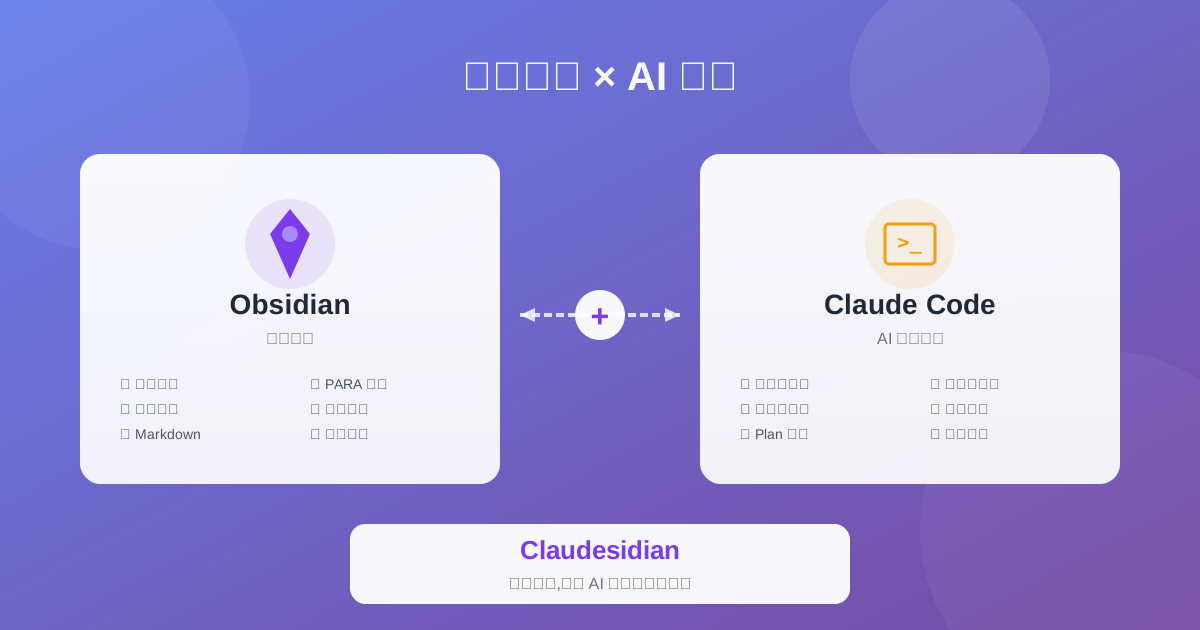
Claudesidian: Transform Obsidian into an AI-Powered Second Brain
Discover Claudesidian, an open-source project that perfectly integrates Obsidian with Claude Code. Built-in PARA method, custom commands, and automated workflows for a complete idea-to-implementation solution.