Overview
Amp (formerly Cody) is an agentic AI coding tool developed by Sourcegraph, officially launched in November 2024. Unlike traditional AI coding assistants that provide simple autocomplete suggestions, Amp is designed to handle complex, multi-step coding tasks with autonomous reasoning capabilities. It runs as both a VS Code extension and a command-line tool, bringing enterprise-grade code intelligence to individual developers.
As of January 2025, Amp has positioned itself alongside Anthropic's Claude Code at the top "S-tier" of AI coding tools, notably outclassing even established players like Cursor in recent comparison rankings. The tool leverages multiple frontier models simultaneously through its sophisticated model routing system, including GPT-5 (via the "Oracle" feature), Claude Opus 4.5, and other cutting-edge AI models.
Amp's core competitive advantage lies in its unconstrained model usage and advanced agent architecture. Rather than limiting users to a fixed token budget or restricting model access, Amp intelligently routes tasks to the best available model for each specific operation. The platform combines multi-model routing with specialized helpers: subagents for parallel work, an Oracle model for deeper analysis using GPT-5 with medium-level reasoning, and a Librarian that can read remote code repositories when needed.
Core Features and Advantages
Multi-Model Routing System
Amp's most distinctive feature is its ability to seamlessly coordinate multiple AI models within a single workflow. Unlike competitors that lock you into one model, Amp automatically selects the optimal model for each subtask—using fast models for routine operations and frontier models like Claude Opus 4.5 or GPT-5 for complex reasoning.
What Makes It Unique: The system doesn't just switch between models; it orchestrates them. For example, when you ask Amp to refactor a large codebase, it might use Claude Opus for architectural planning, GPT-4.1 for code generation, and specialized subagents to work on different files in parallel.
Real-World Impact: Developers report completing tasks in hours that would traditionally take days, with one user noting they migrated an entire codebase from one framework to another in a single afternoon using Amp's Agent Mode.
Oracle Deep Analysis
The Oracle feature gives Amp access to advanced reasoning capabilities through GPT-5 (with reasoning level set to medium by default). This is particularly useful for debugging complex issues, understanding intricate code patterns, or making architectural decisions.
Practical Use Cases:
- Debugging race conditions and concurrency issues
- Analyzing performance bottlenecks across multiple services
- Understanding legacy code with minimal documentation
- Making security vulnerability assessments
CLI and VS Code Integration
Use Amp directly from your terminal with the CLI (npm install -g @sourcegraph/amp) or as a VS Code extension. The dual-interface approach means you can work in your preferred environment without learning a new IDE.
CLI Power Users: The command-line interface is particularly popular among developers who prefer terminal-based workflows. You can pipe code to Amp, chain commands, and integrate it into build scripts or Git hooks.
VS Code Extension: Integrates seamlessly with existing VS Code workflows, appearing as an intelligent coding partner within the editor you already know.
Autonomous Agent Mode
Amp's Agent Mode goes beyond simple code generation to handle multi-step tasks autonomously. The agent can:
- Search your codebase and external documentation
- Make up to 25 tool calls to complete complex tasks
- Execute terminal commands (with your permission)
- Edit multiple files simultaneously with coordinated changes
- Continue working with the "Continue" button when it reaches tool limits
Yolo Mode: For repetitive tasks, enable Yolo Mode to let the agent execute commands without asking for confirmation each time—ideal for running test suites or build processes iteratively.
Librarian Remote Code Access
The Librarian feature allows Amp to fetch and analyze code from remote repositories, documentation sites, and package registries. This is invaluable when working with unfamiliar libraries or integrating third-party APIs.
Shareable Threads
All Amp conversations are organized into threads that can be shared with team members. This makes it easy to collaborate on complex problems, document decisions, and onboard new developers to codebases.
Use Cases
Amp is particularly well-suited for these scenarios:
- Complex Refactoring Projects: Multi-file changes requiring coordinated edits across the codebase
- Framework Migrations: Moving from one framework or language version to another
- Legacy Code Modernization: Understanding and updating old codebases with minimal documentation
- API Integration: Researching and implementing integrations with unfamiliar third-party services
- Performance Optimization: Deep analysis of performance bottlenecks across services
- Security Audits: Comprehensive code reviews for vulnerabilities
Less Suitable Scenarios:
- Simple autocomplete needs: Amp is overkill for basic tab-completion
- Highly regulated environments: Cloud-dependent features may not meet compliance requirements
- Offline development: Core features require internet connectivity
Pricing and Value
Amp uses a straightforward daily pricing model, significantly simpler than competitor subscription tiers:
| Plan | Price | Key Benefits |
|---|---|---|
| Free Mode | $0 | Ad-supported, basic features, training data shared |
| Smart Mode | $10/day | Any mode including Claude Opus 4.5, unlimited usage |
| Research Preview | Free during beta | New users get $10 daily grant |
Pricing Philosophy: As of January 2026, Amp charges $10/day for any mode, including smart mode with Opus 4.5. This pay-as-you-go model is highly cost-effective for developers who don't code every day—you only pay for days you actually use the tool.
Cost Comparison: Compared to Cursor's $20/month subscription (which equals ~$0.66/day if used daily), Amp costs more per active day but can be significantly cheaper for part-time users. A developer who codes 3 days per week would pay ~$120-130/month with Amp vs $20/month with Cursor—however, Amp provides unconstrained access to top-tier models without usage caps.
Free Mode Tradeoff: Amp's free, ad-supported mode with training data sharing represents an innovative approach to democratizing AI coding tools, though privacy-conscious users may prefer paid tiers.
User Reviews and Community Feedback
Based on feedback from Reddit, Hacker News, Twitter, and developer forums:
Positive Reviews:
- "Amp finally delivers on the promise of agentic coding. It actually completes complex tasks autonomously." — r/ClaudeCode
- "The Oracle feature saved me days of debugging. It understood a race condition I'd been struggling with for weeks." — Hacker News
- "Model routing is brilliant. I don't have to think about which AI to use anymore." — Twitter developer
- "Spinning out from Sourcegraph gives them the agility to compete with Cursor and Claude Code." — Product Hunt review
Negative Reviews:
- Young Product: "Still feels like a research preview—some features are rough around the edges"
- Cost for Daily Users: "$10/day adds up fast if you're coding full-time every day"
- Limited Ecosystem: "Doesn't have the extension ecosystem or community resources that VS Code + Copilot offers"
- Occasional Hallucinations: "Agent mode sometimes goes down rabbit holes or misunderstands requirements"
Potential Drawbacks
1. Cost Structure for Full-Time Developers
- Daily pricing ($10/day) becomes expensive for developers who code 5-7 days per week
- Monthly costs can reach $200-300 for full-time users
- Subscription-based competitors offer better value for daily usage
2. Relative Newness
- Launched late 2024, less mature than established competitors
- Smaller user community means fewer tutorials and troubleshooting resources
- Some advanced features still in active development
3. Model Dependency
- Requires internet connectivity and cloud model access
- Performance dependent on external API availability
- Data privacy concerns for sensitive codebases
4. Learning Curve
- Agentic workflow paradigm differs from traditional coding
- Tool call limits (25 per session) can interrupt flow on complex tasks
- Understanding when to use Oracle vs standard models takes practice
Getting Started
Quick Start Guide
Install via npm:
npm install -g @sourcegraph/amp ampOr Install VS Code Extension: Search for "Amp (Research Preview)" in VS Code marketplace by Sourcegraph
Authenticate: Follow prompts to sign in with your Sourcegraph account or create a new one
Start Your First Task: Try something like: "Refactor this component to use TypeScript" or "Find and fix all security vulnerabilities in this file"
Pro Tips
- Use Oracle for Hard Problems: Prefix requests with "Oracle:" for deep analysis on complex issues
- Enable Yolo Mode for Tests: Let agent run test suites automatically without confirmation prompts
- Share Threads for Collaboration: Use shareable threads to document complex decisions and get team input
- Leverage Librarian: Ask Amp to research documentation or external code when integrating new libraries
Alternatives
If Amp isn't the right fit, consider these alternatives:
- Cursor: Best for developers who code daily and want all-in-one IDE experience ($20/month)
- GitHub Copilot: Better integration with GitHub workflows and Microsoft ecosystem ($10/month)
- Claude Code: More comprehensive CLI tool with hooks and extensibility (similar pricing)
- Cline (formerly Claude Dev): Free, open-source alternative for VS Code
Conclusion
Amp represents a bold approach to AI-assisted coding, prioritizing autonomous capability and model flexibility over constrained subscriptions. Its multi-model routing, Oracle deep analysis, and truly agentic behavior make it particularly powerful for complex, multi-step tasks that would traditionally require hours of manual work.
Recommended for:
- Part-time developers or freelancers who don't code every day
- Teams tackling complex refactoring or migration projects
- Developers who value model quality and autonomy over cost predictability
- Early adopters interested in cutting-edge agentic coding capabilities
Not Recommended for:
- Full-time developers seeking predictable monthly costs
- Teams requiring mature ecosystems with extensive documentation
- Organizations with strict data residency or offline requirements
- Developers primarily needing basic autocomplete features
If you work on complex coding tasks a few days per week and want access to the most powerful AI models without artificial limits, Amp's $10/day model offers excellent value. Start with the research preview to experience the platform before committing to daily charges.
Comments
No comments yet. Be the first to comment!
Related Tools
Claude Subagents
claude.ai/code
Multi-agent architecture in Claude Code that enables parallel task execution through specialized AI workers with isolated context windows, overcoming single-agent limitations for complex operations.
Codex CLI
platform.openai.com/docs/models/codex
Codex CLI is a command-line interface tool for OpenAI's Codex model, enabling developers to generate, edit, and refactor code directly from the terminal using natural language prompts.
Google Antigravity
antigravity.google
Google Antigravity is an AI-powered, agent-first IDE built on VS Code that enables developers to delegate complex coding tasks to autonomous AI agents powered by Gemini 3 and Claude models.
Related Insights
Skills + Hooks + Plugins: How Anthropic Redefined AI Coding Tool Extensibility
An in-depth analysis of Claude Code's trinity architecture of Skills, Hooks, and Plugins. Explore why this design is more advanced than GitHub Copilot and Cursor, and how it redefines AI coding tool extensibility through open standards.
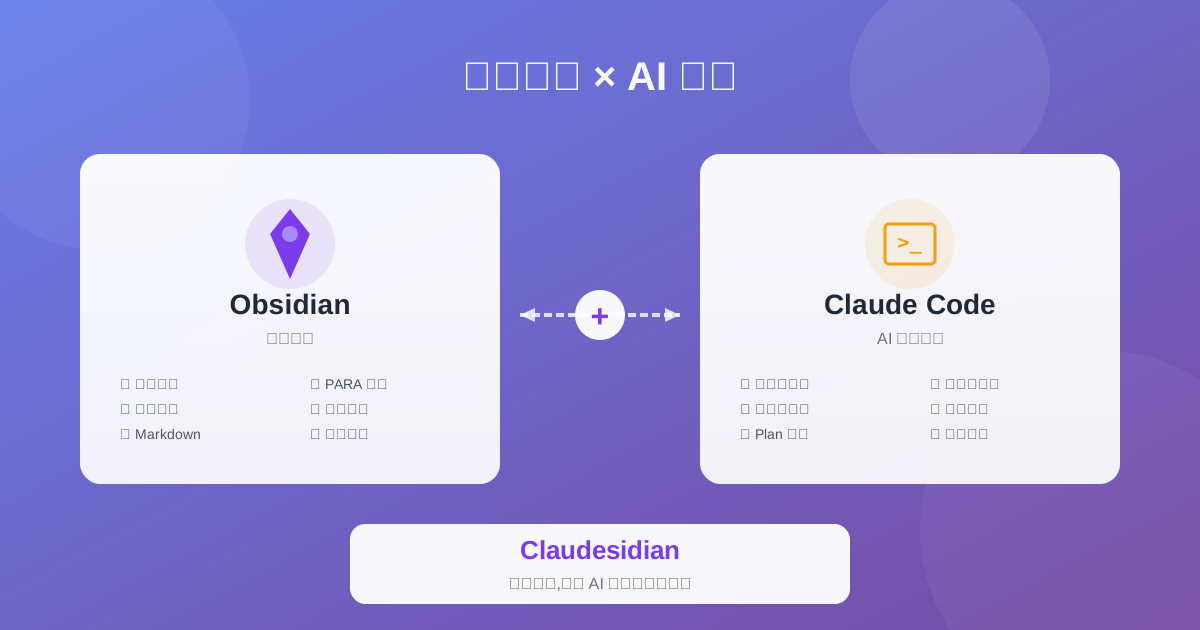
Claudesidian: Transform Obsidian into an AI-Powered Second Brain
Discover Claudesidian, an open-source project that perfectly integrates Obsidian with Claude Code. Built-in PARA method, custom commands, and automated workflows for a complete idea-to-implementation solution.