
Qwen Code
Qwen Code is Alibaba's open-source terminal coding agent. The CLI itself is $0. Model access is billed through Alibaba ModelStudio (Coding Plan with a weekly quota, Token Plan for teams, or a standard API key), third-party providers, or a local/custom endpoint. Qwen OAuth's free tier ended 2026-04-15 and is no longer a selectable /auth entry.
Compare Claude Code if you wanted Anthropic's CLI, Cline if you wanted another $0 individual agent, and Qoder if you wanted Alibaba's IDE seats (Lite $10 / Pro $20 / Pro+ $60 / Ultra $200).
Key Features
- Open CLI, paid models: README still lists Auto-Memory, Auto-Skills, SubAgents, Agent Teams, and MCP. That is not a free ModelStudio quota forever.
- Auth after OAuth: Authentication docs recommend ModelStudio first, then third-party keys (DeepSeek, MiniMax, Z.AI, ModelScope, OpenRouter, Requesty) or a custom/local provider (Ollama / vLLM).
- More than a TUI: Interactive
qwen, headlessqwen -p, VS Code / Zed / JetBrains plugins, Desktop app, experimentalqwen serve, and IM bots. npm needs Node 22+. - Parity claim, not a census: The repo still says it pushed toward Claude Code feature parity. Confirm the installed binary; do not treat that as audited one-to-one coverage.
Use Cases
- People who will stay on BYOK or local models and treat the CLI as Apache-2.0 tooling.
- People who will buy a ModelStudio Coding Plan or Token Plan after OAuth died, and will recheck the live Alibaba quota instead of a leftover free tier.
- People comparing Qwen Code vs Qoder: one is an open CLI, the other is Alibaba's priced IDE.
Limitation: We did not open a logged-in ModelStudio checkout, so there is no public dollar table on this page. Quality still depends on the model you attach.
Pricing
CLI is free. Model access on 2026-08-17.
| Path | Price | Notes from first-party pages |
|---|---|---|
| Qwen Code CLI | $0 | Apache-2.0. 27,102 stars on the check date. |
| ModelStudio Coding Plan | Subscription | Individual path. Weekly quota. Confirm the live Alibaba page. |
| ModelStudio Token Plan | Usage | Team/company path with a dedicated endpoint. |
| ModelStudio API key | Usage | Standard key against an existing ModelStudio account. |
| Third-party / local | Provider or $0 local | DeepSeek, MiniMax, Z.AI, OpenRouter, Ollama, vLLM, and others listed in /auth. |
| Qwen OAuth | Discontinued | Free tier ended 2026-04-15. Not a dialog entry. |
If a leftover blog still says Qwen OAuth is the default free login, treat this table as the source.
Getting Started
- Install with
curl -fsSL https://qwen-code-assets.oss-cn-hangzhou.aliyuncs.com/installation/install-qwen-standalone.sh | bash, ornpm install -g @qwen-code/qwen-code@latest, orbrew install qwen-code. - Run
qwen, then/auth. Pick ModelStudio, a third-party provider, or a custom/local endpoint. - Use
/initforQWEN.mdif you want project instructions. - Do not send users through Qwen OAuth.
Frequently Asked Questions
Is the CLI still free?
Yes. The Apache-2.0 CLI is $0. Models are billed by the provider you attach.
Can I still use Qwen OAuth?
Not as a supported login. The free tier ended 2026-04-15. Use ModelStudio, OpenRouter, or another /auth option.
Same as Claude Code or Qoder?
No. Claude Code is Anthropic's agent. Qoder is Alibaba's IDE with public $10 / $20 / $60 / $200 seats. This page is the open CLI.
Alternatives
- Claude Code: Anthropic CLI / IDE / desktop agent.
- Cline: $0 individual VS Code/CLI agent plus BYOK.
- Qoder: Alibaba IDE seats, not this CLI.
Tips
- Quote 27,102 stars and Apache-2.0 from the GitHub check.
- Confirm
/authbefore you assume OAuth still works.
Conclusion
Qwen Code is an Apache-2.0 terminal agent with 27,102 stars, not a leftover free OAuth login. Start at github.com/QwenLM/qwen-code, attach a live provider, then decide whether Claude Code or Qoder already covers the seat you need.
Comments
No comments yet. Be the first to comment!
Related Tools


Related Insights
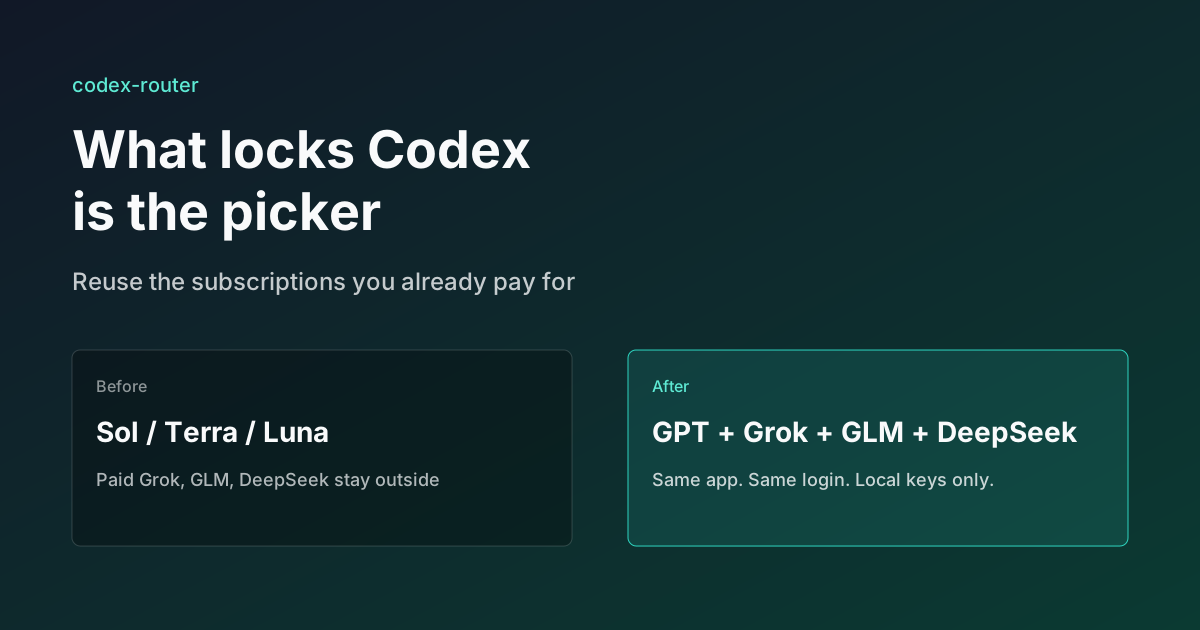
What Locks Codex Is the Picker, Not the Models
You already pay for OpenCode Go, Grok, and Z.ai, but the Codex picker still shows mostly GPT. The community project codex-router does not teach another install ritual. It puts subscriptions you already bought back into the selector, keeps keys on the machine, and leaves native GPT alone.
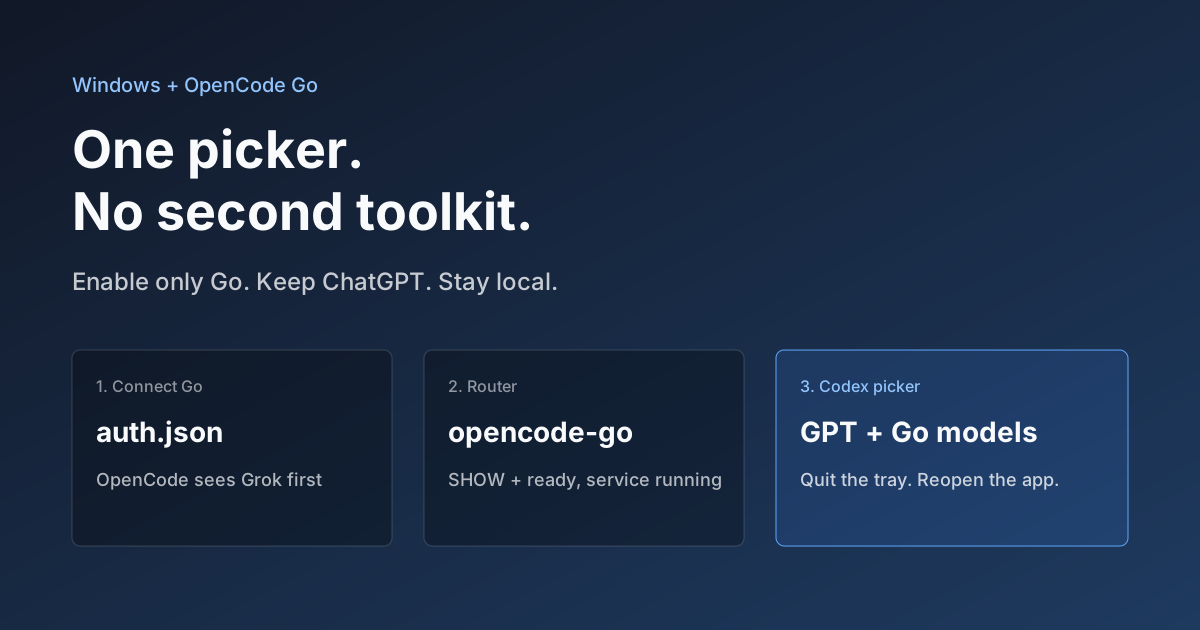
Hook OpenCode Go into Codex on Windows. Do Not Open a Second Toolkit.
A ChatGPT-signed Codex desktop app still shows mostly GPT in the picker. On Windows, enable only OpenCode Go and the Grok, GLM, Kimi, DeepSeek, and MiniMax models you already pay for appear in the same selector. Keys stay local. Native GPT stays put.

Skills + Hooks + Plugins: How Anthropic Redefined AI Coding Tool Extensibility
An in-depth analysis of Claude Code's trinity architecture of Skills, Hooks, and Plugins. Explore why this design is more advanced than GitHub Copilot and Cursor, and how it redefines AI coding tool extensibility through open standards.