

Grok 4.7 is SpaceXAI's flagship successor to Grok 4.6, positioned for long-running software engineering, knowledge work, and agentic tasks. The model appeared in OpenRouter's catalog on 2026-09-21 under the canonical slug grok-4.7-20260916, and GitHub's own documentation lists Grok 4.7 as GA in GitHub Copilot alongside Grok 4.5 and 4.6. It is also live in Devin Desktop and Devin CLI. The headline number on the listing is 46.4 on the Artificial Analysis Intelligence Index, up from 44.3 for Grok 4.6.
Model Specifications
| Specification | Grok 4.7 |
|---|---|
| Context window | 500,000 tokens |
| Max output | 450,000 tokens |
| Input | Text, image, file |
| Output | Text |
| Reasoning effort | low, medium, high (default), xhigh; reasoning is mandatory |
| Tool calling / structured output | Supported through the OpenRouter endpoint |
| License | Closed weights |
SpaceXAI has not published a parameter count for Grok 4.7. The "2.1T" figure that circulated before release came from Elon Musk's X posts rather than a model card, and the 1.5T number behind Grok 4.5 and 4.6 was sourced the same way. Treat any parameter claim you see for this model as unconfirmed.
Pricing
Prices below are per million tokens from the OpenRouter listing, checked on 2026-09-22.
| Prompt size | Input | Cached input | Output |
|---|---|---|---|
| < 200K tokens | $1.60 | $0.40 | $4.80 |
| >= 200K tokens | $3.20 | $0.80 | $9.60 |
Web search costs $0.005 per request. Against Grok 4.6 at $2.00 input and $6.00 output, the sticker price is roughly 20% lower, and the long-prompt surcharge doubles rather than triples the rate.
The Token-Cost Caveat
A cheaper per-token price does not automatically mean a cheaper task. Community reporting on Artificial Analysis output-token counts puts Grok 4.6 High at about 36,000 tokens per task and Grok 4.7 High at about 66,000, and the release-day discussion on Reddit and X was dominated by exactly that trade-off. Several developers said they were moving back to Grok 4.6 for routine work. If cost per completed task is what you are optimising, benchmark advertised prices against your own trajectories before switching a team over.
Availability
- GitHub Copilot: listed as GA in GitHub's supported-models documentation.
- Devin: available in Devin Desktop and Devin CLI.
- Vercel AI Gateway: SpaceXAI's own account announced a 40% Grok 4.7 discount on AI Gateway running through 2026-09-27.
- OpenRouter and the Grok API: listed and callable today.
- Consumer apps: rollout to the Grok apps was still in progress on release day, with users reporting they had not received it yet.
Limitations
- Closed weights. Like the rest of the Grok line, this is an API and subscription model, not a downloadable one.
- No verified parameter count. The pre-release 2.1T rumour has not been confirmed by SpaceXAI.
- Incomplete independent scoring. At release, OpenRouter carried an intelligence index for Grok 4.7 but no coding or agentic index, and Grok 4.6 already had both.
- Mixed first-week reception. The strongest criticism was about token burn rather than capability.
- Long-prompt penalty. Past 200K prompt tokens every rate doubles.
FAQ
Is Grok 4.7 better than Grok 4.6?
On the Artificial Analysis Intelligence Index the listing shows 46.4 against 44.3, so yes on measured intelligence. On cost, it depends on how many tokens your workload actually emits; the widely shared complaint is that 4.7 spends far more of them.
Is it open weights?
No. Grok 4.7 is closed. For open weights in this price band, compare DeepSeek V4 Pro 0813.
Where can I use it today?
GitHub Copilot, Devin Desktop and Devin CLI, OpenRouter, the xAI API, and Vercel AI Gateway.
Does it support reasoning effort controls?
Yes. Low, medium, high (default), and xhigh are all exposed, and reasoning is mandatory rather than optional.
Alternatives
- Grok 4.6: the previous flagship, still the cheaper choice per completed task for many coding workloads.
- Claude Opus 5: the reference point for effort-controlled enterprise coding and long-horizon agent work.
- GPT-5.6 Sol: OpenAI's flagship, and the model Grok 4.7 is most often compared to on price.
Conclusion
Grok 4.7 is a straightforward iteration with a sharper price: better measured intelligence than Grok 4.6, a lower cost per token, and day-one availability inside GitHub Copilot and Devin, which is where most developers will actually meet it. The catch is token efficiency. Run it on your own workloads before assuming the cheaper rate card produces cheaper tasks.
Comments
No comments yet. Be the first to comment!
Related Tools


Related Insights

Grok Bot and Hermes Bot: one person finally gets a think tank and a secretariat
Grok Bot now ships with Cursor Pro+. Hermes Bot runs on a VPS. They are not smarter chat boxes. The think tank advises, the secretariat executes, and you still make the call.
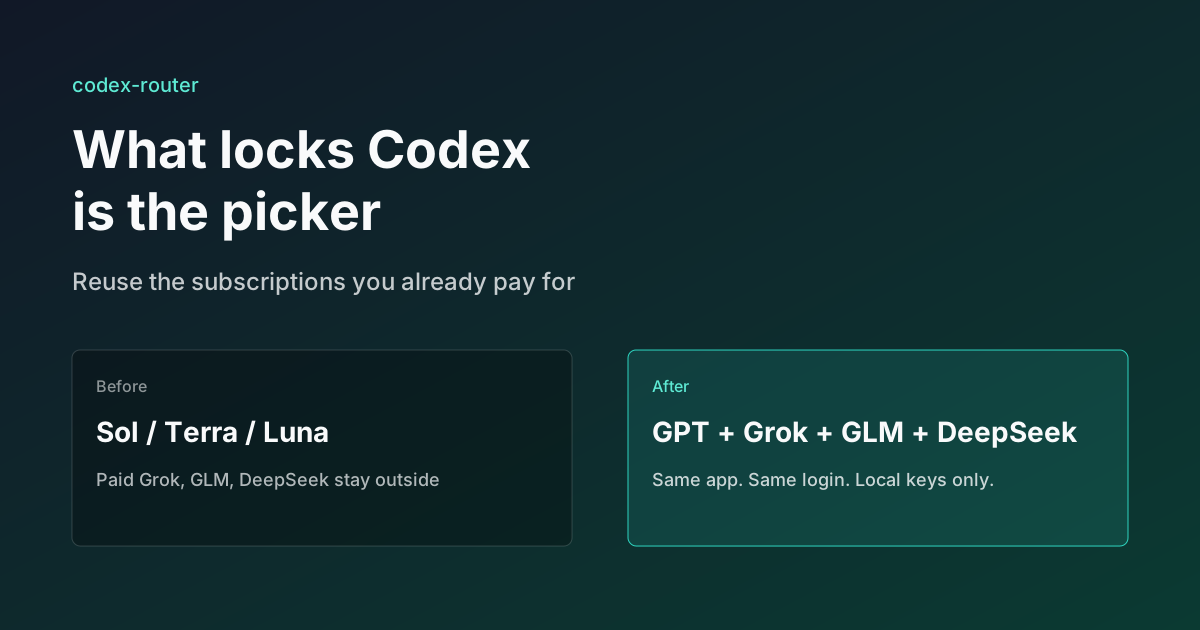
What Locks Codex Is the Picker, Not the Models
You already pay for OpenCode Go, Grok, and Z.ai, but the Codex picker still shows mostly GPT. The community project codex-router does not teach another install ritual. It puts subscriptions you already bought back into the selector, keeps keys on the machine, and leaves native GPT alone.
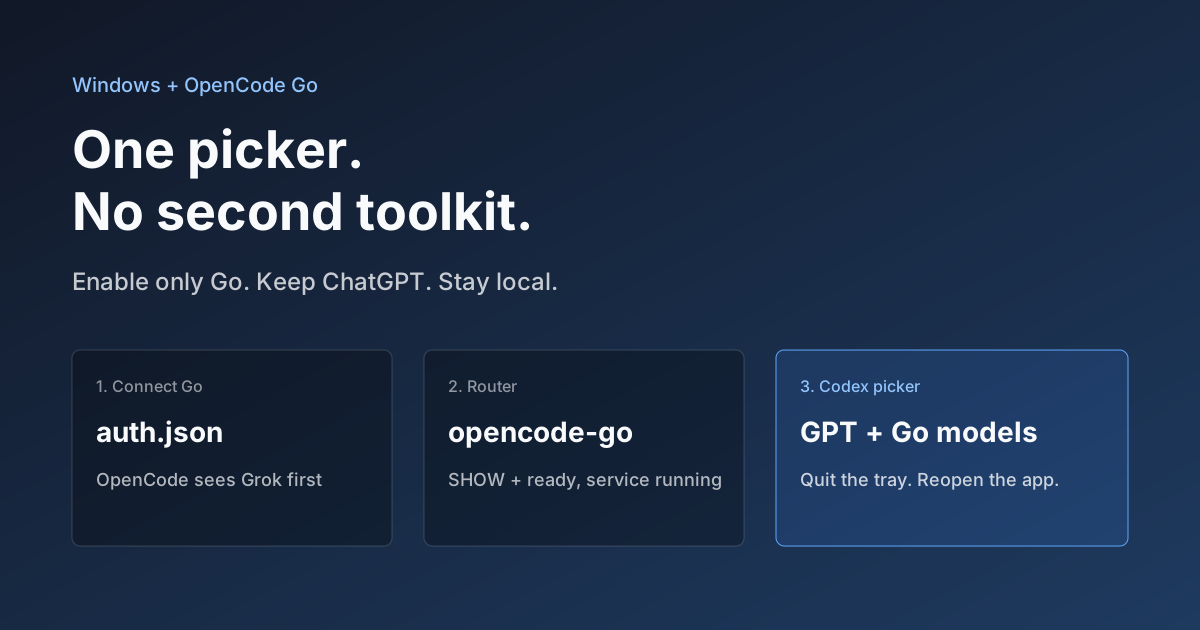
Hook OpenCode Go into Codex on Windows. Do Not Open a Second Toolkit.
A ChatGPT-signed Codex desktop app still shows mostly GPT in the picker. On Windows, enable only OpenCode Go and the Grok, GLM, Kimi, DeepSeek, and MiniMax models you already pay for appear in the same selector. Keys stay local. Native GPT stays put.