

Peacebell
Peacebell is Wayne Workman's small English language-model project focused on World War II. The author publishes 291M and 148M checkpoints, with Apache-2.0 model licensing. The 291M model card describes a model trained from random initialization rather than a fine-tune or distillation of another checkpoint. Its narrow scope makes it an interesting example for studying domain-specific small-model training, rather than a replacement for a general assistant.
Key features
- A GPT-style decoder, a custom SentencePiece tokenizer, and documented training datasets.
- English dialogue and question answering about the Second World War, as described by the author.
- Downloadable weights and inference code, with CPU and GPU execution options.
- A browser demo, including a CPU-only Space that does not require ZeroGPU quota.
Use cases and boundaries
A learner can ask a narrow historical question, compare the response with an authoritative history source, and inspect where the small model loses detail. A researcher can examine the model card and dataset provenance to study specialized training. These are evaluation workflows, not evidence that every historical answer is accurate.
The model card explicitly describes closed-book behavior: answers come from model memory. It has no open-book or RAG ability. Pasting a source passage does not make its answer grounded in that passage, and it may ignore or contradict supplied context. The documented 32,768-token context is an architectural limit, not a promise of reliable long-conversation reasoning.
Pricing and license
The model cards declare Apache-2.0. Downloading open weights does not include free unlimited hosting; local compute and any hosted service charges are separate. No paid Peacebell subscription price was verified. The 291M repository was created September 14, 2026, according to Hugging Face metadata; that date is used here instead of inventing a launch time for the whole project.
Getting started
- Try the CPU demo with a short question in English.
- Use the recommended temperature of zero and start a new conversation when changing subjects.
- Compare dates, names, quotations, and quantities with reliable historical sources.
- For local execution, read the inference instructions and inspect the shipped custom modeling code before loading it.
Frequently asked questions
Can it analyze uploaded historical documents?
It is not trained for retrieval-grounded reading. Use a document-oriented research tool for that workflow.
Does a smaller checkpoint guarantee faster or better answers?
No catalog benchmark was run. Performance depends on the checkpoint, hardware, runtime, and task; parameter count alone does not establish quality.
Alternatives and next step
Compare Llama 3.2 1B Instruct for a broader small-model starting point, or NotebookLM for work centered on supplied documents. Explore the local AI tag.
Begin with a small, repeatable set of historical questions and record errors alongside successful answers. Peacebell is useful for examining a focused training project, with source checking remaining essential.
Comments
No comments yet. Be the first to comment!
Related Tools


Related Insights
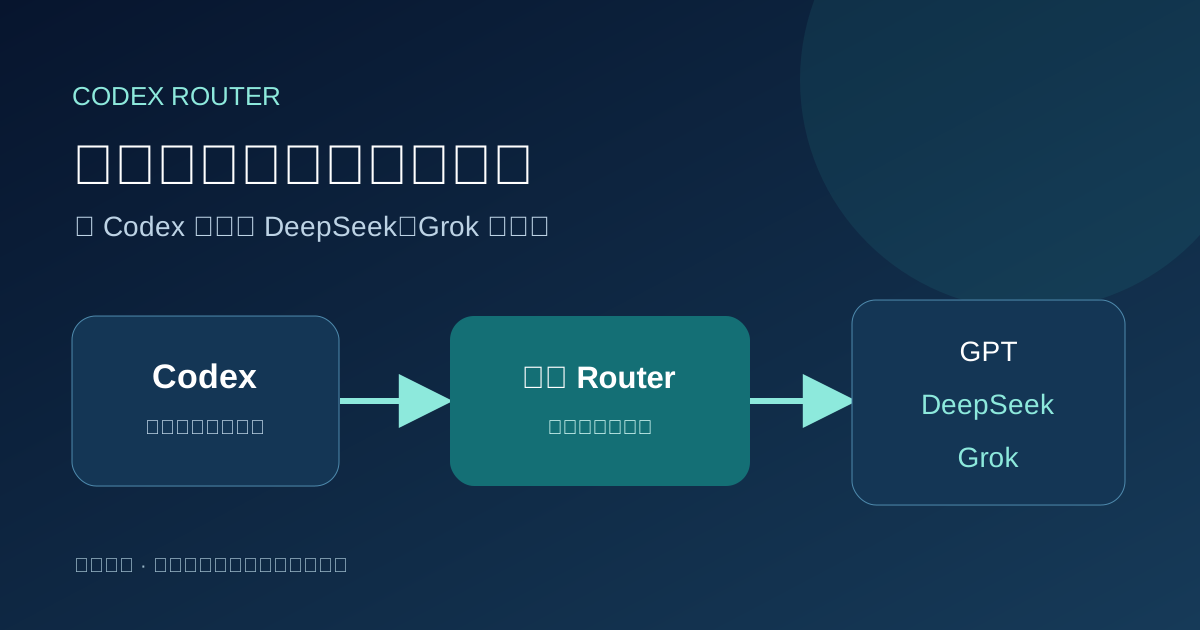
Running low on ChatGPT Codex quota? Switch to DeepSeek or Grok inside Codex
Codex Router lets you keep your Codex workspace while using DeepSeek, Grok, and other external models. A plain-English guide to routing, quotas, and network access.
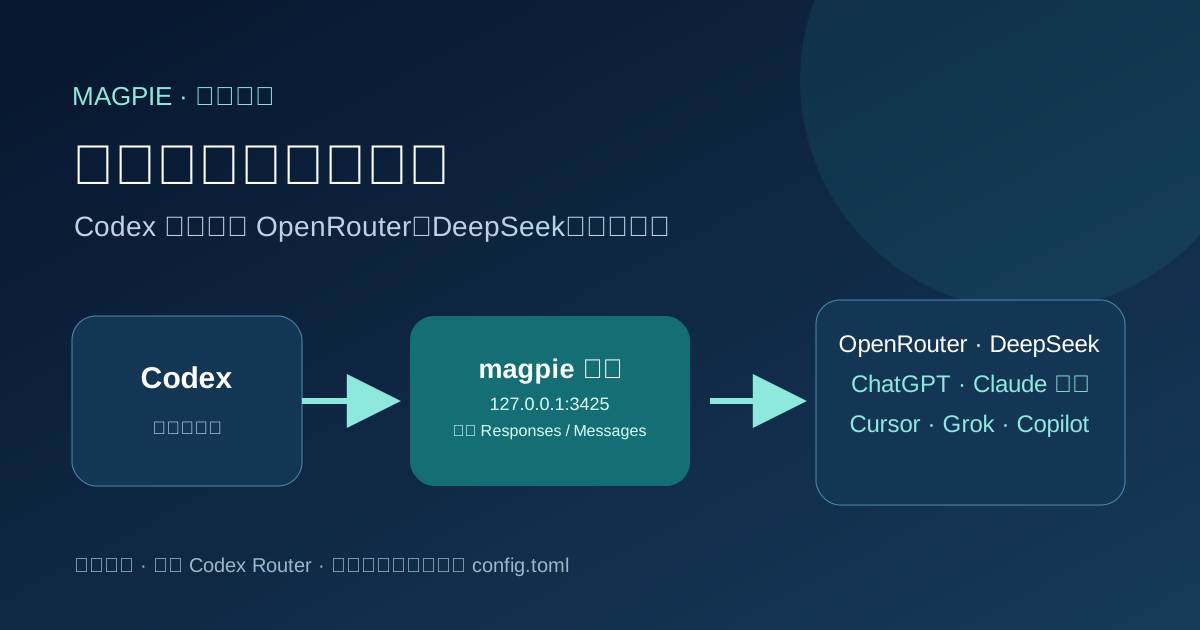
Codex on any model: magpie makes Codex Router unnecessary
magpie is a free, open-source menu bar app that runs a local gateway and puts OpenRouter, DeepSeek and your ChatGPT, Claude, Cursor, Grok and Copilot subscriptions right into Codex's own model picker, with one click and no Codex Router.

Obsidian CLI + Codex: Turn Your Vault into an Agent Knowledge Engine
Obsidian CLI gives Codex and other agents a searchable, auditable, link-aware interface to a local Vault, using real cases and reproducible workflows.