

Algorithmic Art Skill
Algorithmic Art is an example Claude Skills package for p5.js sketches, not a leftover generative-art studio. skills/algorithmic-art/SKILL.md still says: write an algorithmic philosophy (.md), then express it as p5.js (.html + .js) with seeded randomness. Frontmatter triggers on generative art, flow fields, and particle systems, and again forbids copying existing artists.
Compare Canvas Design if you wanted a static PNG/PDF, Claude Skills for loading, and Claude Code for the host CLI.
Key Features
- Two artifacts after the manifesto: Interactive viewer (
.html) and algorithm (.js). That is first-party, not a leftover NFT factory. - p5.js, not a hosted renderer: You get local files. There is no Anthropic art Cloud.
- Seeded variation is in the file: SKILL.md names seeded randomness, noise fields, particles, flows.
- YouTube leftovers are optional: We do not keep an unverified Coding Train embed as a product requirement.
Use Cases
- People who asked Claude Code for generative / flow-field art.
- People who should have used Canvas Design because they wanted a poster.
- Teams browsing Anthropic examples (169,913 stars on the parent repo).
Limitation: Output quality is the model plus p5.js. We did not re-run a gallery census.
Pricing
GitHub on 2026-08-18.
| Piece | Price | Notes from first-party pages |
|---|---|---|
| anthropics/skills example | $0 to clone | 169,913 stars. |
| Claude Code / Claude | Confirm that product | Skill runs in the agent. |
If a leftover blog still sells a paid generative studio, treat this table as the source.
Getting Started
- Open github.com/anthropics/skills/tree/main/skills/algorithmic-art.
- Confirm Claude Skills for how to install the folder.
- Confirm Canvas Design if you wanted PNG/PDF, not HTML/JS.
- Do not paste "NFT collection factory" into a deck.
Frequently Asked Questions
Is it a product?
No. It is one example folder in anthropics/skills.
Does it require p5.js knowledge?
The skill writes p5.js for you. You still review the files.
Same as Canvas Design?
No. Static documents vs generative HTML/JS.
Alternatives
- Canvas Design: Static PNG/PDF example.
- Doc Co-Authoring: Writing example.
- Claude Skills: Platform docs.
Tips
- Quote philosophy +
.html+.jsfrom SKILL.md. - Keep the original-art warning.
- Confirm Claude Code pricing instead of inventing a studio seat.
Conclusion
Algorithmic Art is an Anthropic example skill that writes a p5.js philosophy then HTML/JS, not a leftover generative studio. Start at github.com/anthropics/skills/tree/main/skills/algorithmic-art, then decide whether Canvas Design already covers the static case.
Comments
No comments yet. Be the first to comment!
Related Tools


Related Insights

Anthropic Subagent: The Multi-Agent Architecture Revolution
Deep dive into Anthropic multi-agent architecture design. Learn how Subagents break through context window limitations, achieve 90% performance improvements, and real-world applications in Claude Code.

Skills + Hooks + Plugins: How Anthropic Redefined AI Coding Tool Extensibility
An in-depth analysis of Claude Code's trinity architecture of Skills, Hooks, and Plugins. Explore why this design is more advanced than GitHub Copilot and Cursor, and how it redefines AI coding tool extensibility through open standards.
Seven AI Coding CLIs, Six Months: No Matter How Strong the Model, Work Needs Supervision
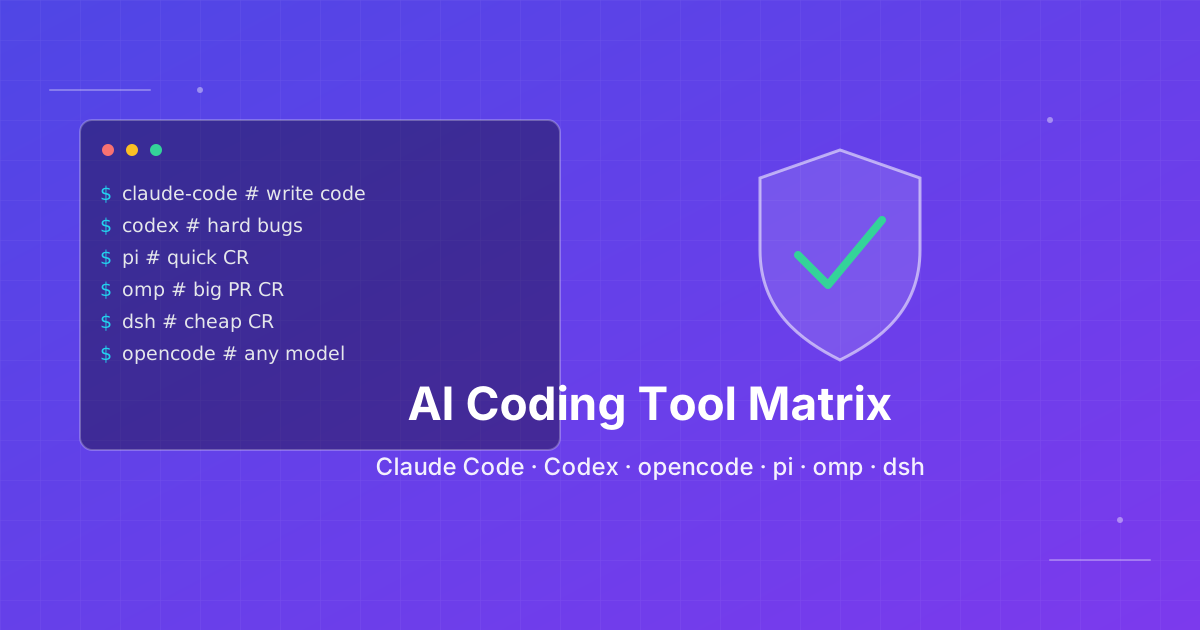
Claude Code, Codex, opencode, pi, omp and DeepSeek Harness all have personalities. After six months of deep use I run a division of labor: pi for the fastest cheapest reviews, omp for complex PRs, DeepSeek Harness on V4 Flash for high-frequency low-cost review, and Claude Code, Qoder and Cursor for writing. No matter how strong the model, work needs supervision — ideally from an independent third party.