

Receiving Code Review is a skill from Superpowers (skill source). It activates when an agent gets review feedback, before it implements anything, and replaces reflexive agreement with technical evaluation. Its principle: verify before implementing, ask before assuming, technical correctness over social comfort.
Key Features
- Response pattern: read the whole review, restate each requirement, verify it against the codebase, evaluate it for this codebase, respond, then implement one item at a time and test each.
- Forbidden phrases: "You're absolutely right!", "Great point!" and thanks of any kind. A correct review gets "Fixed" plus what changed.
- Unclear items block everything: if items 4 and 5 of six are unclear, the agent asks before implementing any of them, because items may be related.
- Source-aware trust: feedback from you is trusted once understood; external reviewers get five checks, including whether they understood the full context and whether the change breaks other platforms.
- YAGNI check: when a reviewer asks to "implement properly", the agent searches for real usage and may propose removal instead.
- Order of work: blocking issues first, then simple fixes, then complex refactors.
- GitHub etiquette: inline review comments are answered in their thread through the
gh apireplies endpoint, not as a top-level comment.
Use Cases
- Processing reviewer output from Requesting Code Review.
- Handling pull request comments from teammates or bots.
- Any review where some suggestions may be wrong for your stack.
Pricing
Free and open source under the MIT license. Prime Radiant, the company behind Superpowers, sells commercial support to enterprises. The practical cost is tokens: process skills add questions, reviews and subagent runs.
Getting Started
Superpowers installs as one plugin, so this skill arrives with the rest of the library (15 skills in v6.4.1). In Claude Code run /plugin install superpowers@claude-plugins-official. Cursor uses /add-plugin superpowers, Gemini CLI uses gemini extensions install https://github.com/obra/superpowers, and the README lists commands for Codex, GitHub Copilot CLI, OpenCode, Pi and other harnesses. Skills trigger on their own; you can also ask for one by name. Paste review feedback or point the agent at a pull request; it should restate and verify before editing.
Limitation: agents following it can come across as terse, since it bans thanks. It also relies on the agent having enough codebase access to check each claim.
FAQ
Will it ignore my feedback?
No. Your feedback is trusted after it is understood; the skepticism is aimed at external reviewers.
What if the agent pushed back and was wrong?
The skill has a section for correcting itself plainly and moving on.
Alternatives
- CodeRabbit: produces the review comments this skill processes.
- Andon: turns recurring defects into lasting countermeasures.
- Systematic Debugging: for feedback that reveals a real bug.
Conclusion
It makes agents treat review as engineering, not etiquette. More in the skills hub.
Comments
No comments yet. Be the first to comment!
Related Tools

Related Insights
Claude Code's Next Frontier: Not Code, But Your Local Obsidian Knowledge Base
Explore how Obsidian + Claude Code transforms from a knowledge management tool into your private AI assistant. Complete guide including obsidian-skills, Claudian plugin, Claudesidian template, and best practices for achieving both data privacy and AI capabilities.
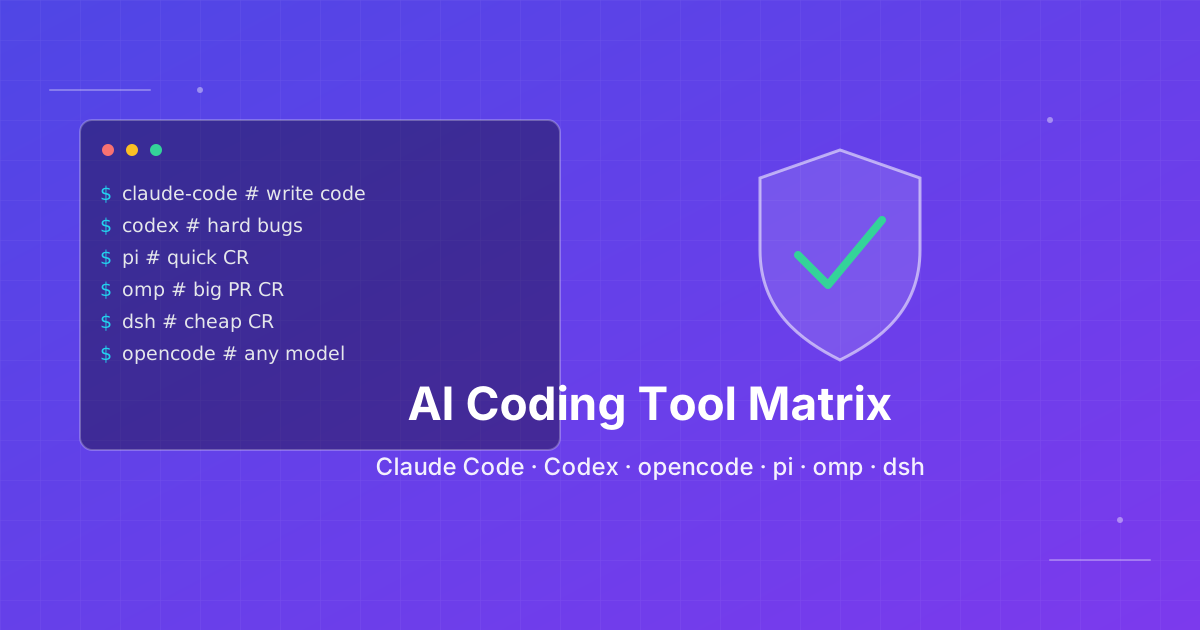
How to pick an AI coding CLI for your repo
Match Claude Code, Codex CLI, OpenCode, Pi, omp, DeepSeek Harness, and Grok Build to the work you actually run. Docs rechecked 2026-10-06.

Anthropic Subagent: The Multi-Agent Architecture Revolution
Deep dive into Anthropic multi-agent architecture design. Learn how Subagents break through context window limitations, achieve 90% performance improvements, and real-world applications in Claude Code.