

Requesting Code Review is a skill from Superpowers (skill source). It tells a coding agent when and how to get its own work reviewed: by dispatching a separate reviewer subagent that receives precisely crafted context, never the session's history, so the review judges the work product rather than the reasoning that produced it.
Core principle: review early, review often.
Key Features
- When: mandatory after each task in Subagent-Driven Development, after a major feature, and before merging to main; optional when stuck, before a refactor, or after a tricky bug fix.
- How: record
BASE_SHAandHEAD_SHA, then fill the bundledcode-reviewer.mdtemplate with a description, the plan or requirements, and the git range. - Reviewer prompt: the template frames the spec as a vision document, so behavior a reasonable user would expect counts even if the spec is silent, and asks the reviewer to list what it chose not to judge.
- Acting on feedback: fix Critical issues immediately, fix Important issues before moving on, note Minor ones, and push back with technical reasoning when the reviewer is wrong.
- Context economy: the diff lives in the reviewer's context, and only findings come back to the coordinating agent.
Use Cases
- A checkpoint between tasks in a long autonomous run.
- A final review before opening a pull request.
- A fresh perspective when the agent is stuck.
Pricing
Free and open source under the MIT license. Prime Radiant, the company behind Superpowers, sells commercial support to enterprises. The practical cost is tokens: process skills add questions, reviews and subagent runs.
Getting Started
Superpowers installs as one plugin, so this skill arrives with the rest of the library (15 skills in v6.4.1). In Claude Code run /plugin install superpowers@claude-plugins-official. Cursor uses /add-plugin superpowers, Gemini CLI uses gemini extensions install https://github.com/obra/superpowers, and the README lists commands for Codex, GitHub Copilot CLI, OpenCode, Pi and other harnesses. Skills trigger on their own; you can also ask for one by name. After a task, ask the agent to request a review, or let the workflow skills trigger it.
Limitation: it needs a harness with subagents and a git history to diff. A reviewer from the same model family can share blind spots, so it complements, not replaces, human or tool-based review.
FAQ
Does it post comments on GitHub?
No. The review happens in a subagent and the findings return to the session.
What about responding to the review?
That is the sibling skill, Receiving Code Review.
Alternatives
- CodeRabbit: paid AI review directly on pull requests.
- Qodo: credit-priced AI PR review.
- Skills for Real Engineers: includes its own code review skill.
Conclusion
A cheap, repeatable second opinion inside the agent loop. More in the skills hub.
Comments
No comments yet. Be the first to comment!
Related Tools

Related Insights
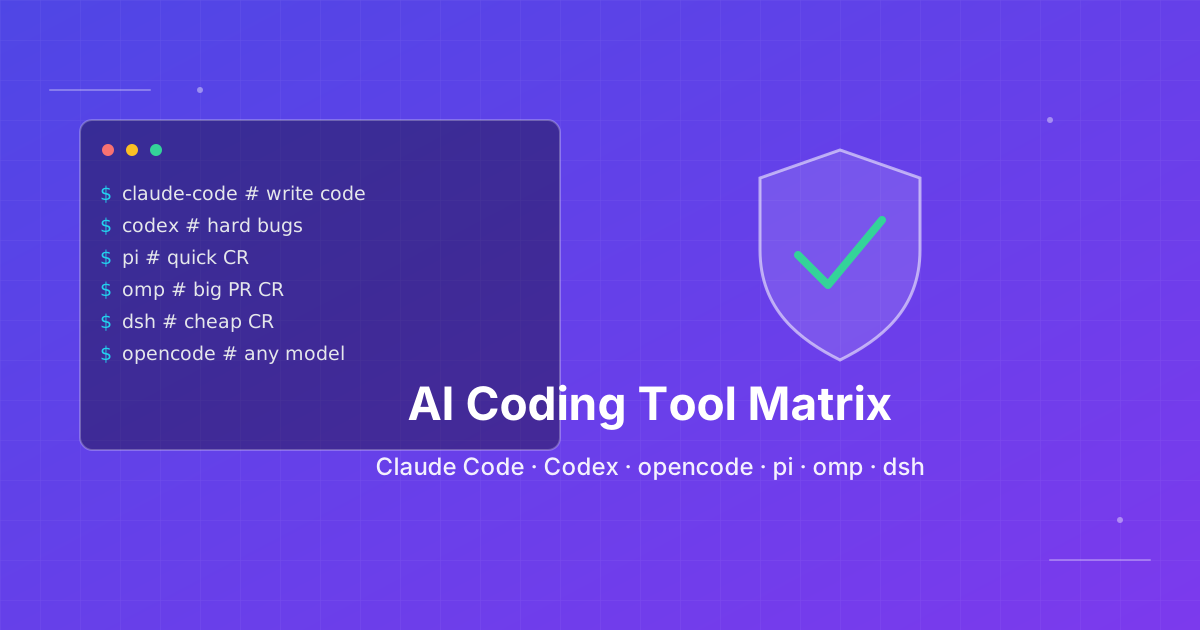
How to pick an AI coding CLI for your repo
Match Claude Code, Codex CLI, OpenCode, Pi, omp, DeepSeek Harness, and Grok Build to the work you actually run. Docs rechecked 2026-10-06.

Anthropic Subagent: The Multi-Agent Architecture Revolution
Deep dive into Anthropic multi-agent architecture design. Learn how Subagents break through context window limitations, achieve 90% performance improvements, and real-world applications in Claude Code.

Skills + Hooks + Plugins: How Anthropic Redefined AI Coding Tool Extensibility
An in-depth analysis of Claude Code's trinity architecture of Skills, Hooks, and Plugins. Explore why this design is more advanced than GitHub Copilot and Cursor, and how it redefines AI coding tool extensibility through open standards.