

Leviathan
Leviathan is an open-source, local-first retrieval tool for agents that need to work with large operational record sets. It turns JSONL, JSON, CSV, TSV, SQLite data, or the output of a database CLI into a SQLite-backed full-text index. Instead of handing an agent a long log dump, its search command returns short, ranked cards with citations. The first stable release, v0.1.0, was published on October 6, 2026 under the Apache-2.0 license.
Key Features
- Broad input support: index line-delimited JSON, regular JSON, CSV, TSV, SQLite, or structured output streamed from tools such as
psqland DuckDB. - Schema-aware setup:
leviathan initinfers a commented configuration, while a mapping can name IDs, titles, text, groups, dates, filters, and display fields. - Compact, cited retrieval:
search,recent,resolve, andgetprovide focused record cards instead of a raw-history paste. Group resolution is designed to report ambiguity rather than silently guess. - Agent integrations: use the CLI with a repository skill, or run
leviathan mcpfor four read-only MCP tools: search, group resolution, record lookup, and index description. - Local operations: the project states that it keeps its index in one SQLite file and can consume database CLI output without taking database credentials itself.
When It Fits
Leviathan is aimed at coding agents, support agents, and internal assistants that must answer questions over tickets, incident logs, CRM exports, or maintenance histories. A practical workflow is to export a bounded data set, run leviathan init to inspect fields, index it with a configuration file, and give the agent its CLI skill. The agent can then search by a customer, machine, or project group before asking for the records behind an answer.
The repository includes a synthetic maintenance-log benchmark. Its published 1-million-record result reports a median 436-token answer context, 99.0% top-five relevant-record retrieval, and 33 ms median latency. Treat this as a project benchmark, not an independent product comparison: the data generator, methodology, hardware, and caveats are all published in the repository.
Installation and Pricing
Leviathan is Apache-2.0 licensed. The project documents cargo install leviathan-index, installation from the Git repository, and prebuilt binaries in GitHub Releases. There is no hosted pricing page or managed service in the official materials reviewed for this entry; the relevant cost is the local machine, index storage, and any surrounding data-export process.
Limitations and Risks
- It is a new v0.1.0 project, so teams should validate its index behavior and release cadence before making it a production dependency.
- Retrieval quality depends on a correct field mapping and the structure of the source records. It is not a replacement for access controls or source-data quality work.
- The benchmark uses synthetic data, and its results should not be generalized to every data set without reproducing the supplied benchmark or testing representative data.
Quick Start
cargo install leviathan-index
leviathan init ./export
leviathan index tickets.csv --id "Ticket ID" --group customer_id --date created_at
leviathan search -g acme "sso login loop after password reset"
Start with a non-sensitive export and inspect the resulting cards before connecting an agent. For a database source, keep credentials in the database client and pipe only the rows intended for indexing into Leviathan.
FAQ
Is Leviathan a hosted vector database?
No. The official project describes a local static binary that builds a SQLite-backed index. It can be used through a CLI or an optional read-only MCP server.
Does it require an LLM to index records?
The documented index and search workflow is local full-text retrieval. An LLM is the consumer of the returned cards when an agent uses the tool, not a stated requirement for building the index.
What is a good alternative?
- Hindsight for an agent memory system that extracts and consolidates facts with LLMs.
- AgentMemory for local coding-agent memory.
- Letta for stateful agents with a managed option.
Conclusion
Leviathan is a focused option when an agent must search large, structured local histories without loading them wholesale into context. Review the official README and the benchmark methodology, then test it with a representative, access-controlled export.
Comments
No comments yet. Be the first to comment!
Related Tools


Related Insights

Anthropic Subagent: The Multi-Agent Architecture Revolution
Deep dive into Anthropic multi-agent architecture design. Learn how Subagents break through context window limitations, achieve 90% performance improvements, and real-world applications in Claude Code.
Stop Cramming AI Assistants into Chat Boxes: Clawdbot Picked the Wrong Battlefield
Clawdbot is convenient, but putting it inside Slack or Discord was the wrong design choice from day one. Chat tools are not for operating tasks, and AI isn't for chatting.
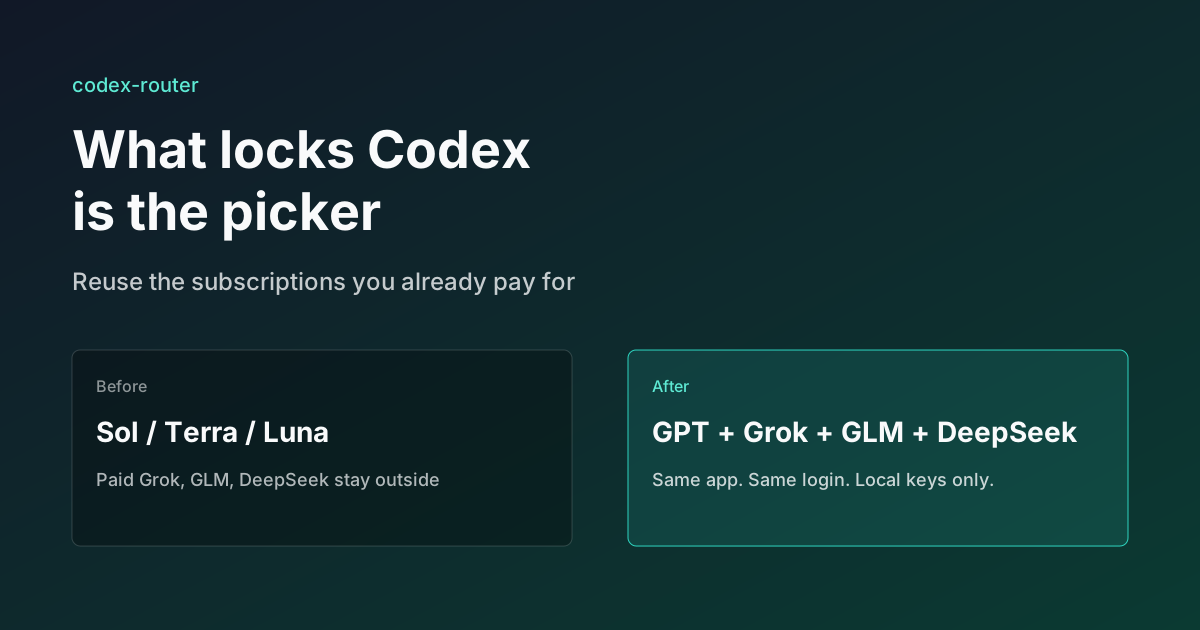
What Locks Codex Is the Picker, Not the Models
You already pay for OpenCode Go, Grok, and Z.ai, but the Codex picker still shows mostly GPT. The community project codex-router does not teach another install ritual. It puts subscriptions you already bought back into the selector, keeps keys on the machine, and leaves native GPT alone.