
Open Agents is Vercel Labs' open-source reference app for building and running background coding agents on Vercel. It is a full, working system rather than a library: the web UI, the agent runtime, sandbox orchestration, and the GitHub integration all ship together, so a prompt can turn into a branch and a pull request without your laptop staying awake. The first-party repository was created on 2025-12-26 and is published under MIT. On 2026-09-21 GitHub listed 5,823 stars and 758 forks, and the last push was 2026-08-29. The README is explicit that the repo is meant to be forked and adapted, not treated as a black box.
How It Is Structured
Open Agents is three layers stacked into one deployment:
Web -> Agent workflow -> Sandbox VM
- The web app handles authentication, sessions, chat, and the streaming UI.
- The agent runs as a durable workflow on Vercel rather than inside the request that started it.
- The sandbox is the execution environment: filesystem, shell, git, dev servers, and preview ports.
The design decision the project calls out first is that the agent is not the sandbox. The agent runs outside the VM and reaches in through tools for reading files, editing, searching, and running shell commands. That separation is what lets agent execution survive a single request lifecycle, lets sandbox lifecycle hibernate and resume on its own, and lets model choice and sandbox implementation evolve independently.
Key Features
- Chat-driven coding agent with file, search, shell, task, skill, and web tools.
- Durable multi-step execution backed by the Vercel Workflow SDK, with streaming and cancellation.
- Isolated Vercel sandboxes that resume from snapshots and hibernate when idle.
- Git work inside the sandbox: clone the repository, work on a branch, and optionally auto-commit, push, and open a pull request after a successful run.
- Session sharing through read-only links, plus optional voice input via ElevenLabs transcription.
Use Cases
- Self-hosted coding agents: teams that want an internal agent platform rather than a hosted product they cannot inspect.
- Long-running background work: refactors, migrations, and test sweeps that should keep going after the tab that started them is closed.
- A reference to learn from: the layered breakdown of web, workflow, and sandbox is useful even if you end up replacing parts of it.
Limitation: this is a template, not a managed product. You supply Postgres, an auth secret, Vercel OAuth credentials, and a GitHub App before it is fully usable, and you own upgrades once you fork it. Auto-commit and auto-PR are preference-driven options, not always-on behavior.
Pricing
| Plan | Price | Notes |
|---|---|---|
| Open Agents | $0 | MIT source, deployed on your own account. |
| Infrastructure | Usage-based | You pay Vercel for functions, workflows, sandboxes, and storage. |
There is no vendor subscription for the software itself as of 2026-09-21; cost is whatever the underlying Vercel and database usage comes to.
Getting Started
The fastest path is the Deploy with Vercel button in the README, which provisions the app and prompts for the required environment variables.
POSTGRES_URL=
BETTER_AUTH_SECRET=
NEXT_PUBLIC_VERCEL_APP_CLIENT_ID=
VERCEL_APP_CLIENT_SECRET=
NEXT_PUBLIC_GITHUB_CLIENT_ID=
GITHUB_CLIENT_SECRET=
GITHUB_APP_ID=
GITHUB_APP_PRIVATE_KEY=
GITHUB_WEBHOOK_SECRET=
For a local run, see apps/web/.env.example. A minimal runtime needs only POSTGRES_URL and BETTER_AUTH_SECRET, but sign-in and GitHub access need their own credentials.
Frequently Asked Questions
Is this a product I can just use?
It is a reference app. It runs, but the intent is that you fork it and adapt the layers to your own environment and policies.
Does the agent run inside the sandbox?
No. The agent stays outside and interacts with the sandbox through tools, which is what makes durable runs and independent sandbox lifecycle possible.
Which ports can a sandbox expose?
The bundled configuration exposes ports 3000, 5173, 4321, and 8000, and can start from a configured base snapshot.
Alternatives
- E2B: focused sandbox infrastructure if you already have an agent runtime and only need the execution layer.
- Daytona: another managed sandbox option for agent code execution.
- LangGraph: a durable graph runtime for the agent logic itself when you would rather bring your own sandbox and UI.
Tips
- Read the "agent is not the sandbox" section before changing anything. Most of the flexibility in the project comes from that boundary.
- Wire the GitHub App early. Auto-commit and auto-PR are where the value shows up, and they need those credentials to do anything.
- Keep the workflow layer in charge of long runs. Starting work inline in a chat request throws away the durability that makes the template interesting.
Conclusion
Open Agents is a concrete answer to "what does a real background coding agent deployment look like." If you are building an internal agent platform and want a forked starting point instead of a week of architecture decisions, it is one of the better places to begin, and it pairs naturally with a dedicated sandbox layer such as E2B.
Comments
No comments yet. Be the first to comment!
Related Tools


Related Insights
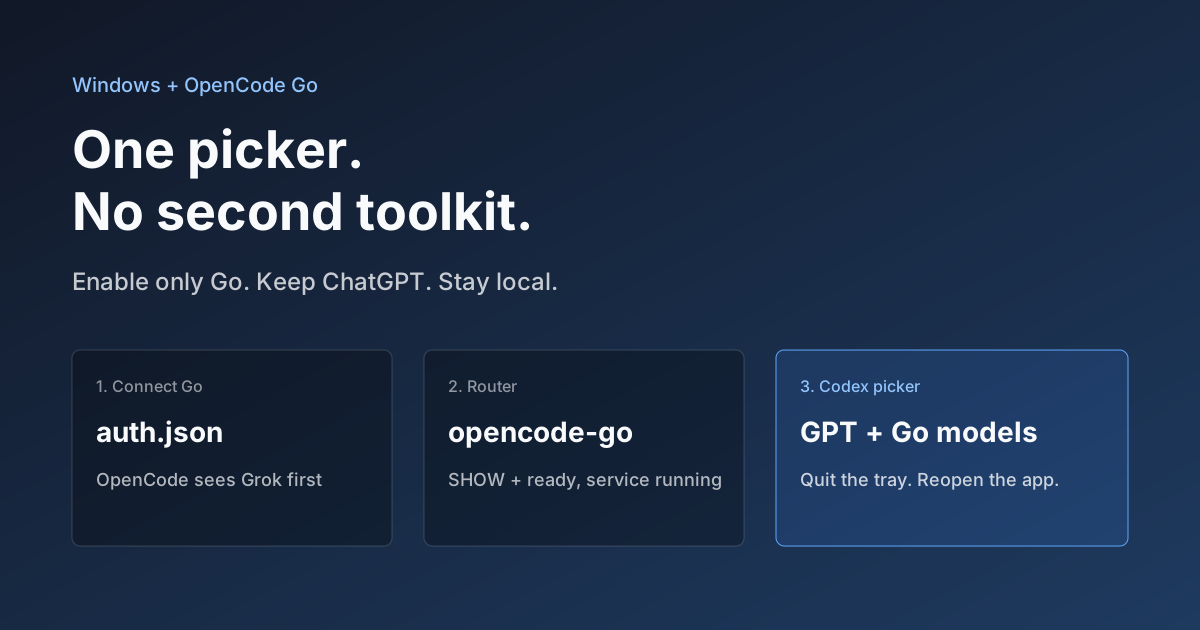
Hook OpenCode Go into Codex on Windows. Do Not Open a Second Toolkit.
A ChatGPT-signed Codex desktop app still shows mostly GPT in the picker. On Windows, enable only OpenCode Go and the Grok, GLM, Kimi, DeepSeek, and MiniMax models you already pay for appear in the same selector. Keys stay local. Native GPT stays put.
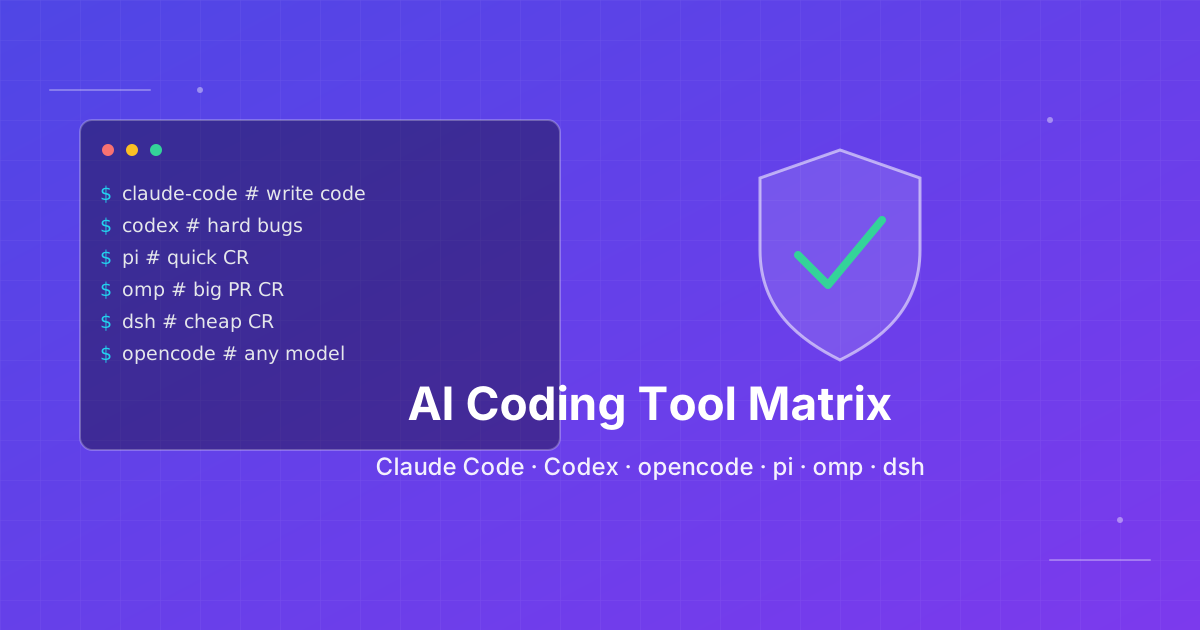
Seven AI Coding CLIs, Six Months: No Matter How Strong the Model, Work Needs Supervision
Claude Code, Codex, opencode, pi, omp and DeepSeek Harness all have personalities. After six months of deep use I run a division of labor: pi for the fastest cheapest reviews, omp for complex PRs, DeepSeek Harness on V4 Flash for high-frequency low-cost review, and Claude Code, Qoder and Cursor for writing. No matter how strong the model, work needs supervision — ideally from an independent third party.

Skills + Hooks + Plugins: How Anthropic Redefined AI Coding Tool Extensibility
An in-depth analysis of Claude Code's trinity architecture of Skills, Hooks, and Plugins. Explore why this design is more advanced than GitHub Copilot and Cursor, and how it redefines AI coding tool extensibility through open standards.