Six AI Coding CLIs, Six Months: No Matter How Strong the Model, Work Needs Supervision

Six AI Coding CLIs, Six Months: No Matter How Strong the Model, Work Needs Supervision

Share:

In 2026, whose terminal doesn't have a few AI coding tools installed? Claude Code, Codex CLI, opencode, pi, omp — and DeepSeek recently shipped its own official harness. I have all of them installed, and I've been using them hard for six months.

Two conclusions up front:

First, there are no bad tools, only mismatched ones — and making one tool do everything is the biggest waste of all.

Second, no matter how strong the model, work needs supervision — ideally from an independent third party.

Here's my real-world breakdown of all six CLIs: what each is great at, where each falls short, and when to reach for which.

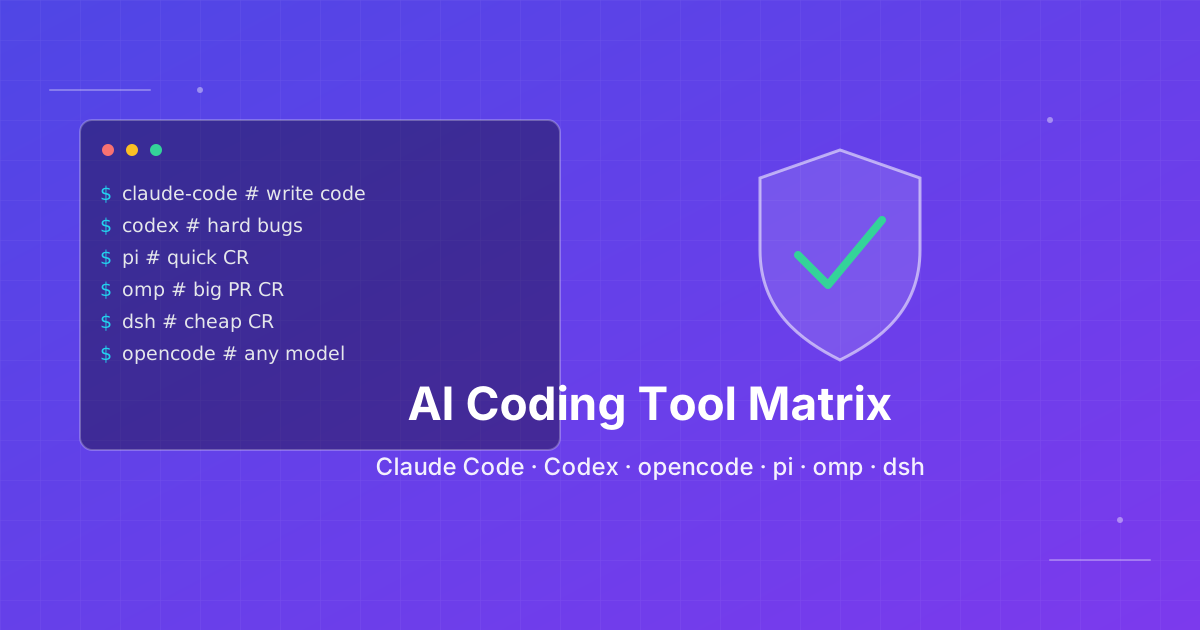
The six tools at a glance

Tool One-liner Best at Clear weakness
Claude Code The most mature terminal coding agent Global understanding, complex refactors, initiative Expensive, tight quotas, strict risk controls
Codex CLI The high-reasoning executor Hard debugging, code review, batch jobs, stability Slow, mediocre code style and abstractions
opencode The model-agnostic universal adapter Trying models, saving tokens, TUI feel Ecosystem still catching up
pi The minimalist harness Fast, cheap, near-zero cost Low capability ceiling
omp The batteries-included agent Full-featured review, real-time advisor, LSP/DAP/browser built in Relatively heavy
DeepSeek Harness DeepSeek's official harness Cheap, fast, absurd cache-hit pricing Just open-sourced, iterating fast

Tool by tool: strengths, weaknesses, and use cases

Claude Code: the writing workhorse

90% of my serious development goes through it. The ecosystem — skills, subagents, hooks, /code-review — is the most mature of the six, and it has the most initiative: give it a goal and it reads code, runs tests, iterates on its own approach, from planning to implementation in one run. For large refactors (20+ files), its global understanding is on another level.

The price is real. It burns tokens fast, quotas create anxiety, and the account risk controls are notorious — the "my CC got banned" memes could fill a book. My rule: serious tasks for it, trivial tasks elsewhere.

Codex CLI: the troubleshooter and straight-talking reviewer

"Quiet and effective" is its whole personality. In high-reasoning mode its debugging is ferocious — there's a Reddit report of "all three bugs fixed in one shot," and my experience matches: it doesn't fuss, it executes the instruction, then verifies. Cost control is good too; it burns noticeably fewer tokens than Claude for the same job.

It's also a formidable reviewer. The Reddit analogy nails it: "Claude will claim everything is done; Codex will point out this and that still need fixing." Give it code to review and it pulls no punches — the issue list comes back clear and complete. That's why the community pairing of "cc max writes, codex reviews" is so popular.

Two weaknesses, though. One is speed, and its "act first, ask later" temperament — with a vague requirement it starts guessing and you need to watch it closely. The other is mediocre code taste: it solves problems solidly, but the style and abstraction level of what it writes are just okay — naming, layering, readability, the "soft skills" — clearly a notch below Claude. So my rule is: let it build, let it review, but don't let it design the architecture. Great for nasty bugs, batch jobs, and high-risk operations that need a sandbox; wrong tool for exploratory work that needs constant alignment, or for codebases with a strong style culture.

opencode: the universal adapter

An open-source agent from SST (MIT), and its biggest card is model-agnosticism — 75+ providers, swap in GLM, MiniMax, DeepSeek, Claude or GPT at will, free models included. The TUI feel is widely regarded as the best of the mainstream three, and it burns fewer tokens than Claude Code.

My use: trying out models, comparing providers, budget-sensitive batch work. It never locks you into any vendor, and that freedom is addictive.

pi: the minimalist

pi is Mario Zechner's deliberately minimal harness: four core tools, a system prompt of ~1k tokens, 15+ providers. It doesn't chase capability ceilings; it chases speed and cheapness — results in seconds at near-zero cost.

So my role for it is clear: the laziest possible CR tool. Single files, small changes, a few minutes of diff — have pi sweep style, latent bugs and security smells. Speed and cheapness are the feature: the cost is low enough that you review every change.

omp: the family pack

omp (Oh My Pi) is the batteries-included fork: hash-anchored edits, native LSP refactors, DAP debugging, browser automation, subagents, 60+ providers — all the IDE capabilities stuffed into the terminal.

My role for it: the complex-PR review tool. For wide-blast-radius PRs it genuinely reads code, runs tests and checks the effect before judging — a full tier above pi in review quality, at costs and speeds that still beat premium models. The balanced pick.

It also ships real-time review: the --advisor runtime attaches a reviewer model (say openai-codex/gpt-5.5) as an advisor that watches every turn the main agent takes, injecting inline notes — a quiet aside, a concern, or a hard blocker — and the main agent course-corrects on the spot, or explains why it won't. Review isn't an afterthought; it happens as you write. That's omp's most distinctive card.

DeepSeek Harness: the cheap review machine

dsh is DeepSeek's official agent harness (MIT, open-sourced August 13, 2026, "Everything is a Plugin") with web / headless / tui profiles; I run 0.1.0-rc.6. Paired with V4 Flash: 1M context, extremely fast, and cache-hit input pricing at $0.0028/M — one fiftieth of the $0.14/M miss rate.

That's the absurd part: it's cheap enough to be an unpaid review laborer. Its cache-friendly design (long sessions keep context stable, pushing hit rates higher) means high-frequency, large-batch reviews run freely — dozens of passes for nearly nothing.

This playbook isn't my invention

While I was putting this division of labor together, I found the community consensus was already there:

On r/ClaudeCode, one line gets quoted constantly — "Claude sins by overreaching, Codex sins by underreaching." So people plan with Claude, implement with Codex, and have each review the other; the conclusion is "use both." Theo on X gives the identical advice: once the API is written, get a second opinion from Opus with claude -p — it significantly improves the code OpenAI models produce.

The Chinese community goes further. The classic V2EX combo: "the endgame is always holding both and cross-reviewing, one main and one backup"; someone routes Claude Code through CC Switch to DeepSeek for basic coding — cheap and fast — "then hands the final integration check to codex"; another reports a 99% cache hit rate on Claude Code + DeepSeek V4 Pro. A Juejin hands-on piece pictures the daily scene as "Cursor writing on the left, Claude Code as advisor in the terminal on the right, Codex reviewing yesterday's PR in the background" — one primary, two assistants. I believe that's the most pragmatic 2026 workflow.

This year's early drama gave it a push too: Anthropic briefly blocked third-party tools from calling Claude, and DHH called it "a paranoid attempt to lock developers into Claude Code." Whatever your take, it sharpened one consensus — don't tie writing and reviewing to the same model.

My three-tier review system

In daily practice, review runs in three tiers of rising cost:

Tier 1: pi — the minimal check, fastest and cheapest. Small changes, single files, a few minutes of diff: pi returns a report in seconds — style, latent bugs, security smells. Enough, at near-zero cost.

Tier 2: omp — complex PRs, the balanced pick. Wide-blast-radius PRs go to omp; it reads code, runs tests and checks effects before judging. The best quality-to-cost balance — and when you want review while you write, flip on --advisor to have a second model watch every turn live.

Tier 3: DeepSeek Harness + V4 Flash — high frequency, high volume, near-zero cost. Batch reviews, full sweeps, weekly code inspections: dsh handles them all, however many rounds.

The killer move: write with Claude/Codex, review with dsh

The best combination I've found in six months: let Claude Code or Codex write the code, then have them run the dsh command so DeepSeek Harness does an independent review pass. (Incidentally, omp's --advisor is the same idea built in — a reviewer model watching every turn of the main agent, writing and reviewing in one flow.)

Three reasons it works:

  1. Independent third party. The writer and reviewer are different models. Self-review means the author is their own referee — errors hide in the model's weak areas, exactly where it can't check itself. A different model has a completely different error profile, so the blind spots complement each other.
  2. High cache hit rate makes cost disappear. DeepSeek's KV cache is prefix-matched; stable long-session contexts easily push hit rates to 95%+ (someone on V2EX reported 99%). At $0.0028/M, dozens of review passes don't hurt.
  3. Speed is productivity. V4 Flash is fast; one dsh command returns a report in tens of seconds. Review flips from "sometimes" to "every commit" — and frequency is itself quality.

Why "independent third-party supervision" actually works

  • Self-review has blind spots. Code a model just wrote always "looks right" to it — that's the dangerous part.
  • Cross-validation catches misses. Two models make non-overlapping mistakes; what A misses, B will probably flag.
  • The cost barrier is gone. Independent review used to mean a second premium-model bill; V4 Flash pricing makes "review every commit" the default.
  • The community already does it. Theo's claude -p second opinion, Reddit's two-model cross-review, the "don't lock yourself to one vendor" consensus — independent third-party review isn't my invention, it's the community's answer in 2026.

Practical steps

Today: give your writing agent one rule — before delivery, have it run dsh (or any other model) over the change.

This week: lock in your review tiers — pi for small changes, omp for big PRs, dsh for high-frequency batches; fix one of Claude Code / Codex / Qoder / Cursor as your writer.

Long term: settle on "writer X + reviewer Y, X ≠ Y". Which model is strongest matters less than the fact that someone is watching.

The bottom line

There's no best tool — only the right tool for each job. The 2026 move isn't picking one winner; it's building a matrix: let every tool do what it's best at, and let a cheap, fast, independent third party hold the quality line.

No matter how strong the model, work needs supervision — ideally from an independent third party.

Comments

No comments yet. Be the first to comment!

Related Tools

Related Articles
Publisher

AI Nexus Team

AI Nexus Team

@hunterzhang86

9 min read