

Reap
Reap sells Visa credentials for agent purchases. It mints a tokenized, single-use card per payment intent, locked to amount, merchant, and time. The same page still prints cards issued in ~120ms. Passkey auth, USDC settlement, 40+ markets, and TAP / MPP / ACP are still on that page. reap.global/pricing lists Card Issuing and Agentic Payments as Talk to us / Get a quote. Dashboard rows such as physical/virtual card FREE, ATM 2%, FX 2%, and bill-pay 0.5% / $25 FX are not the agentic SKU table.
Compare Payman if you wanted bank-facing agent demos, and Skyfire if you wanted KYA / pay tokens instead of Visa cards.
Key Features
- Issuer, not a wrapper: Reap presents itself as a licensed Visa issuer, not a card-on-file proxy.
- One card per intent: Amount, merchant, and lifetime are set at mint. Raw PAN stays out of the model.
- ~120ms is still first-party: Keep that latency only as product-page copy. We did not time a live mint.
- Quote, not a public agentic ladder: Issuing and agentic payments are sales conversations.
- Dashboard fees are a different product: FREE physical/virtual cards and ATM/FX percentages belong to the spend dashboard, not to the agent credential SKU.
Use Cases
- Commerce agents that must pay a Visa merchant without holding a reusable card.
- Platforms that need issuer-level merchant/amount locks plus an audit trail.
- Teams comparing Reap vs Payman vs Skyfire on public pages, not on invented seat prices.
Limitation: We did not complete KYB, mint a live card, or re-verify TAP / MPP / ACP against the protocol specs. Editorially composed reviews from the old entry are out.
Pricing
reap.global/pricing on 2026-08-17.
| Surface | Price | Notes from that page |
|---|---|---|
| Card Issuing | Talk to us / quote | Not a public dollar table. |
| Agentic Payments | Talk to us / quote | Same quote path. Confirm the live official page. |
| Dashboard spend | Public fee rows | Physical/virtual card FREE; ATM 2%; FX 2%; bill-pay 0.5% or $25 FX. Not the agentic SKU. |
If a leftover blog lists a self-serve agentic dollar, treat the quote buttons as the source.
Getting Started
- Open the agentic payments page before you write a deck.
- Use Talk to us if you needed issuing or agent credentials.
- Do not copy dashboard ATM/FX rows into an agent pricing slide.
- Confirm Payman or Skyfire if you needed a different public surface this week.
Frequently Asked Questions
Is there a public agentic dollar table?
No. Issuing and agentic payments are quote-based.
Does Reap still claim ~120ms issuance?
Treat it as marketing copy until you time it.
Same as Payman or Skyfire?
No. Payman sells bank demos. Skyfire documents KYA / pay tokens. Reap mints scoped Visa credentials.
Alternatives
- Payman: Bank and credit-union agentic banking, unlisted price.
- Skyfire: KYA plus payment tokens, unlisted seat table.
- Crossmint: Public $0 / $99 / $499 wallet ladder on the last refresh.
Tips
- Call Reap an issuer-side Visa credential, not a reusable virtual card.
- Keep dashboard fees off the agentic quote.
- Confirm the pricing page before you invent a per-mint dollar.
Conclusion
Reap is still a Visa issuer path for single-use agent credentials, with ~120ms still printed on the product page and no public agentic dollar table. Start at reap.global/products/agentic-payments, then decide whether Payman or Skyfire already covers the surface you need.
Comments
No comments yet. Be the first to comment!
Related Tools


Related Insights

Anthropic Subagent: The Multi-Agent Architecture Revolution
Deep dive into Anthropic multi-agent architecture design. Learn how Subagents break through context window limitations, achieve 90% performance improvements, and real-world applications in Claude Code.
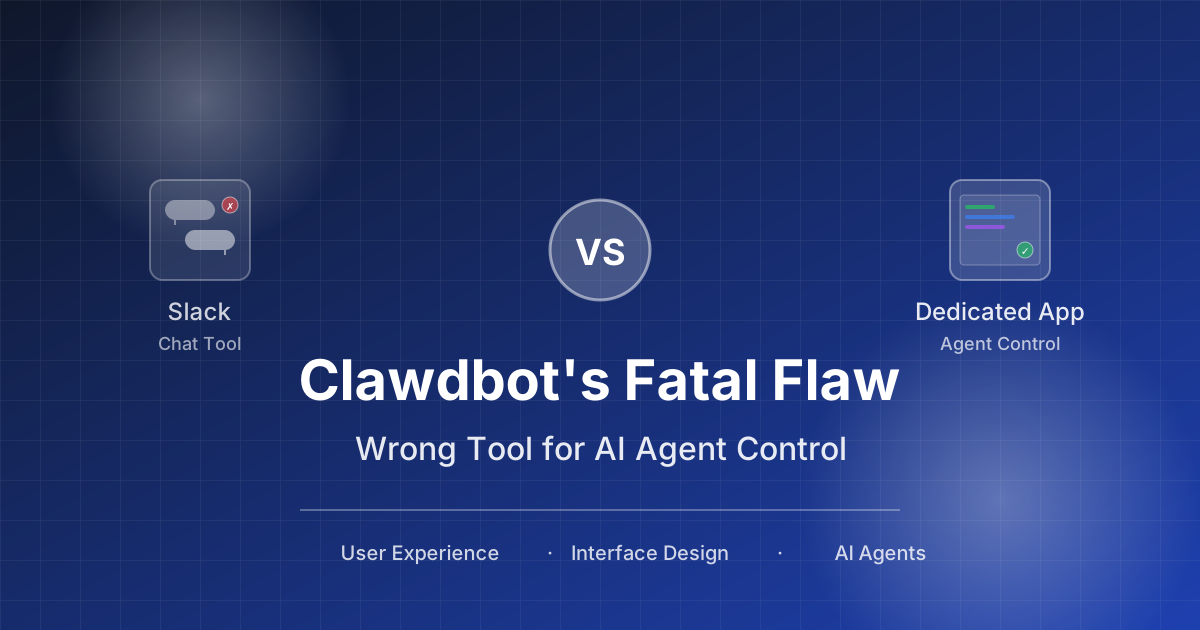
Stop Cramming AI Assistants into Chat Boxes: Clawdbot Picked the Wrong Battlefield
Clawdbot is convenient, but putting it inside Slack or Discord was the wrong design choice from day one. Chat tools are not for operating tasks, and AI isn't for chatting.

Grok Bot and Hermes Bot: one person finally gets a think tank and a secretariat
Grok Bot now ships with Cursor Pro+. Hermes Bot runs on a VPS. They are not smarter chat boxes. The think tank advises, the secretariat executes, and you still make the call.