

AngelSlim
AngelSlim is Tencent Hunyuan AI Infra’s model compression toolkit. It brings quantization, distillation, sparse attention and speculative decoding into a common engineering workflow. The public repository was created on July 4, 2025. A recent Weibo discussion about offline translation led to this listing, but neither the toolkit nor its translation demonstrations should be treated as an October 2026 launch.
What it provides
The official repository documents support across language models, vision-language models and diffusion models. Its compatibility table is the starting point: support for a family does not mean that every compression method or serving backend works with every checkpoint. The project also supplies compressed model examples and documentation for reproducing workflows.
Quantization is relevant when weights exceed the available memory budget. Distillation concerns training a smaller model from guidance by another model. Sparse attention and speculative decoding address different runtime bottlenecks. These methods can be combined in suitable configurations, but they are not interchangeable switches with an automatic accuracy guarantee.
A practical evaluation workflow
Start with one supported model and a measurable deployment constraint, such as memory required by a translation service. Keep an uncompressed baseline and a held-out evaluation set. Apply the documented quantization recipe, use representative calibration data where the recipe requires it, and compare memory, latency and task quality under the same hardware and input lengths. Inspect failed translations or missing details rather than relying only on average scores.
Only add another optimization after isolating its effect. Preserve the original checkpoint, configuration and evaluation results so that a regression can be traced and rolled back. For edge deployments, measure actual device memory and cold-start behavior as well as the exported file size.
Cost, license and quick start
The toolkit’s license states Apache 2.0 with listed third-party exceptions; individual models and dependencies retain their own terms. The repository does not describe a hosted subscription plan. Compression and distillation still consume compute, and the downstream serving infrastructure has costs.
- Read the official documentation and the current support table.
- Install
angelslimin an isolated environment following the documented requirements. - Select an example matching your checkpoint and target runtime.
- Reproduce that example before changing calibration or precision.
- Gate deployment on your own task evaluation and measured resource savings.
FAQ, limitations and alternatives
Does a smaller artifact prove better translation? No. File size, memory use, latency and output quality are separate measures. A social post’s comparison with another service is not a benchmark reproduced by this entry.
Is it a chat application? It is primarily a model optimization toolkit for developers, rather than an end-user translation app.
Compare Strata for running a supported local model, and Ollama for a different model-running workflow. These runners do not replace compression evaluation. Browse the AI ecosystem and open-source tag. The next step is a single supported example with a baseline you can verify.
Comments
No comments yet. Be the first to comment!
Related Tools


Related Insights
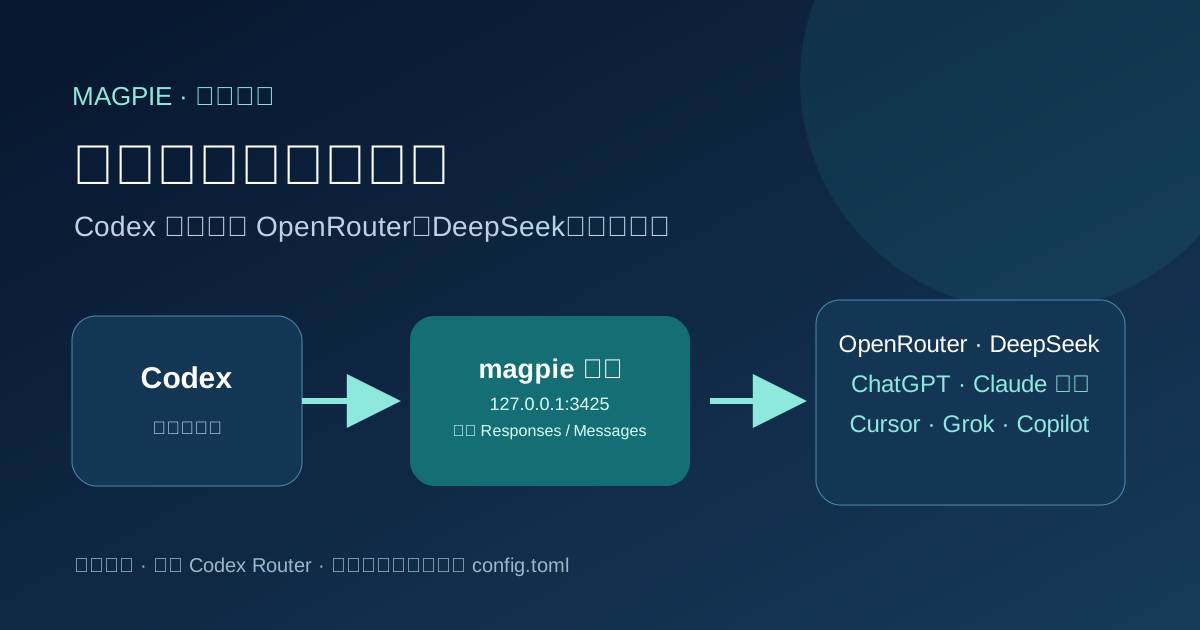
Codex on any model: magpie makes Codex Router unnecessary
magpie is a free, open-source menu bar app that runs a local gateway and puts OpenRouter, DeepSeek and your ChatGPT, Claude, Cursor, Grok and Copilot subscriptions right into Codex's own model picker, with one click and no Codex Router.
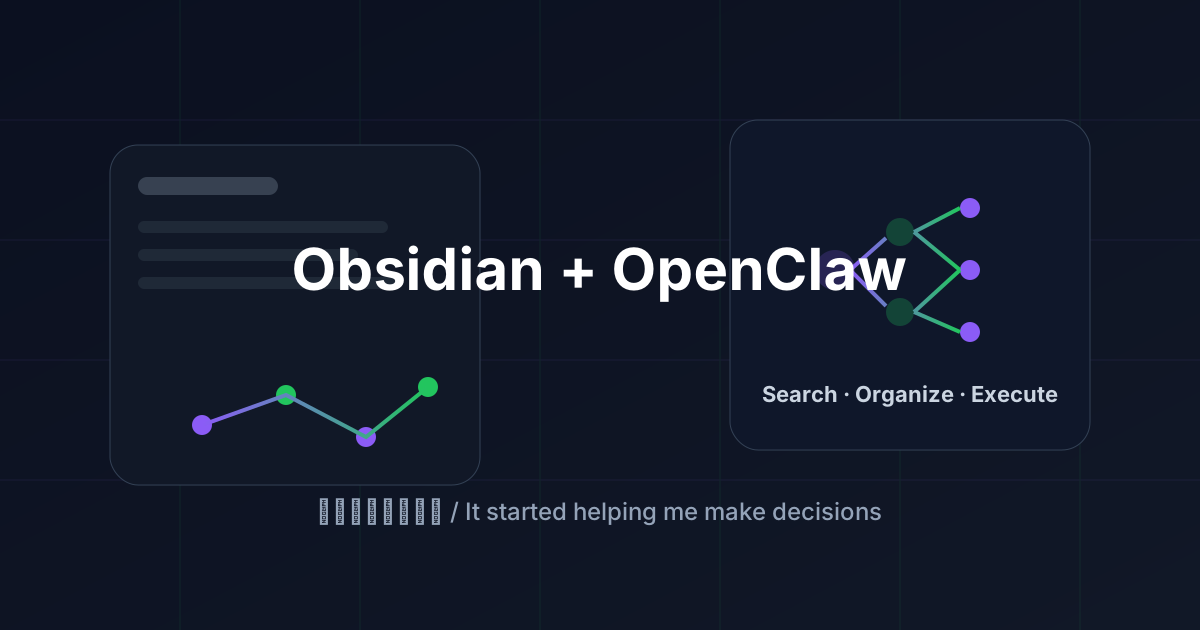
After I Connected Obsidian to OpenClaw, It Started Helping Me Make Decisions
Once Obsidian stopped being just a place to store notes and started working with OpenClaw, it began helping me organize context, connect information, and improve real decisions.