

Augment Code
Augment Code is an enterprise coding-agent platform built around a semantic Context Engine. LLM usage is billed at provider list price plus a flat 40% service fee (the page says no fee on compute). Enterprise is custom (SSO, CMEK, ISO 42001, private deploy, dedicated support). The public table on the public page has no Free / Indie $20 / Standard $60 / Max $200 row. A trial is mentioned; community support only, and the SLA does not apply to trials or beta usage.
Compare Cursor if you wanted an individual IDE seat, GitHub Copilot if you wanted GitHub-native completions plus a cloud agent, and Qodo if you wanted credit-pack review instead of a $100 team flat.
Key Features
- Context Engine: Semantic search over the repo through IDE, CLI, MCP, and SDKs. Treat the live connectors as the catalog.
- IDE agent: Plans, edits, runs commands, and keeps checkpoints in VS Code, JetBrains, or Vim/Neovim.
- Remote agents and Auggie CLI: Cloud agents and a terminal UI for longer tickets. Do not freeze "15+ agents" as a guaranteed SKU.
- GitHub code review: AI PR review is on paid plans. Enterprise review extras sit behind sales.
- Team-flat meter: One $100 check covers up to 50 seats. Extra usage is a top-up, valid 12 months after purchase on the FAQ on the public page.
Use Cases
- Small teams on a large monorepo that would rather pay $100 flat than 50 individual IDE seats.
- Regulated orgs that need Enterprise SSO / CMEK / ISO 42001, not a public Indie row.
- People comparing Augment vs Cursor vs Copilot on the live price page, not on leftover $20 / $60 / $200 blogs.
Limitation: The $100 included usage plus the 40% LLM fee can burn faster than a per-seat IDE. Named 4.7/5 scores and "no free plan since July 2026" are not sentences on the pricing page we used, so we do not treat them as current first-party copy.
Pricing
augmentcode.com/pricing on 2026-08-17.
| Plan | Price | Notes from that page |
|---|---|---|
| Business | $100 / month flat | Up to 50 seats. $100 pooled usage / month (LLM + Context Engine + compute). Top-ups if you exceed it. |
| Enterprise | Custom | Higher volume, SSO, CMEK, ISO 42001, private deploy, dedicated support / SLA. |
| Trial | Time-boxed | Community support only. SLA does not apply. |
If a leftover blog still lists Indie $20 or Max $200, treat this table as the source.
Getting Started
- Open augmentcode.com/pricing and read the $100 usage FAQ before you buy.
- Install the VS Code or JetBrains extension from augmentcode.com.
- Run one PR review and one agent edit on a real repo before you assume 50 seats will stay inside $100 usage.
- Confirm Cursor or Copilot if you only needed an individual seat.
Frequently Asked Questions
Is there still an Indie $20 plan?
Not on the public table on the public page. The live rows are Business and Enterprise.
Is usage per seat?
No. Business pools $100 of usage across the team.
Same as Copilot?
No. Copilot is GitHub-native completions and agents. Augment is a context engine plus a $100 team flat.
Alternatives
- Cursor: Individual IDE if you do not need a 50-seat flat.
- GitHub Copilot: GitHub-native completions and cloud agent.
- Qodo: Credit-pack review if the $100 meter is the wrong shape.
Tips
- Quote Business as $100 / month flat for up to 50 seats, $100 usage included.
- Do not paste Indie $20 or Max $200 into a deck.
- Confirm the 40% LLM fee before you point every model at the pool.
Conclusion
Augment Code is a $100 team-flat coding-agent suite, not a public Indie / Standard / Max ladder. Start at augmentcode.com/pricing, then decide whether Cursor or GitHub Copilot already covers the seat you need.
Comments
No comments yet. Be the first to comment!
Related Tools


Related Insights
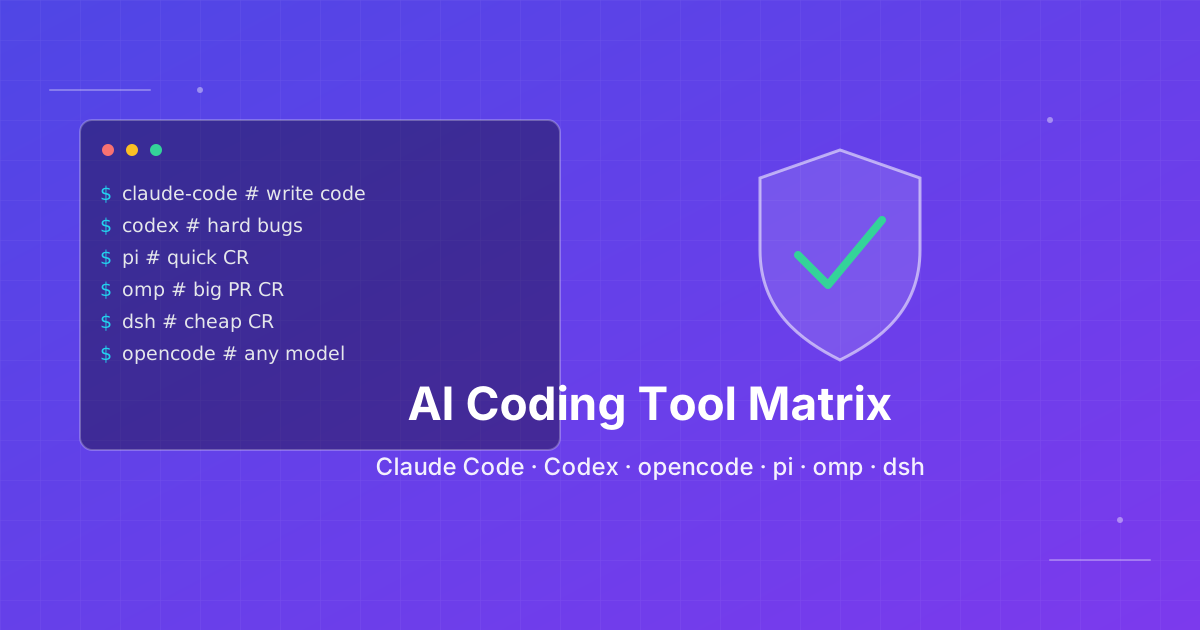
Seven AI Coding CLIs, Six Months: No Matter How Strong the Model, Work Needs Supervision
Claude Code, Codex, opencode, pi, omp and DeepSeek Harness all have personalities. After six months of deep use I run a division of labor: pi for the fastest cheapest reviews, omp for complex PRs, DeepSeek Harness on V4 Flash for high-frequency low-cost review, and Claude Code, Qoder and Cursor for writing. No matter how strong the model, work needs supervision — ideally from an independent third party.

Skills + Hooks + Plugins: How Anthropic Redefined AI Coding Tool Extensibility
An in-depth analysis of Claude Code's trinity architecture of Skills, Hooks, and Plugins. Explore why this design is more advanced than GitHub Copilot and Cursor, and how it redefines AI coding tool extensibility through open standards.
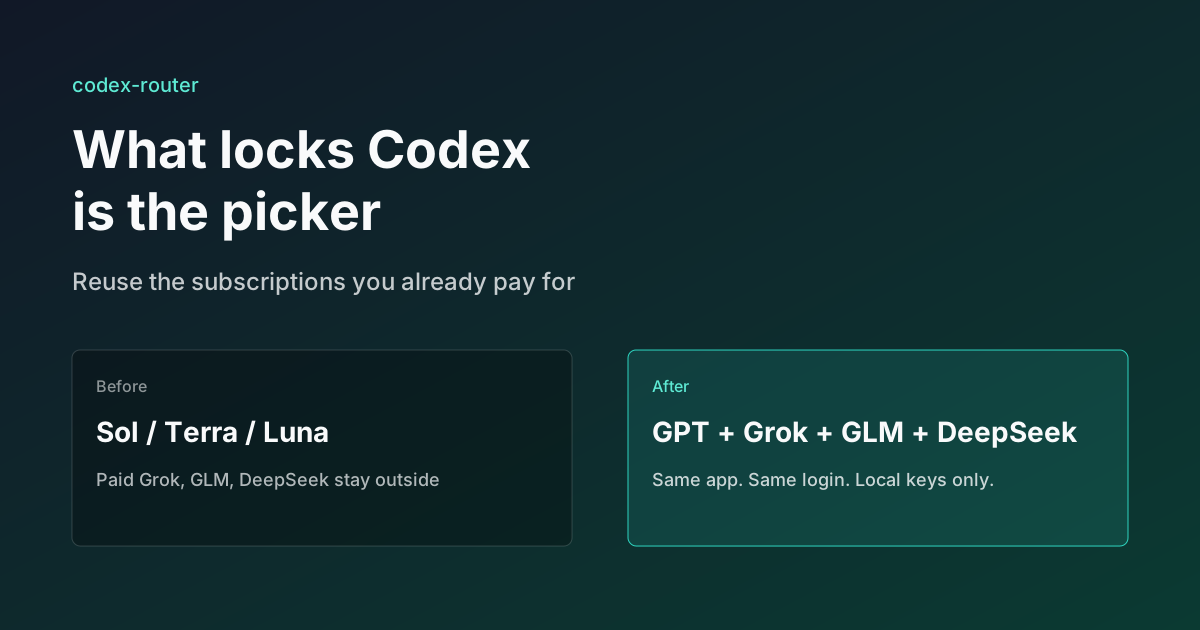
What Locks Codex Is the Picker, Not the Models
You already pay for OpenCode Go, Grok, and Z.ai, but the Codex picker still shows mostly GPT. The community project codex-router does not teach another install ritual. It puts subscriptions you already bought back into the selector, keeps keys on the machine, and leaves native GPT alone.