

FastFlowLM
FastFlowLM is a lightweight NPU-first runtime for AMD Ryzen AI laptops. The ROCm project says it runs large language models on XDNA2 NPUs without a GPU, supports context windows up to 256,000 tokens, and needs only a 17 MB runtime. It is built around a familiar single-command CLI and also exposes a local server mode that accepts OpenAI-compatible requests. The project became part of AMD ROCm on August 11, 2026, which is the publication date used here; the earlier community version dates back to 2025.
Key Features
- Runs on AMD Ryzen AI NPUs: Supports Strix, Strix Halo, Kraken, and Gorgon Point XDNA2 parts, keeping inference off the GPU and main CPU.
- Lightweight runtime: The README claims a 17 MB footprint that installs in around 20 seconds.
- Long context: Supports configs up to 256k tokens, with Qwen3-4B-Thinking-2507 listed as an example.
- CLI and server modes:
flm runopens a chat session andflm serveexposes a local server on port 52625 by default. - Vision, audio, embedding, and MoE support: The project highlights these alongside text LLM inference.
- Easy stopping and monitoring: Slash commands such as
/verbosereport performance, and Windows users can watch NPU usage in Task Manager.
Use Cases
Who Should Use This Tool?
- Laptop owners with a Ryzen AI XDNA2 chip: You can run small-to-medium models locally without buying a discrete GPU.
- Privacy-focused users: Models and kernels run on your machine, so text can stay local.
- Developers prototyping local apps: The OpenAI-compatible server mode gives a simple way to point existing tools at an NPU-backed model.
Problems It Solves
- No GPU on a thin laptop: FastFlowLM turns the NPU already inside the chip into an inference engine.
- Setup friction: A single installer and
flm run <model>command are simpler than manually wiring NPU kernels. - Local API access: Server mode exposes a local port that third-party clients can use.
Advantages & Unique Selling Points
Compared to Competitors: It is purpose-built for AMD NPUs rather than CPU-first like llama.cpp or GPU-first like many cloud tools.
What Makes It Stand Out: The project's all-in-one runtime aims for a small download, long context, and no GPU requirement, all from the official ROCm organization.
Getting Started
- Install the latest flm-setup MSI from the releases page, or follow the Linux getting-started guide.
- Update to the required AMD NPU driver, documented as 32.0.203.311 or above on Windows.
- Open PowerShell and run
flm run llama3.2:1bto test the runtime. - Use
flm listto see available models andflm servefor the local API mode.
Integration
- Hugging Face for model downloads.
- OpenAI-compatible HTTP API for local client integration.
- AMD Ryzen AI NPU drivers and hardware.
Frequently Asked Questions
Do I need a discrete GPU?
No. FastFlowLM is made for Ryzen AI NPUs and does not require a separate graphics card.
Does it work on older Ryzen laptops?
Support is for Ryzen AI chips with XDNA2 NPUs (Strix, Strix Halo, Kraken, and Gorgon Point). Check your chip before installing.
Is the runtime open source?
The orchestration code and CLI are MIT-licensed, while optimized NPU binary kernels are described as free for any use including commercial use.
Why is the download blocked in some regions?
Model downloads come from Hugging Face. The project notes that users in regions without Hugging Face access can manually download the model and place it in the configured path.
Alternatives
If FastFlowLM is not the right fit, consider these alternatives:
- Ollama: A general local model runner that works across more hardware, including GPUs and CPUs.
- ExLlamaV3: A CPU and GPU inference engine with a wide model ecosystem.
- DeepSeek Harness: A desktop-oriented coding-agent harness if you need agentic workflows rather than raw model serving.
Tips & Best Practices
- Confirm your exact NPU generation before installing; not every Ryzen PC has XDNA2.
- Keep the AMD driver current because older driver versions are no longer supported.
- Use server mode when you want to point other tools at the model; use CLI mode when you just want a quick local chat.
Conclusion
FastFlowLM makes AMD's Ryzen AI NPU useful for local inference with a compact runtime and a familiar CLI. It is not a replacement for decoding models on large GPU clusters, but it is a credible option for laptop-scale AI work that must stay private and local.
Comments
No comments yet. Be the first to comment!
Related Tools


Related Insights

Skills + Hooks + Plugins: How Anthropic Redefined AI Coding Tool Extensibility
An in-depth analysis of Claude Code's trinity architecture of Skills, Hooks, and Plugins. Explore why this design is more advanced than GitHub Copilot and Cursor, and how it redefines AI coding tool extensibility through open standards.
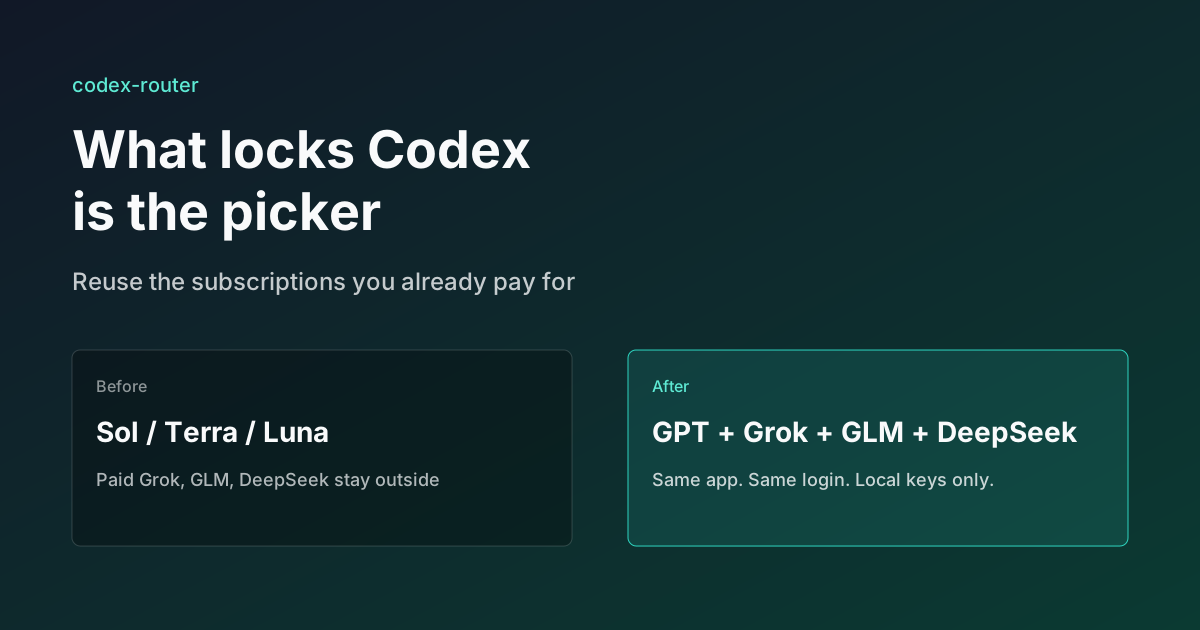
What Locks Codex Is the Picker, Not the Models
You already pay for OpenCode Go, Grok, and Z.ai, but the Codex picker still shows mostly GPT. The community project codex-router does not teach another install ritual. It puts subscriptions you already bought back into the selector, keeps keys on the machine, and leaves native GPT alone.
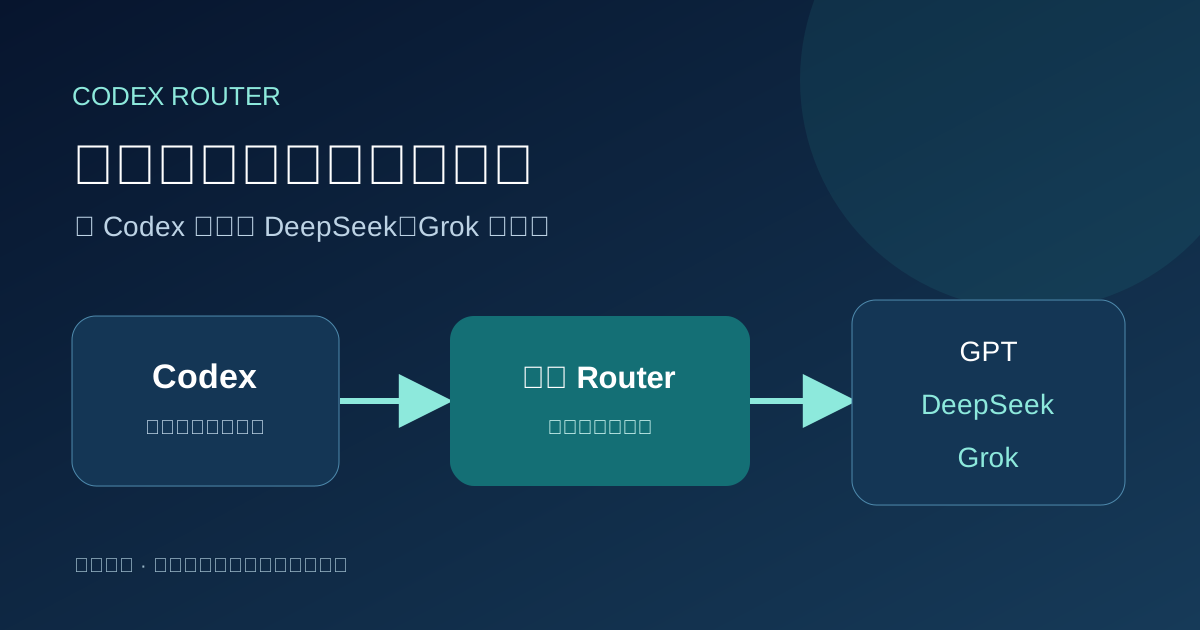
Running low on ChatGPT Codex quota? Switch to DeepSeek or Grok inside Codex
Codex Router lets you keep your Codex workspace while using DeepSeek, Grok, and other external models. A plain-English guide to routing, quotas, and network access.