

Plandex
Plandex is a terminal-based AI development tool built around plan-and-execute, not autocomplete. It is designed for large coding tasks that span many steps and touch dozens of files, where the context stays coherent instead of degrading. The CLI is open source under MIT, and the project reports about 15.6K stars with a native Go binary you can run locally and self-host.
Compare Cline if you want an IDE-embedded agent, Aider if you prefer tight Git pair-programming, or Claude Code when you want Anthropic's first-party terminal agent.
Key Features
- 2M-token effective context: loads only what each step needs but keeps about 100k tokens per file, with fast tree-sitter project maps for directories of 20M tokens or more.
- Plan and execute: you can run full autonomy (load files, plan, implement, run commands, auto-debug) or step through a reviewable diff.
- Cumulative diff sandbox: AI changes stay out of your project files until you are ready to apply them, so rollback and debug stay simple.
- Mixed-model routing: combine models from Anthropic, OpenAI, Google, and open source providers through curated model packs.
- Git integration: commit message generation with optional automatic commits, plus branches for exploring parallel solutions.
Use Cases
Who Should Use This Tool?
- Developers on large codebases: use it when the design spans many files and other tools fall apart past a certain project size.
- Teams doing migrations: apply deterministic refactors in controlled diff batches and send only the edge cases to the model.
- Engineers combining providers: route cheap local or open source models for grunt work and frontier models for hard reasoning.
Problems It Solves
- Context collapse: smart context management keeps large projects coherent instead of drifting.
- Messy changes: a cumulative diff sandbox keeps generated edits separate from the real source.
- Runaway cost: cross-model context caching reduces spend across Anthropic, OpenAI, and Google.
Pricing
Plandex is MIT licensed and free to self-host. You pay only for model tokens from the providers you route to; there is no per-seat fee for the CLI.
Advantages & Unique Selling Points
- Large-task focus: specifically tuned for the case where a change spans dozens of files and long multi-step plans.
- Reliable file edits: validates syntax and logic with multiple fallback layers instead of blindly patching.
- Version control for the plan itself: branch and explore different models or approaches without losing state.
Getting Started
- Install the CLI from plandex.ai or the GitHub releases.
- Initialize with
plandexin your project directory. - Configure providers and pick a model pack. Point local mode at your own server if you prefer self-hosting.
- Describe the task, then choose autonomy or step-by-step review.
Frequently Asked Questions
Is Plandex free?
The CLI is MIT licensed and self-hostable at no charge. Model token costs are separate and depend on the providers you route to.
Does it work for small projects too?
Yes, but it gets its biggest advantage when a task spans many files, long plans, or large repositories.
Can I use my own models?
Yes. Plandex routes to Anthropic, OpenAI, Google, and open source providers, with curated packs trading capability, cost, and speed.
How is it different from an IDE agent?
Plandex is terminal-first, plan-and-execute, and sandboxed behind a cumulative diff rather than an always-on completion surface.
Alternatives
- Cline: IDE, CLI, and SDK agent with BYOK inference.
- Aider: Git-centric pair programming in the terminal.
- Claude Code: Anthropic's first-party terminal agent.
- Goose: Block's extensible local agent.
Tips
- Use the diff sandbox for large changes; review batches rather than a single giant apply.
- Lean on project maps before you ask the model to plan a deep refactor.
- Route expensive frontier models to the hard reasoning and cheaper models to mechanical edits.
Conclusion
Plandex is an MIT terminal agent built for large, real-world tasks. If other tools stop scaling past a certain project size, start at plandex.ai and decide whether the plan-and-execute flow fits how you review large diffs.
Comments
No comments yet. Be the first to comment!
Related Tools


Related Insights

Skills + Hooks + Plugins: How Anthropic Redefined AI Coding Tool Extensibility
An in-depth analysis of Claude Code's trinity architecture of Skills, Hooks, and Plugins. Explore why this design is more advanced than GitHub Copilot and Cursor, and how it redefines AI coding tool extensibility through open standards.
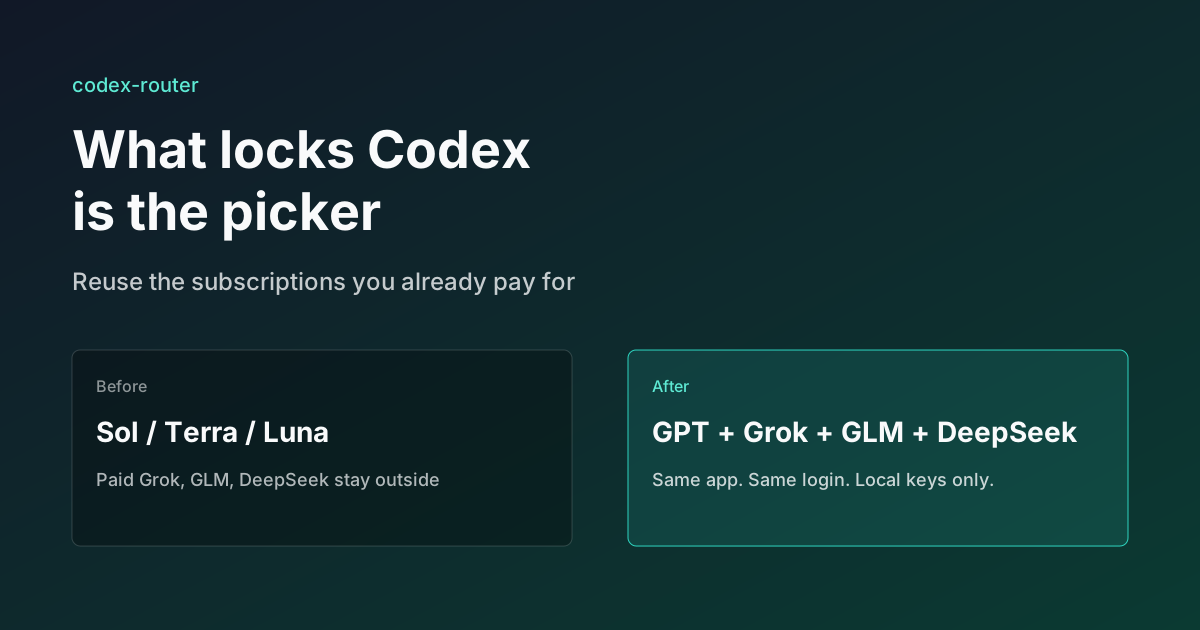
What Locks Codex Is the Picker, Not the Models
You already pay for OpenCode Go, Grok, and Z.ai, but the Codex picker still shows mostly GPT. The community project codex-router does not teach another install ritual. It puts subscriptions you already bought back into the selector, keeps keys on the machine, and leaves native GPT alone.
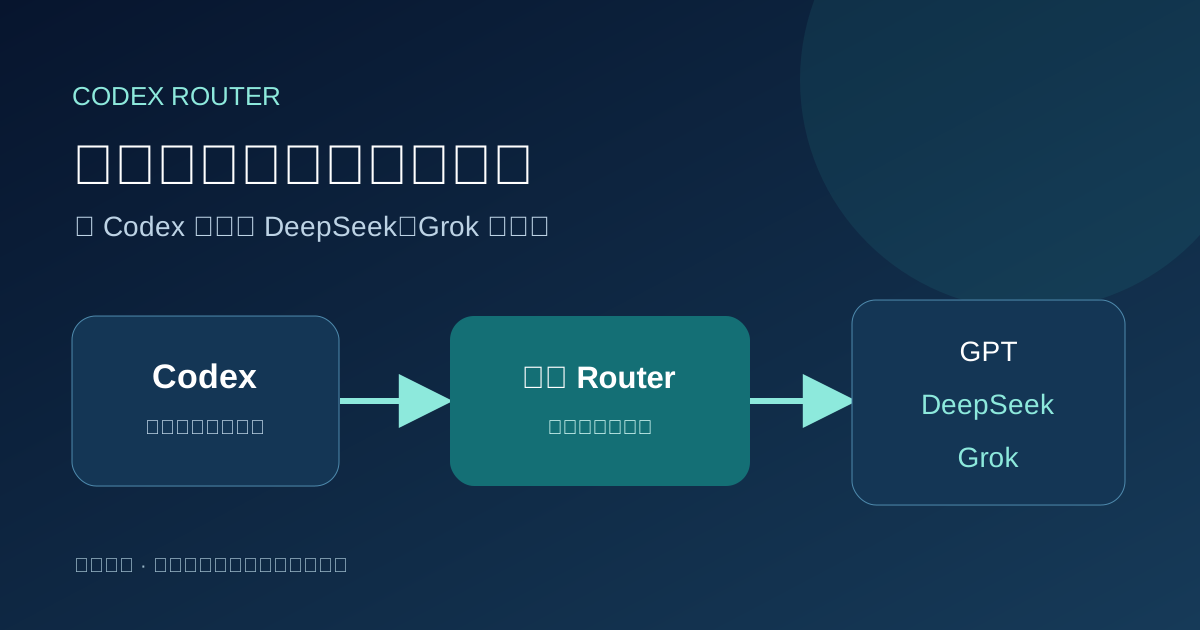
Running low on ChatGPT Codex quota? Switch to DeepSeek or Grok inside Codex
Codex Router lets you keep your Codex workspace while using DeepSeek, Grok, and other external models. A plain-English guide to routing, quotas, and network access.