

OpenSandbox is Alibaba's open-source general-purpose AI sandbox platform, purpose-built for AI application scenarios. OpenSandbox provides multi-language SDKs, a unified sandbox protocol, and a sandbox runtime environment, supporting LLM-related capabilities such as command execution, file operations, code execution, browser operations, and agent execution.
Key Features
Multi-Language SDK Support: Client SDKs for Python, Java/Kotlin, JavaScript/TypeScript, and more. Go support is on the development roadmap. A unified API interface delivers a consistent experience across languages.
Unified Sandbox Protocol: All sandboxes follow the same OAS interface specification. Defines sandbox lifecycle management APIs and sandbox execution APIs. Extend custom sandbox runtimes through the unified protocol.
Multiple Runtime Options: Supports local execution environments. Kubernetes cluster execution support (on the roadmap). Flexible deployment modes for different scenarios.
Built-In Implementations:
- Command Execution (Command): Safely run system commands inside the sandbox
- Filesystem: File operation capabilities inside the sandbox
- Code Interpreter: Execute Python, JavaScript, and other code
- Browser Use: Browser automation operations
- Coding Agent: Integrates AI coding assistants such as Claude Code
Secure Isolation: Isolated environments prevent external side effects. Protects the host system from malicious code. Safely run third-party plugins and untrusted code.
Apache 2.0 License: An open-source, business-friendly license. The community can freely use, modify, and distribute it.
Use Cases
LLM Code Interpreter: Run LLM-generated code in an isolated sandbox. Prevents generated code from damaging the system. Safely validate AI-generated code logic.
Third-Party Plugin Runtime: Provide a secure runtime environment for third-party plugins on your platform or app. Isolates plugins from each other. Protects the core system.
Automated Testing: Execute automated test scripts in sandboxes. Isolated test environments that do not affect the main system. Run multiple test tasks in parallel.
Browser Automation: Safely execute browser automation tasks. Data scraping, UI testing, automated operations. Isolated browser environments prevent security risks.
Remote Development Environments: Provide remote development capabilities such as VS Code Web. Build a secure cloud IDE inside a sandbox. Support isolated development environments for multiple users.
Desktop Sandbox Environment: Create isolated environments for running desktop applications. Test software behavior without polluting the system. Safely evaluate unknown applications.
AI Agent Execution: Provide a secure execution environment for AI agents. Agents can perform file operations, run code, and more. Restrict agent permissions to prevent overreach.
Technical Architecture
Sandbox Lifecycle Management: Standardized APIs for creating, starting, stopping, and destroying sandboxes. A unified lifecycle management interface. Supports sandbox status monitoring and management.
Sandbox Execution API: Defines interfaces for code execution, command running, file operations, and more. A unified execution protocol that supports multiple execution types. An extensible execution capability framework.
Client SDKs: Encapsulate the low-level protocol details behind a clean API. Support synchronous and asynchronous execution modes. Complete error handling and logging.
Runtime Environment: Local process isolation or container-based isolation. Resource limits and permission controls. Secure network and filesystem isolation.
Technical Advantages
Generality: Not tied to any specific AI model or application scenario. A unified protocol and interface that adapts to many needs. An extensible architecture that supports custom sandbox implementations.
Security: Strict isolation mechanisms prevent code escape. Resource limits and permission controls. Prevents malicious code from affecting the host system.
Ease of Use: Multi-language SDKs lower the integration barrier. A unified API design simplifies development. Rich examples and documentation.
Extensibility: Supports custom sandbox runtimes. Add new execution capabilities through the unified protocol. A modular design that makes new features easy to add.
Enterprise-Grade Support: An Alibaba open-source project with enterprise-grade quality assurance. An active community and continuous maintenance updates.
Integration Example
Python SDK:
from opensandbox import Sandbox

# Create a sandbox instance
sandbox = Sandbox()

# Execute code
result = sandbox.execute_code("print('Hello, OpenSandbox!')")

# File operations
sandbox.write_file("/tmp/test.txt", "content")
content = sandbox.read_file("/tmp/test.txt")

# Command execution
output = sandbox.run_command("ls -la")
Java/Kotlin SDK: A similar API design adapted to the Java ecosystem. Supports integration with frameworks such as Spring Boot.
The Value of OpenSandbox
OpenSandbox solves the security problem of code execution in AI applications. LLM-generated code may contain errors or malicious logic, making direct execution risky. Sandbox isolation makes it possible to safely validate and run AI-generated code.
The unified sandbox protocol lets different AI applications share the same security infrastructure. Developers no longer need to reimplement sandboxing for every application, reducing development cost and security risk.
Multi-language SDK support lets OpenSandbox fit into different technology stacks. Whether it is a Python data science application or a Java enterprise system, sandbox capabilities are easy to integrate.
As an Alibaba open-source project, OpenSandbox offers enterprise-grade quality assurance and continuous maintenance. For developers and enterprises that need to safely execute AI-generated code, run third-party plugins, or build automated systems, OpenSandbox is a reliable solution.
Sources:
Related: 1Code and Agent Browser. Hub: dev-tools.
Comments
No comments yet. Be the first to comment!
Related Tools


Related Insights

Skills + Hooks + Plugins: How Anthropic Redefined AI Coding Tool Extensibility
An in-depth analysis of Claude Code's trinity architecture of Skills, Hooks, and Plugins. Explore why this design is more advanced than GitHub Copilot and Cursor, and how it redefines AI coding tool extensibility through open standards.
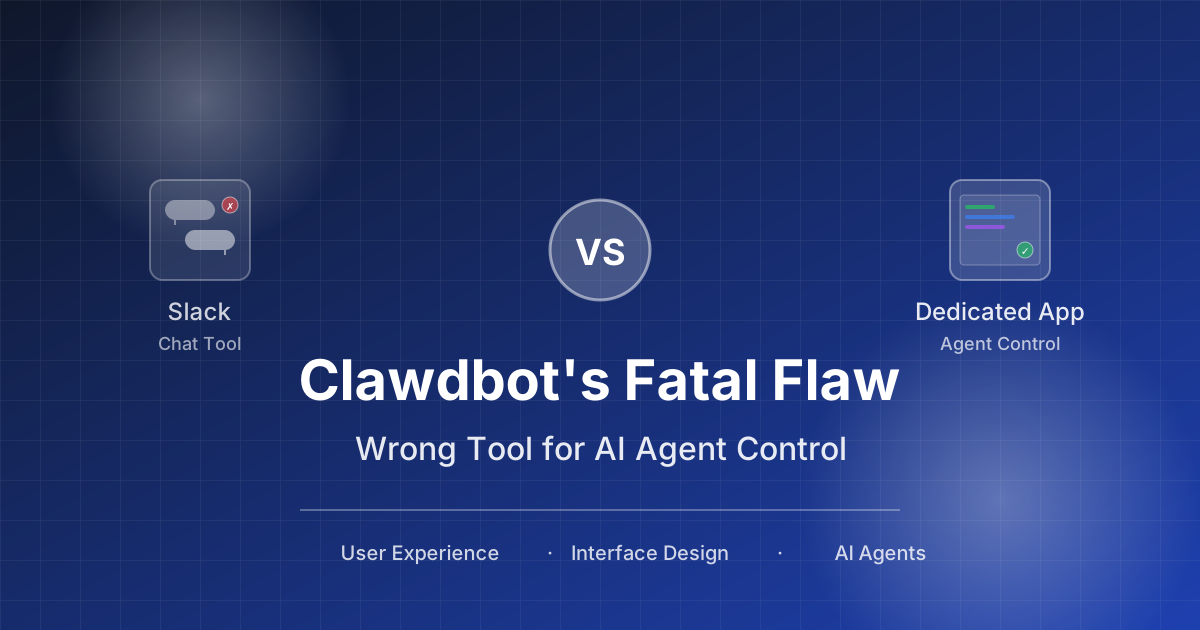
Stop Cramming AI Assistants into Chat Boxes: Clawdbot Picked the Wrong Battlefield
Clawdbot is convenient, but putting it inside Slack or Discord was the wrong design choice from day one. Chat tools are not for operating tasks, and AI isn't for chatting.
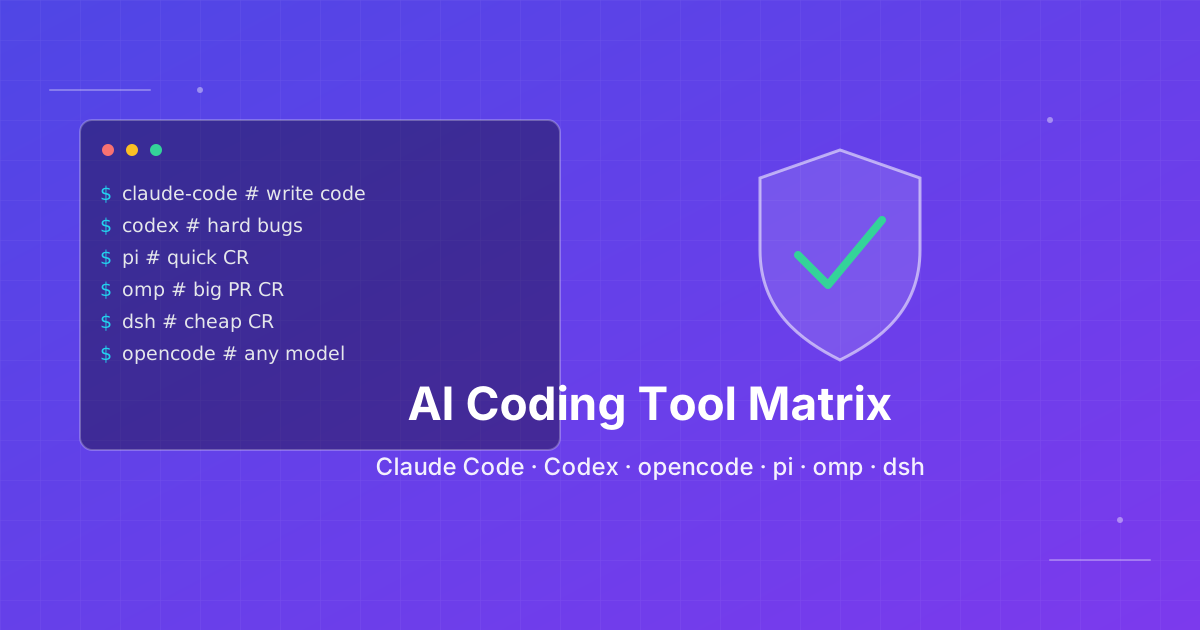
Seven AI Coding CLIs, Six Months: No Matter How Strong the Model, Work Needs Supervision
Claude Code, Codex, opencode, pi, omp and DeepSeek Harness all have personalities. After six months of deep use I run a division of labor: pi for the fastest cheapest reviews, omp for complex PRs, DeepSeek Harness on V4 Flash for high-frequency low-cost review, and Claude Code, Qoder and Cursor for writing. No matter how strong the model, work needs supervision — ideally from an independent third party.