

Tabby
Tabby is TabbyML's self-hosted coding assistant. The same page also lists annual Basic $180 / year, Business $280 / year, and Enterprise $480 / year rows. github.com/TabbyML/tabby had 33,830 stars the same day. The repo LICENSE is Apache-2.0 for the core, with an ee/ commercial directory. Latest GitHub release on the public page was v0.32.0 (2026-01-25). A Pochi teammate product on the same site bills token usage with $20 free monthly credits and auto-bills after $10. That is not Tabby Community.
Compare GitHub Copilot if you wanted a hosted seat, Continue if you wanted another Apache-2.0 IDE agent, and Cody if you wanted Sourcegraph's enterprise assistant.
Key Features
- Self-hosted completion: Run a local or on-prem server and point VS Code / JetBrains / Vim at it. No DBMS is required on the welcome docs on the public page.
- Answer engine and inline chat: Paid compare rows still list Answer Engine, Code Browser, and Context Providers above Community.
- Bring your model: Docs still mention CodeLlama, StarCoder, CodeGen, and other coding LLMs. Treat the live model list as the catalog.
- License split: Community is the Apache-2.0 tree. Team/Enterprise unlock the commercial bits. Do not call the whole repo unlimited-free for a 50-person company.
Use Cases
- Air-gapped teams that will run inference on their own GPU.
- Small shops under 5 users that can stay on Community $0.
- Orgs that will pay $19 / seat instead of Copilot for on-prem control.
Limitation: You still buy hardware and operate the box. StarCoder-1B examples on old blogs are not a quality guarantee. Pochi's $20 credit pool is a different product on the same marketing site.
Pricing
tabbyml.com/pricing on 2026-08-17.
| Plan | Price | Notes from that page |
|---|---|---|
| Community | $0 | Open source. Up to 5 users. |
| Team | $19 / seat / month | Up to 50 users. |
| Enterprise | Custom | Contact sales. |
| Basic / Business / Enterprise (annual rows) | $180 / $280 / $480 per year | Extra yearly cards on the same page. Confirm which SKU they map to before you buy. |
| Pochi usage (separate) | $20 free credits / month | Token billing; auto-charge after $10. Not Tabby Community. |
If a leftover blog still says Tabby is only free, treat this table as the source.
Getting Started
- Open tabbyml.com/pricing and decide Community vs Team $19 before you provision a GPU.
- Follow tabby.tabbyml.com/docs/welcome or the GitHub Docker example.
- Install the IDE extension and point it at your server URL.
- Confirm Copilot or Continue if you did not actually need on-prem.
Frequently Asked Questions
Is Tabby still fully free?
Community is $0 for up to 5 users. Team is $19 / seat / month.
Is the license plain Apache-2.0?
The core is Apache-2.0. The ee/ tree is a separate commercial license.
Same as Copilot?
No. Copilot is hosted. Tabby is a self-hosted server you operate.
Alternatives
- GitHub Copilot: Hosted completions and agents.
- Continue: Apache-2.0 IDE agent, now under Cursor.
- Cody: Sourcegraph enterprise assistant.
Tips
- Quote Community $0 (5 users) and Team $19 / seat.
- Do not paste "no paid plan" into a deck.
- Confirm whether you are buying Tabby or Pochi.
Conclusion
Tabby is a self-hosted completion server with a public Team $19 seat, not an unmetered Copilot clone. Start at tabbyml.com/pricing, then decide whether GitHub Copilot already covers the seat you need.
Comments
No comments yet. Be the first to comment!
Related Tools


Open-source terminal pair programmer. Apache-2.0 and BYOK. You pay the model API, not an Aider seat.

Related Insights

Skills + Hooks + Plugins: How Anthropic Redefined AI Coding Tool Extensibility
An in-depth analysis of Claude Code's trinity architecture of Skills, Hooks, and Plugins. Explore why this design is more advanced than GitHub Copilot and Cursor, and how it redefines AI coding tool extensibility through open standards.
Stop Cramming AI Assistants into Chat Boxes: Clawdbot Picked the Wrong Battlefield
Clawdbot is convenient, but putting it inside Slack or Discord was the wrong design choice from day one. Chat tools are not for operating tasks, and AI isn't for chatting.
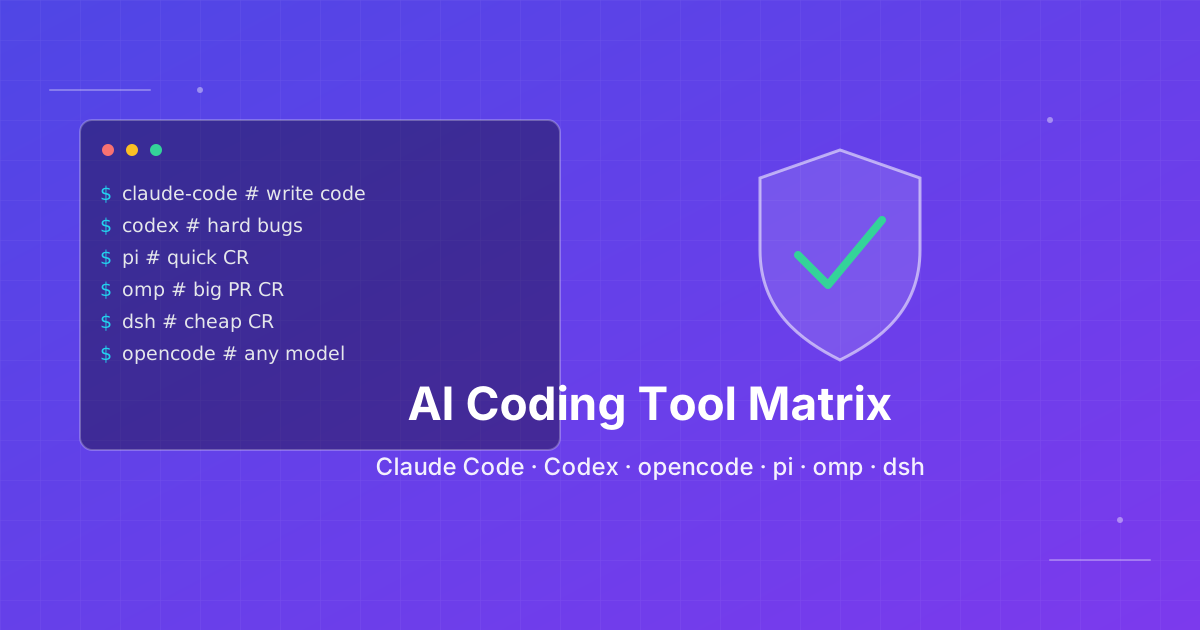
Seven AI Coding CLIs, Six Months: No Matter How Strong the Model, Work Needs Supervision
Claude Code, Codex, opencode, pi, omp and DeepSeek Harness all have personalities. After six months of deep use I run a division of labor: pi for the fastest cheapest reviews, omp for complex PRs, DeepSeek Harness on V4 Flash for high-frequency low-cost review, and Claude Code, Qoder and Cursor for writing. No matter how strong the model, work needs supervision — ideally from an independent third party.