

Ember-1
Ember-1 is the first specialized model from Fireworks Research, announced 2026-09-23 and served from Fireworks' own serverless API. It is built on Kimi K3 and makes one claim: Kimi K3's quality with roughly 40 percent fewer tokens. Fireworks frames it as "half the tokens, same answers," and the launch is the first release in a series the company plans to ship as specialized intelligence rather than another frontier model.
The model library entry lists 2026-09-22 as the creation date, and the announcement post is dated 2026-09-23.
Why Token Efficiency Is the Product
Reasoning models spend most of their generated tokens thinking. Fireworks measured Kimi K3 spending sometimes more than 90 percent of its output on internal reasoning, and the cost compounds in agentic work: each turn replays the previous reasoning back into context, so early traces get re-read and re-billed on every later call.
Turning reasoning effort down was not the fix, because low effort gave up too much quality. So the team trained the model to reason more efficiently instead. They ran more than 50 training experiments and over 200 evaluations on Fireworks Serverless Training, and reported that Kimi K3's reasoning could be shortened by 35 to 50 percent without losing accuracy on seven benchmarks and two customers' production traffic.
Model Specifications
| Specification | Ember-1 |
|---|---|
| Base model | Kimi K3 |
| Provider | Fireworks AI |
| Architecture | Mixture-of-experts, 2.78T parameters |
| Context window | 1,040K tokens |
| Max output | 943,718 tokens (per OpenRouter) |
| Input | Text and images |
| Reasoning efforts | Low, high, max (default max) |
| Tool use | Function calling, structured outputs |
| Fine-tuning | Not supported in the model library; Fireworks says training support is launching |
| Pricing | $3.00 input / $0.30 cached input / $15.00 output per 1M tokens |
| Released | Research preview, 2026-09-23 |
Benchmarks
Fireworks measured Ember-1 against three reasoning-effort settings of the base model. The cost columns are the delta versus K3 at max effort.
| Benchmark | N | K3 low | K3 high | K3 max | Ember-1 | Cost vs K3 max |
|---|---|---|---|---|---|---|
| Terminal Bench 2.1 | 89 | 76.4% | 77.6% | 80.9% | 82.0% | -51.9% |
| SWE-bench Verified | 500 | 80.4% | 86.0% | 93.2% | 92.2% | -15.5% |
| SWE-Interact | 75 | 6.7% | 13.3% | 21.3% | 20.0% | -32.5% |
| DeepSWE 1.1 | 113 | 55.8% | 62.8% | 66.4% | 75.2% | -23.7% |
| τ-2 Bench Airline | 50 | 64% | 64% | 64% | 66% | -5.9% |
Read the table honestly: Ember-1 beats K3 max on Terminal Bench 2.1, DeepSWE 1.1, and the airline tool-use set, lands slightly below on SWE-bench Verified and SWE-Interact, and dominates K3 at low effort everywhere. The win is the cost column, not a new capability ceiling.
Fireworks also reports that Ember-1 set a new cost-per-task Pareto frontier on Doximity's Bedside Bench, a physician-validated benchmark of 500 clinical cases, against models including GPT-5.6 Sol, GPT-6 Astra, and Claude Opus 5.
Production Evidence
Two customers ran live A/B tests on production coding workloads. Both saw roughly 35 percent fewer tokens per task at comparable quality, and one is now running Ember-1 in production with plans to replace the base model entirely. Internally, Fireworks switched its own developers over before any customer saw the model and reported no complaints, with a measured drop from 49.3K to 29.9K output tokens per task and a 71.3 percent reduction in reasoning tokens.
These are vendor-reported numbers with no independent replication yet. The directional claim is still the useful part: the savings come from removing reasoning that never changed the answer.
Pricing
Ember-1 is listed at $3.00 per million input tokens, $0.30 per million cached input tokens, and $15.00 per million output tokens, which matches Kimi K3's public API pricing. Fireworks is not selling a cheaper rate card, it is selling fewer tokens on the same rate card, so the savings only appear in workloads where reasoning tokens dominate the bill.
Getting Started
- Call the model as
accounts/fireworks/models/ember-1through the serverless API, the Fireworks Python client, the REST API, or an OpenAI-compatible client. - Keep reasoning effort at the default max unless a workload is latency-bound; the point of the model is that max effort is now affordable.
- Measure tokens per task rather than tokens per call on multi-turn agent loops, because that is where the difference compounds.
- If you need a bespoke version, Fireworks says training support for Ember-1 is available to enterprises.
Limitations
- A research preview. Fireworks describes Ember-1 as a research release with two-week serverless access, made permanent based on demand. Do not build a long-term dependency on it without a fallback.
- Vendor benchmarks only. The Pareto-frontier and A/B numbers come from Fireworks. The Bedside Bench result uses the company's own Specialized Intelligence Index, which it also publishes.
- It inherits the base model's ceiling. Ember-1 is an efficiency layer on Kimi K3, so capabilities Kimi K3 does not have do not appear here.
- Fine-tuning is not available today. The model library lists fine-tuning as unsupported even as training support is announced.
FAQ
Is Ember-1 a new frontier model?
No. It is a specialized model built on Kimi K3 that produces shorter reasoning traces for the same answers. Think of it as a cost tier, not a new tier of capability.
Which workloads benefit most?
Agentic coding and multi-turn tool loops, where each turn replays prior reasoning into context. Short single-shot prompts see far less benefit.
Where can I use it?
Through the Fireworks serverless API and on-demand deployments, and it is listed on OpenRouter. Base Kimi K3 remains available as a serving option alongside it.
Is it safe to route production traffic to?
Fireworks reports one customer already running it in production. Given the preview status, keep the base model configured as a switchable fallback.
Alternatives
- Kimi K3: the base model, with the full reasoning traces and the open weights.
- GPT-6 Sol: the frontier coding option when you want more capability and will pay for it.
- Mercury 2.5: an even faster, much cheaper model for the high-frequency calls around a frontier model.
Conclusion
Ember-1 is a bet that the next round of model competition is fought over tokens per task instead of benchmark points. It keeps Kimi K3's answers, cuts the reasoning that never mattered, and lands on the cost frontier of a physician-validated clinical benchmark. Treat the preview status seriously, measure your own token counts, and this is one of the cheapest ways to cut the bill on agentic coding.
Comments
No comments yet. Be the first to comment!
Related Tools


Related Insights
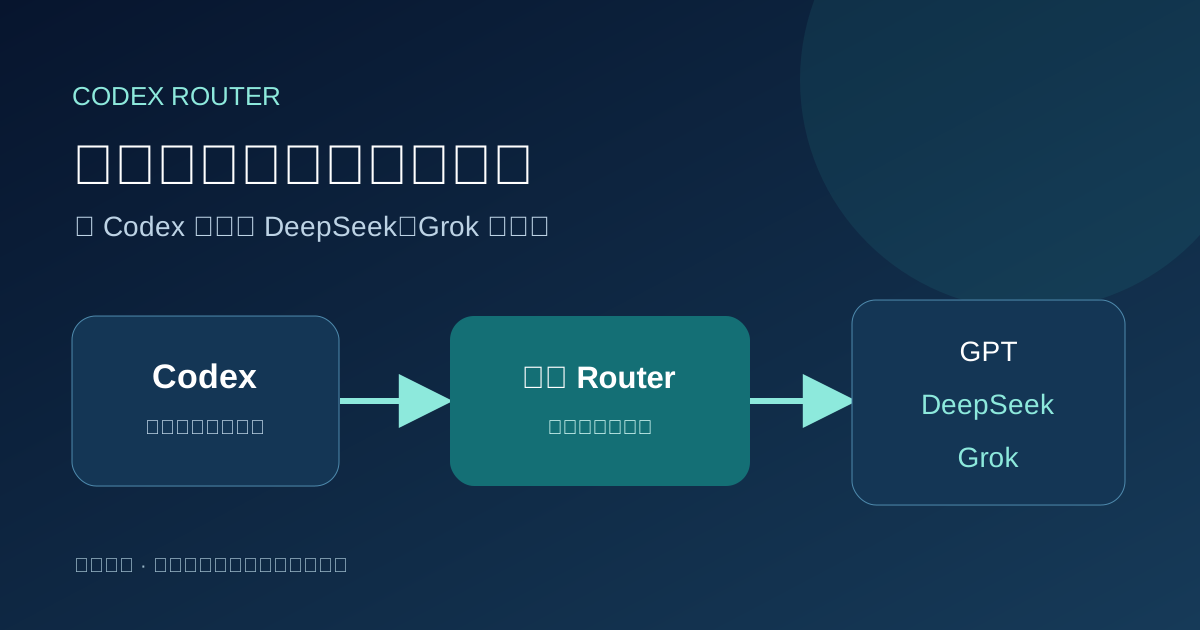
Running low on ChatGPT Codex quota? Switch to DeepSeek or Grok inside Codex
Codex Router lets you keep your Codex workspace while using DeepSeek, Grok, and other external models. A plain-English guide to routing, quotas, and network access.

Obsidian CLI + Codex: Turn Your Vault into an Agent Knowledge Engine
Obsidian CLI gives Codex and other agents a searchable, auditable, link-aware interface to a local Vault, using real cases and reproducible workflows.

Grok Bot and Hermes Bot: one person finally gets a think tank and a secretariat
Grok Bot now ships with Cursor Pro+. Hermes Bot runs on a VPS. They are not smarter chat boxes. The think tank advises, the secretariat executes, and you still make the call.