

Mercury 2
Mercury 2 is Inception's diffusion reasoning model, the release that put the company's parallel-decoding architecture into production use. Inception introduced it in February 2026 and its launch post frames the pitch as a change of curve rather than a change of score: an autoregressive model writes one token at a time, left to right, while Mercury drafts many tokens at once and refines the whole draft over a small number of steps. Inception describes it as more editor than typewriter.
That matters most in loops. A production agent, retrieval pipeline, or extraction job makes dozens of model calls per task, and latency compounds across every step. Mercury 2's argument is that a reasoning-grade model inside a real-time latency budget changes how many steps you can afford to run.
Mercury 2 has since been superseded by Mercury 2.5, which Inception released on 2026-09-08 with a 260K context. Mercury 2 remains available on the API at the same list price, and it is the model most third-party latency benchmarks still reference.
Model Specifications
| Specification | Mercury 2 |
|---|---|
| Architecture | Diffusion language model (dLLM) |
| Context window | 128K tokens (chat) |
| Max output | 50,000 tokens |
| Input / output | Text |
| Reasoning | Tunable reasoning effort |
| Endpoints | v1/chat/completions |
| Features | Tool calling, structured outputs |
| Released | February 2026 |
Pricing
Inception's own documentation lists these rates for Mercury 2:
| Item | Price |
|---|---|
| Input | $0.25 / 1M tokens |
| Cached input | $0.025 / 1M tokens |
| Output | $0.75 / 1M tokens |
There is no launch promotion attached to Mercury 2 today; the 80 percent discount Inception currently advertises applies to Mercury 2.5. Mercury 2 is OpenAI API compatible, so pointing an existing client at https://api.inceptionlabs.ai/v1 is a configuration change rather than a rewrite.
What the Independent Scores Say
Artificial Analysis, checked on 2026-09-25, lists Mercury 2 as released February 2026 and now marks it deprecated in favour of Mercury 2.5. Its measured numbers are still the useful comparison point:
- Speed: 761.4 output tokens per second, third of 174 models.
- Intelligence: 14 on the Artificial Analysis Intelligence Index, 77th of 174 and above the median of 13.
- Cost: $0.25 input and $0.75 output with a 90 percent cache discount.
- Context: 128K tokens, text in and text out.
The gap between Inception's own claim of 1,009 tokens per second on NVIDIA Blackwell and the third-party 761 measurement is the usual vendor-versus-benchmark spread. Trust the shape of the result, not the exact figure.
Where the Speed Shows Up
Inception's launch post collects production case studies, and they are vendor-reported, so treat them as directional:
- Zed uses it for next-edit suggestions and refactors, where a pause breaks the developer's flow.
- Wispr Flow runs real-time transcript cleanup and interactive applications on it.
- Skyvern said Mercury 2 is at least twice as fast as GPT-5.2, which the team called a game changer for browser automation.
- Viant optimized campaign execution across dozens of chained inference calls.
- SearchBlox runs sub-second intelligence across customer support, compliance, and e-commerce search.
- OpenCall reported median model response latency near 170 milliseconds for voice agents.
NVIDIA's own quote in the post, from Shruti Koparkar, ties the benchmark to Blackwell infrastructure.
Getting Started
- Create an API key in the Inception console and export it as
INCEPTION_API_KEY. - Send a request to
https://api.inceptionlabs.ai/v1/chat/completionswithmodel: "mercury-2",reasoning_effort, and amax_completion_tokensceiling. - Find the calls in your pipeline that repeat most: routing, context compaction, query rewriting, reranking, tool-search summaries. Those are where a fast model pays off.
- Measure end-to-end latency and cost per task before and after rather than per call.
Limitations and Risks
- Superseded. Mercury 2.5 has more than double the context, a higher intelligence score, and promotional pricing. New integrations should start there.
- Below the frontier on intelligence. At 14 on the Intelligence Index it is above average but not a frontier model. Keep hard reasoning on a frontier model.
- Text only, 128K context. No image or audio input, and long-context work at 500K to 1M tokens needs a different model.
- Vendor-reported speed. The 1,009 tokens per second headline is Inception's own measurement.
- Output cap. 50,000 output tokens per request, compared with 65,536 on Mercury 2.5.
FAQ
Is Mercury 2 still usable now that Mercury 2.5 exists?
Yes. Inception still serves it on v1/chat/completions at $0.25 / $0.75 per million tokens, and Artificial Analysis continues speed benchmarking for the default workload.
Do I need a new client to use it?
No. It is OpenAI API compatible, so most SDKs work by changing the base URL and the model name.
What is a diffusion language model?
Most LLMs decode one token at a time in order. A diffusion language model generates many tokens in parallel and refines them over a few steps, which is why Inception can claim a different speed curve rather than just faster hardware.
Does it replace a frontier model?
No. Its value is throughput and cost on the high-volume calls around the expensive one, not final-answer quality on hard problems.
Alternatives
- Mercury 2.5: the successor, with 260K context and the current discount.
- Claude Opus 5.5: a frontier model for the calls where judgment matters more than latency.
- Grok 4.7: another current-generation option, with a much larger context window.
Tips
- Use the 90 percent cache discount by keeping system prompts and long stable context at the front of the request.
- Turn reasoning effort down for routing and classification calls; tunable reasoning is what keeps the cost curve flat.
- Benchmark against Mercury 2.5 before committing, since the successor changes the price-to-quality trade in its favour.
Conclusion
Mercury 2 is the model that demonstrated a diffusion LLM could carry production traffic rather than just win a latency benchmark, and the case studies from Zed, Skyvern, and SearchBlox are the evidence. It is no longer the model to start with, because Mercury 2.5 exists, but it remains in the catalog for teams already running it and for anyone who wants to see where the speed argument began.
Comments
No comments yet. Be the first to comment!
Related Tools


Related Insights

Skills + Hooks + Plugins: How Anthropic Redefined AI Coding Tool Extensibility
An in-depth analysis of Claude Code's trinity architecture of Skills, Hooks, and Plugins. Explore why this design is more advanced than GitHub Copilot and Cursor, and how it redefines AI coding tool extensibility through open standards.
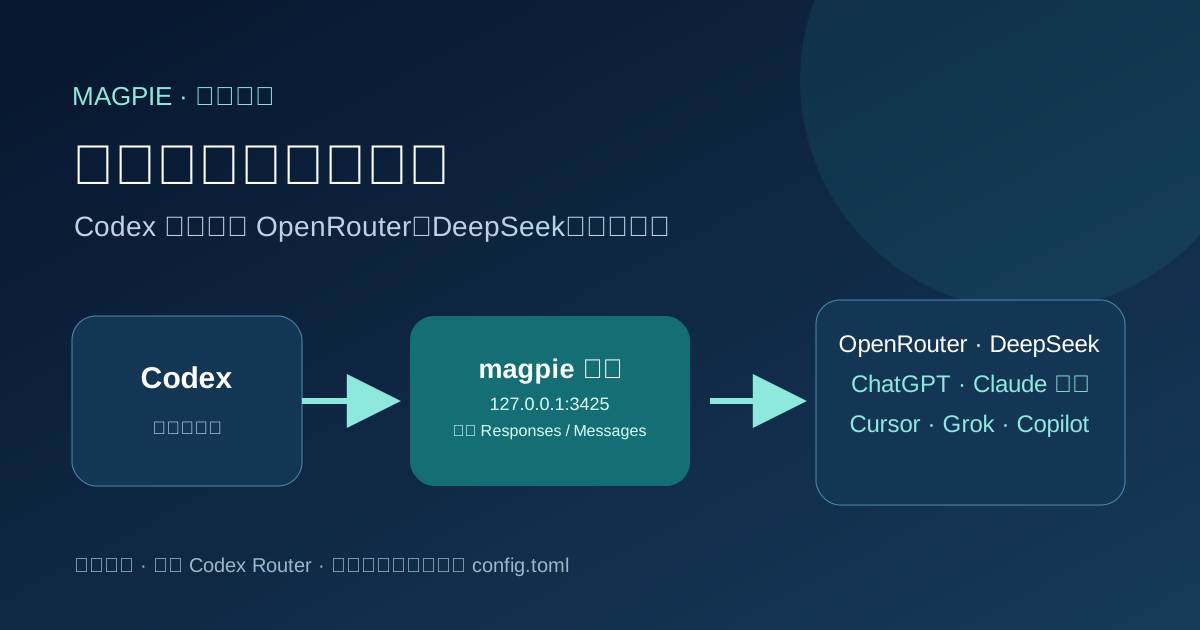
Codex on any model: magpie makes Codex Router unnecessary
magpie is a free, open-source menu bar app that runs a local gateway and puts OpenRouter, DeepSeek and your ChatGPT, Claude, Cursor, Grok and Copilot subscriptions right into Codex's own model picker, with one click and no Codex Router.