

Jev is TypeSafe AI's first public System One model: unstructured program state in, typed probabilistic decisions out. The lab's launch post is dated 2026-09-15. Founder Diogo Almeida (ex-OpenAI instruction-following work) frames it as the opposite of chat: no string generation, no type errors, parallel sampling, and a training method they call Reinforcement Learning for Calibrated Decisions (RLCD). It showed up on r/LocalLLaMA the next day as people asked whether a local OpenJev clone could match it.
The product site is typesafe.ai. Access on 2026-09-17 was still early access / waitlist. There are no official open weights. A community Hugging Face repo named OpenJev is not TypeSafe's model. Compare LangGraph if you wanted a workflow host around an ordinary LLM, or OpenAI Agents SDK if you still needed generated text plus tools.
Key Features
- Typed decisions, not tokens: possible outputs are defined in advance. The lab says schema matching is guaranteed, so type errors are not an empirical rate.
- Calibrated confidence on every answer. Higher confidence is claimed to mean higher accuracy. Software can act, escalate, or abstain.
- Speed and price (first-party, 2026-09-17): input $0.042 / MTok ($42 per billion). Output tokens are listed as free. End-to-end response 70ms-500ms. Homepage claim versus LLM workflows: 193.6x faster, 444.6x cheaper, from their System One workflow evals, not an independent audit.
- Cardinality up to 255 choices. Higher-cardinality tasks use a two-stage score-then-choose path.
- Demos: a Doom bot on structured game state (not pixels) and Wikiracing over Wikipedia links. The Doom path is described as about 10 queries/s and ~$7/hour.
Limitation: Jev cannot write prose, code, or tool-call strings. It is a decision function inside software. Early access may be delayed. The speed/cost multiples come from TypeSafe's own workflows against Astra and Fable averages; treat them as vendor evals.
Use Cases
- Smart branches in production code: classify, route, extract, or score where handwritten rules are brittle.
- Map-reduce over large corpora where you need features, not essays.
- Guardrails that score or judge another model's prompt, trace, or output.
Pricing
| Piece | Price | Notes from first-party pages 2026-09-17 |
|---|---|---|
| Input | $0.042 / MTok | $42 per billion tokens. Site also says 238x lower input than Claude Fable 5.1. |
| Output | $0 | "Too cheap to meter" on the launch post. |
| Access | Waitlist | typesafe.ai. Console and docs returned 307/308 without a public login that day. |
Getting Started
- Join the waitlist at typesafe.ai.
- Read the launch post for the API shape:
statein, named questions, typed answers with probabilities. - Put Jev behind thresholds in your own code. Do not ask it to chat.
- Check evals.typesafe.ai for the workflow comparisons.
First-party start: the introducing Jev post and hello@typesafe.ai.
Frequently Asked Questions
Is this a smaller LLM with JSON mode?
TypeSafe says no. JSON mode still samples strings and can fail the schema. Jev emits typed values in one parallel query.
Can it hallucinate?
It cannot emit an undeclared type. It can still pick the wrong class. That is why confidence and thresholds exist.
Are the 193.6x / 444.6x figures audited?
No. They are TypeSafe's workflow evals. The post says those numbers sit on the high end of real-world gains.
Alternatives
- LangGraph: durable graphs around chat models when you still need generated text.
- OpenAI Agents SDK: tool-calling agents, not calibrated decision APIs.
- Hermes Agent: a full self-hosted agent, not a typed decision model.
Tips
- Decompose into many small questions with probabilities, then branch in code.
- Keep cardinality at or under 255, or plan for the two-stage path.
- Do not paste OpenJev weights and call it Jev. Official access is the TypeSafe API.
Conclusion
Jev is a waitlisted decision API, not a chatbot. If your bottleneck is reliable classify/route/score inside software, the first-party price and latency are the reason to get on the list. If you needed prose or code, stay on a chat model.
Comments
No comments yet. Be the first to comment!
Related Tools


Related Insights

Anthropic Subagent: The Multi-Agent Architecture Revolution
Deep dive into Anthropic multi-agent architecture design. Learn how Subagents break through context window limitations, achieve 90% performance improvements, and real-world applications in Claude Code.
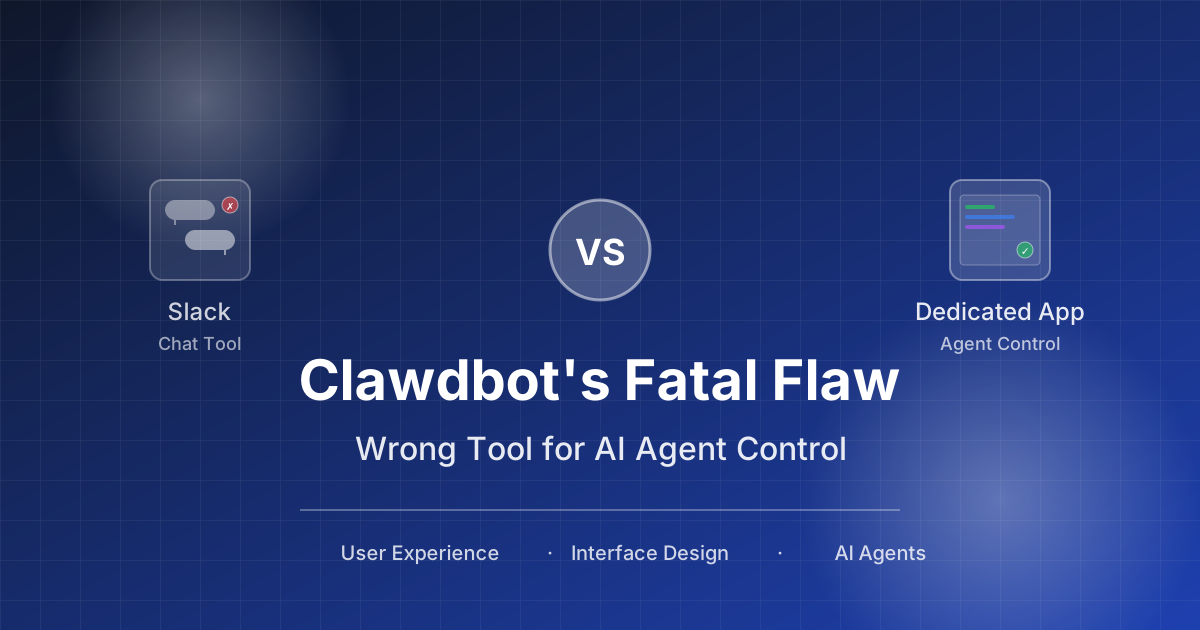
Stop Cramming AI Assistants into Chat Boxes: Clawdbot Picked the Wrong Battlefield
Clawdbot is convenient, but putting it inside Slack or Discord was the wrong design choice from day one. Chat tools are not for operating tasks, and AI isn't for chatting.

Grok Bot and Hermes Bot: one person finally gets a think tank and a secretariat
Grok Bot now ships with Cursor Pro+. Hermes Bot runs on a VPS. They are not smarter chat boxes. The think tank advises, the secretariat executes, and you still make the call.