
LongCat 2.0
LongCat 2.0 is Meituan's open-weight mixture-of-experts model, released under the MIT license. It has 1.6 trillion total parameters with roughly 48 billion active per token, was pretrained on more than 35 trillion tokens, and is designed for long-horizon coding and agentic tasks with a 1M-token context window. It appears in social feeds both as a frontier open-weight release and as a model you can plug into coding harnesses like Claude Code and OpenCode Go.
Key Features
- Large-scale MoE: 1.6T total / ~48B active per token, built on LongCat Sparse Attention (LSA) for efficient long-context inference.
- 1M context: Trained on hundreds of billions of tokens of 1M-context data, with dedicated post-training for coding and agentic tasks.
- Alternative hardware proof point: Full training run and large-scale deployment on AI ASIC superpods across millions of accelerator-days.
- Harness integration: Deeply integrated with Claude Code, OpenClaw, Hermes, and available in OpenCode Go.
- MIT open weights: Free to use, modify, and deploy commercially.
Use Cases
- Coding and repo-level edits: Strong at code understanding, repository-level changes, and automated task execution.
- Agentic workflows: Runs well in agent harnesses that need long context and reliable tool use.
- Long-horizon tasks: Handles research and multi-turn tasks that need to keep a huge window in mind.
- Self-hosting on ASIC or GPU: The model card documents deployment on alternative hardware, so teams can avoid relying on a single vendor.
Pricing
LongCat 2.0 is open-weight under MIT, so the weights are free. You pay for inference compute yourself, whether that is a local GPU or an API provider that hosts the model. Third-party hosts and cloud marketplaces set their own token prices, which we have not audited.
Advantages & Unique Selling Points
Compared to proprietary frontier models:
- Open and MIT: Weights are downloadable and commercially usable, unlike closed models of similar size.
- 1M context at MoE scale: Long-context capability without the quadratic cost of dense attention, via LongCat Sparse Attention.
- Coding-harness ready: Ships with integration paths for Claude Code, OpenClaw, Hermes, and OpenCode Go.
What makes it stand out: It demonstrates frontier-scale training on AI ASIC superpods, and it is one of the larger open-weight MoE releases in the 2026 cycle.
Getting Started
Quick Start Guide
- Download weights: Get the MIT-licensed model from Hugging Face or ModelScope.
- Serve it: Run inference through a supported stack on your own GPU or ASIC capacity.
- Connect a harness: Point Claude Code, OpenClaw, or OpenCode Go at the model for agentic coding.
- Read the model card: Check the benchmark tables and LSA technical details in the tech blog.
Frequently Asked Questions
What license is LongCat 2.0 under?
MIT, with open weights on Hugging Face and ModelScope.
How big is the model?
1.6 trillion total parameters with about 48 billion active per token, and a 1M-token context window.
What is it best at?
Coding, repository-level edits, and long-horizon agentic tasks, per the model card.
Alternatives
If LongCat 2.0 is not the right fit, consider these alternatives:
- DeepSeek V4 Flash: A cheaper, widely hosted open-weight agent model.
- GLM-5.3: Zhipu's coding plan model family.
- Qwen3 8 27B: An open-weight MoE from Alibaba.
Tips & Best Practices
- Match context to the task: the 1M window is valuable for repo-level edits and long research, not for short chats.
- Check third-party token pricing before committing, since the weights are free but inference is not.
- Read the LSA details before scaling, since sparse-attention behavior differs from dense transformers.
Comments
No comments yet. Be the first to comment!
Related Tools


Related Insights
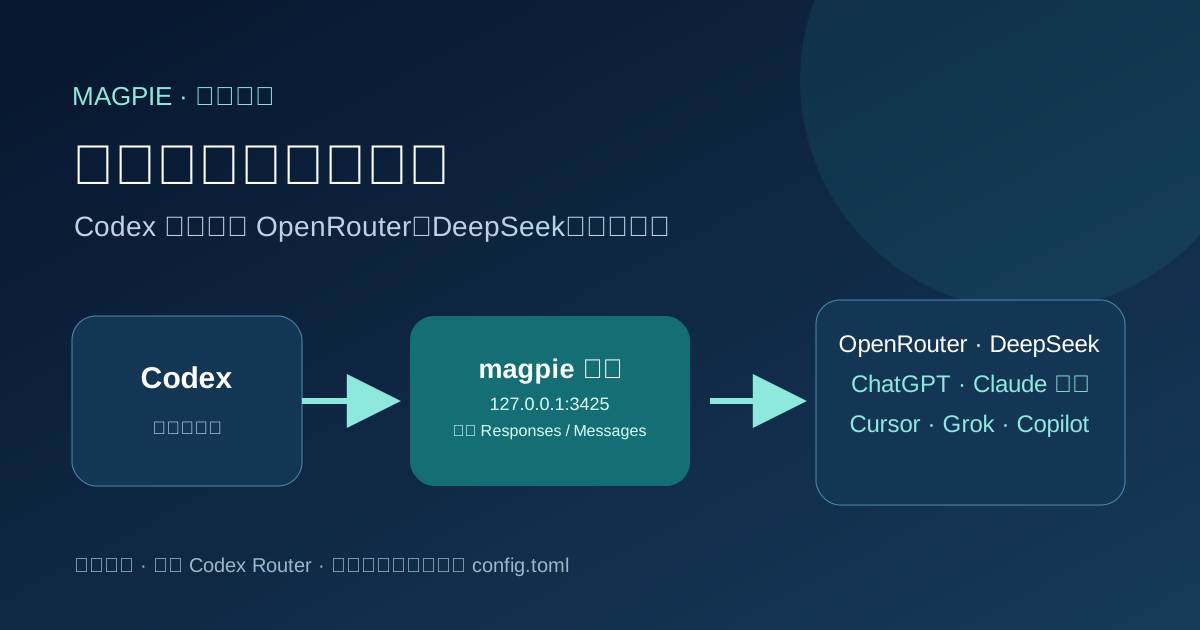
Point Codex at any model with magpie
Install magpie, add a local or signed-in provider, then switch Codex to that model. Rechecked against official magpie docs on 2026-10-06.
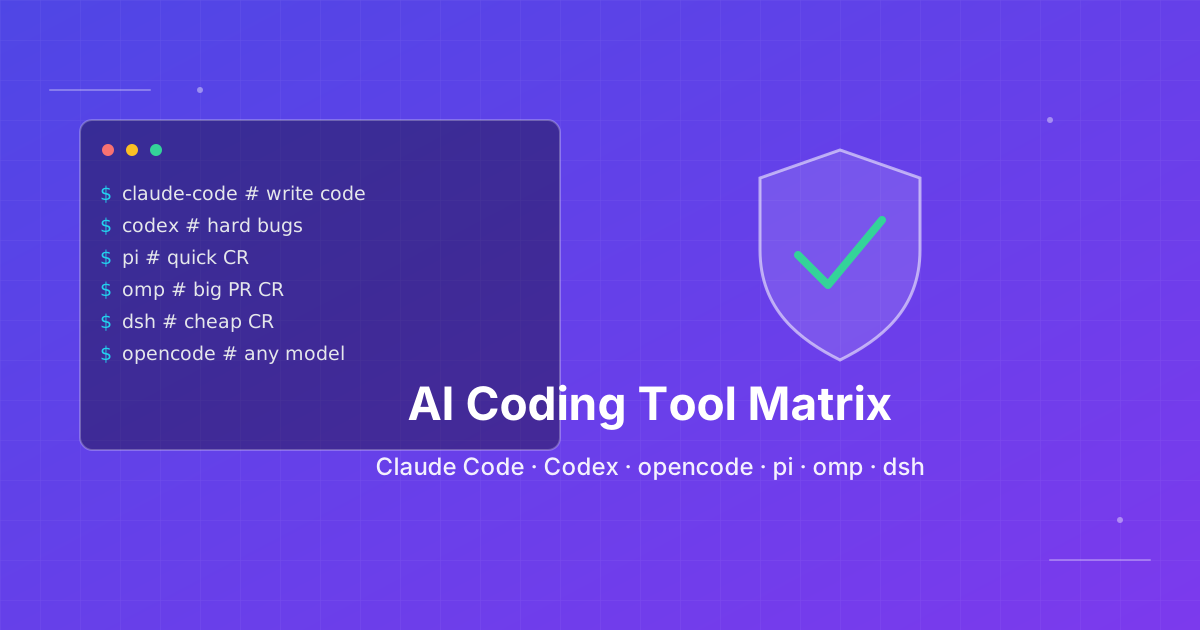
How to pick an AI coding CLI for your repo
Match Claude Code, Codex CLI, OpenCode, Pi, omp, DeepSeek Harness, and Grok Build to the work you actually run. Docs rechecked 2026-10-06.

Skills + Hooks + Plugins: How Anthropic Redefined AI Coding Tool Extensibility
An in-depth analysis of Claude Code's trinity architecture of Skills, Hooks, and Plugins. Explore why this design is more advanced than GitHub Copilot and Cursor, and how it redefines AI coding tool extensibility through open standards.