

Qwen3.8-27B is Alibaba's open-weight dense companion to the flagship Qwen3.8-2.4T-A95B MoE, published on Hugging Face on August 5, 2026 under the Apache 2.0 license. Where the 2.4T flagship chases frontier benchmarks, this 27B dense build serves practitioners who want a current-generation model they can run, fine-tune, and ship on their own hardware. It reads both text and images, and it fulfills the dense open-weight option Alibaba promised alongside Qwen3.8-Max.
Model Specifications
| Specification | Qwen3.8-27B |
|---|---|
| Architecture | Dense (all parameters active per token) |
| Total parameters | ~27.8B (27,781,427,952 across safetensors) |
| Input modalities | Text, images |
| Output modality | Text |
| Context window | Not yet disclosed |
| License | Apache 2.0 |
| API access | QwenCloud (model ID per console) |
Key Features
- Open weights under Apache 2.0: download, self-host, and fine-tune with commercial use allowed.
- Dense architecture: every token activates the full network, so behavior and per-token latency stay predictable with no expert routing to debug.
- Multimodal input: image-text-to-text support covers screenshots, charts, and document understanding in one local model.
- Sized for local rigs: small enough for a single high-end GPU with quantization, large enough for serious reasoning and coding work.
- Fast community uptake: the preliminary model card drew roughly 499 upvotes on r/LocalLLaMA and passed 7,856 Hugging Face likes within days of release.
Use Cases
Who Should Use This Tool?
- Local LLM practitioners who want a current dense model under a permissive license.
- Fine-tuning teams that need full weight access without usage restrictions.
- Privacy-sensitive deployments where prompts and images cannot leave owned hardware.
- Agent builders running small-batch inference at predictable cost.
Problems It Solves
- API cost at volume: self-hosting removes per-token fees for high-volume, small-batch jobs.
- License friction: Apache 2.0 permits commercial products without negotiation.
- MoE complexity: dense weights give uniform per-token cost, which simplifies capacity planning.
Pricing
Weights are free on Hugging Face under Apache 2.0; you pay only for your own compute. Hosted access is available through the QwenCloud API, but Alibaba had not published dedicated per-token pricing for this dense model at launch. Until a rate card lands, treat Qwen3.8-Max pricing ($2.00 input / $6.00 output per 1M tokens, international) as the upper reference point.
Advantages & Unique Selling Points
Compared to Competitors:
- Versus its MoE flagship sibling: a model one machine can actually serve, no cluster required.
- Versus restricted licenses: Apache 2.0 is about as permissive as open weights get.
- Versus older 27B-class models: current Qwen3.8-generation training with native image input.
What Makes It Stand Out:
- First dense open-weight release of the Qwen3.8 generation.
- Also exposed through the QwenCloud API for teams that prefer hosted inference.
User Reviews
Launch reception was strong: the r/LocalLLaMA thread "A preliminary Qwen3.8-27B model card is live!" collected around 499 upvotes, and the Hugging Face repo passed 7,800 likes in its first days. Practitioners add a caveat: dense means heavy. Community testing notes a dense 27B can run dramatically slower than a small-active-parameter MoE such as Qwen3.6 35B-A3B when offloaded to a single low-VRAM card like the RTX 3060, so plan VRAM honestly.
Getting Started
Quick Start Guide
- Download: pull the weights from the Qwen organization on Hugging Face.
- Serve: load with your preferred local runtime, choosing a quantized build if VRAM is tight.
- Evaluate: the card is marked preliminary, so benchmark on your own tasks before production.
- Or go hosted: call the model through the QwenCloud API.
Integration
- Hugging Face ecosystem tooling for download and fine-tuning.
- QwenCloud API for managed inference.
Frequently Asked Questions
Is Qwen3.8-27B a MoE model?
No. It is dense: all roughly 27.8B parameters participate in every token.
Can it run on one consumer GPU?
With quantization on a high-VRAM card, yes. On a 12GB card like the RTX 3060, community reports describe offloading as impractically slow; an MoE with few active parameters fits better there.
What is the context window?
Not yet disclosed. The model card is still marked preliminary.
Is commercial use allowed?
Yes, under Apache 2.0.
Alternatives
- Qwen3.8-2.4T-A95B: the MoE flagship for frontier capability.
- DeepSeek V4 Flash: another strong open model for cost-sensitive deployments.
Tips & Best Practices
- Quantize for single-GPU rigs: full-precision dense 27B demands serious VRAM.
- Watch the model card: it is marked preliminary and specs are still landing.
- Match architecture to hardware: on low VRAM, an MoE with few active parameters will outpace any dense 27B.
Comments
No comments yet. Be the first to comment!
Related Tools

Related Insights
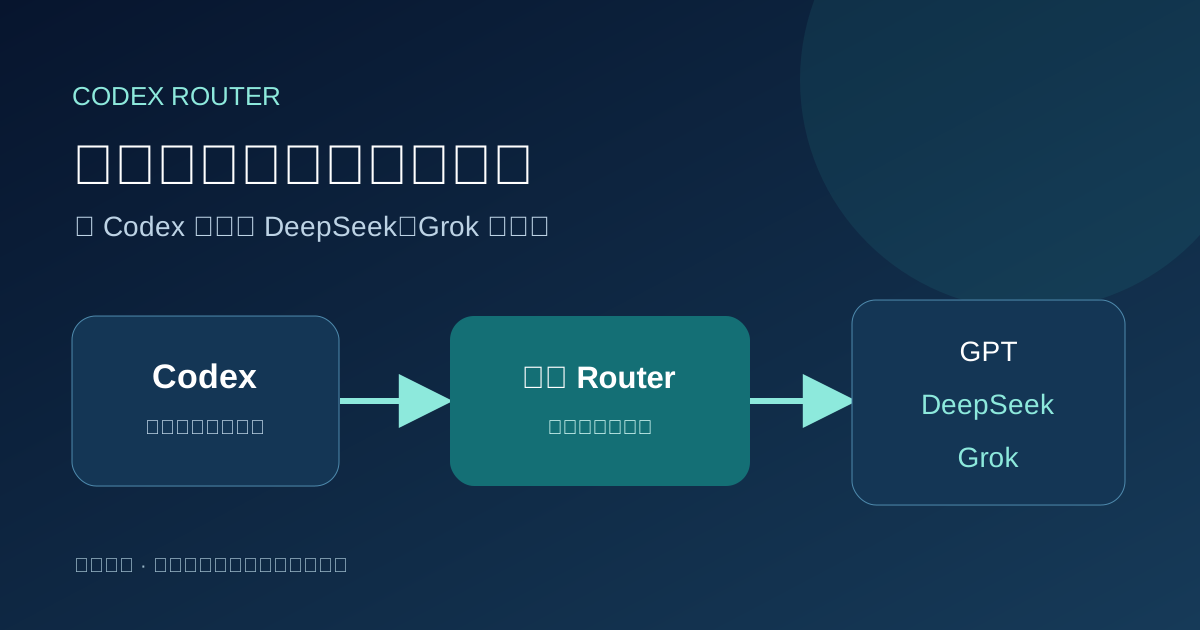
Running low on ChatGPT Codex quota? Switch to DeepSeek or Grok inside Codex
Codex Router lets you keep your Codex workspace while using DeepSeek, Grok, and other external models. A plain-English guide to routing, quotas, and network access.
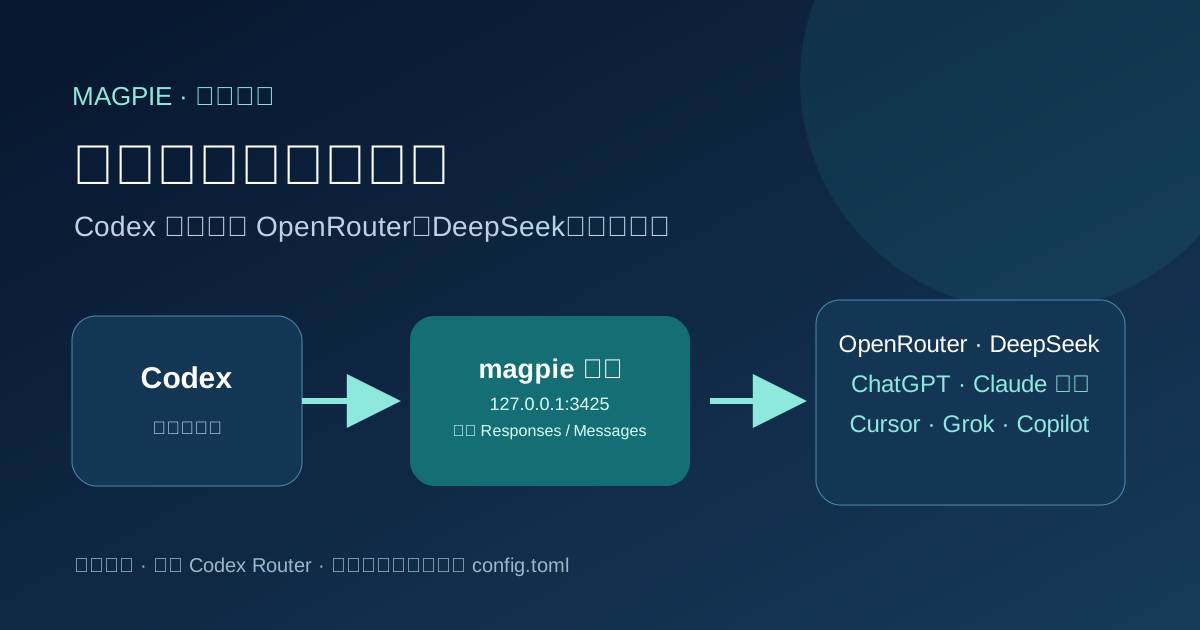
Codex on any model: magpie makes Codex Router unnecessary
magpie is a free, open-source menu bar app that runs a local gateway and puts OpenRouter, DeepSeek and your ChatGPT, Claude, Cursor, Grok and Copilot subscriptions right into Codex's own model picker, with one click and no Codex Router.

Obsidian CLI + Codex: Turn Your Vault into an Agent Knowledge Engine
Obsidian CLI gives Codex and other agents a searchable, auditable, link-aware interface to a local Vault, using real cases and reproducible workflows.