
Hy4 preview
Hy4 preview is a new-generation Mixture-of-Experts flagship from Tencent's Hy Team, released on 2026-08-27. It uses 770B total parameters of which 49B are activated per token, a 1M-token context window, and Apache 2.0 licensing, putting it at the open-source frontier. Tencent ran a blind side-by-side evaluation with 163 internal experts rating 203 engineering tasks, and Hy4 preview edged out both GLM 5.3 (2.99 vs 2.92) and Kimi K3 (2.99 vs 2.94).
Key Features
- 7:1 activation ratio: 770B total, 49B activated per token.
- Gated DeepSeek Sparse Attention (DSA): Extends the DeepSeek/GLM sparse-attention line, paired with IndexCache for cross-layer sparse index reuse.
- iHC residual pathway: Identity Hyper-Connections expand inter-layer information flow.
- 1M-token context: Handles very long-horizon engineering and analysis tasks in one pass.
- Native MTP layer: A built-in multi-token prediction layer (10B params, 0.7B activated) speeds up speculative decoding.
- Productivity-focused training data: Built around the work of Tencent software engineers, game developers, financial analysts, and security experts.
Use Cases
Who Should Use This Tool?
- Long-horizon software engineering: Understanding, planning, debugging, and verifying large multi-file development tasks.
- Office and analysis: Turning messy multi-file context into documents, spreadsheets, and presentations with better precision.
- Game development: Turning a single prompt into a playable prototype and iterating with game engines.
- Scientific research: Stronger reasoning on hard questions across AI research, molecular dynamics, condensed-matter physics, and pure math.
Problems It Solves
- Context overflow on big tasks: A 1M token window covers an entire project or report in one pass.
- Sparse attention cost: Gated DSA plus IndexCache reduces the compute of long-context inference.
- Task drift on long horizons: The activation budget and reasoning focus keep a model on track across multi-turn engineering work.
Pricing
| Path | Cost | Notes |
|---|---|---|
| Weights (Apache 2.0) | $0 | Downloadable from Hugging Face, ModelScope, cnb.cool, and GitCode. |
| Self-host inference | You pay | Deploy with vLLM or SGLang and call the OpenAI-compatible API. |
| Hosted API | N/A | Not offered by Tencent at release; use your own deployment. |
Advantages & Unique Selling Points
- Open frontier scale: 770B/49B at Apache 2.0 with a 1M context.
- Beats peers on blind engineering eval: 2.99 vs GLM 5.3's 2.92 and Kimi K3's 2.94 across 203 tasks.
- Productivity-first data: Co-designed with CodeBuddy and WorkBuddy, so wins show up in real shipped work.
Getting Started
- Download weights from tencent/Hy4-preview.
- Deploy with vLLM or SGLang.
- Call the OpenAI-compatible endpoint at
http://127.0.0.1:8000/v1. - Start with a small task before scaling to full-context engineering work.
Frequently Asked Questions
Is the model open source?
Yes, Apache License 2.0. Weights are downloadable from multiple hubs.
What GPU do I need?
A single model of this scale (770B total) requires multi-GPU or a well-provisioned inference server. There is no hosted API at release.
Does it run a hosted API?
Tencent does not ship a hosted API for the preview; deploy vLLM or SGLang yourself.
Alternatives
- GLM-5.3: Zhipu's open front-end model, close competitor on the blind eval.
- DeepSeek V4: Another open-weight reasoning flagship.
- Kimi K3: Moonshot's open-weight model, close competitor on the blind eval.
Tips
- Use a long context window deliberately; a 1M window is costly if you do not need it.
- Prefer SGLang or vLLM with tensor parallelism for 49B activated params.
- Treat the 203-task blind eval as a directional signal, not a universal ranking.
Comments
No comments yet. Be the first to comment!
Related Tools


Related Insights

Claude Code account precautions: before you spend $200, do these six things
Gmail plus Apple private sign-in, Cliproxy residential routing for CC and emulators, IP/DNS checks, gradual upgrades, and history-preserving sign-out. Includes a profile and script.

Create a US Apple Account: switch the App Store, keep iCloud signed in
Register with your own email and phone, complete store setup, and redeem a US gift card purchased with Alipay. Diagrams explain iCloud, purchase accounts and private Apple sign-in.
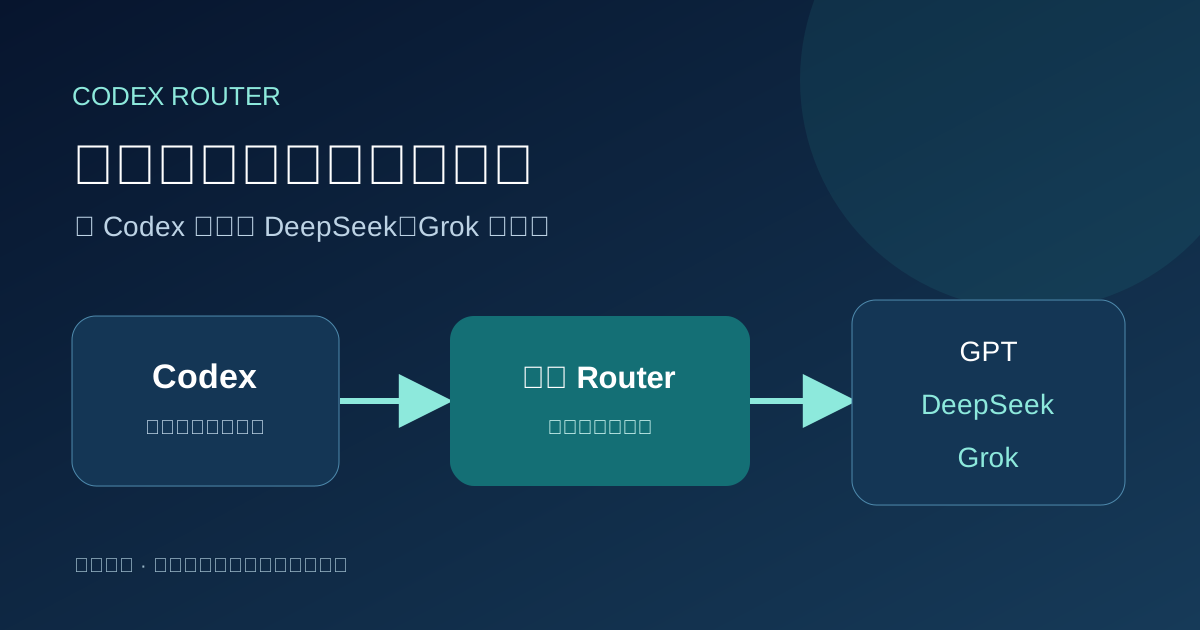
Running low on ChatGPT Codex quota? Switch to DeepSeek or Grok inside Codex
Codex Router lets you keep your Codex workspace while using DeepSeek, Grok, and other external models. A plain-English guide to routing, quotas, and network access.